Industries / Figureheads
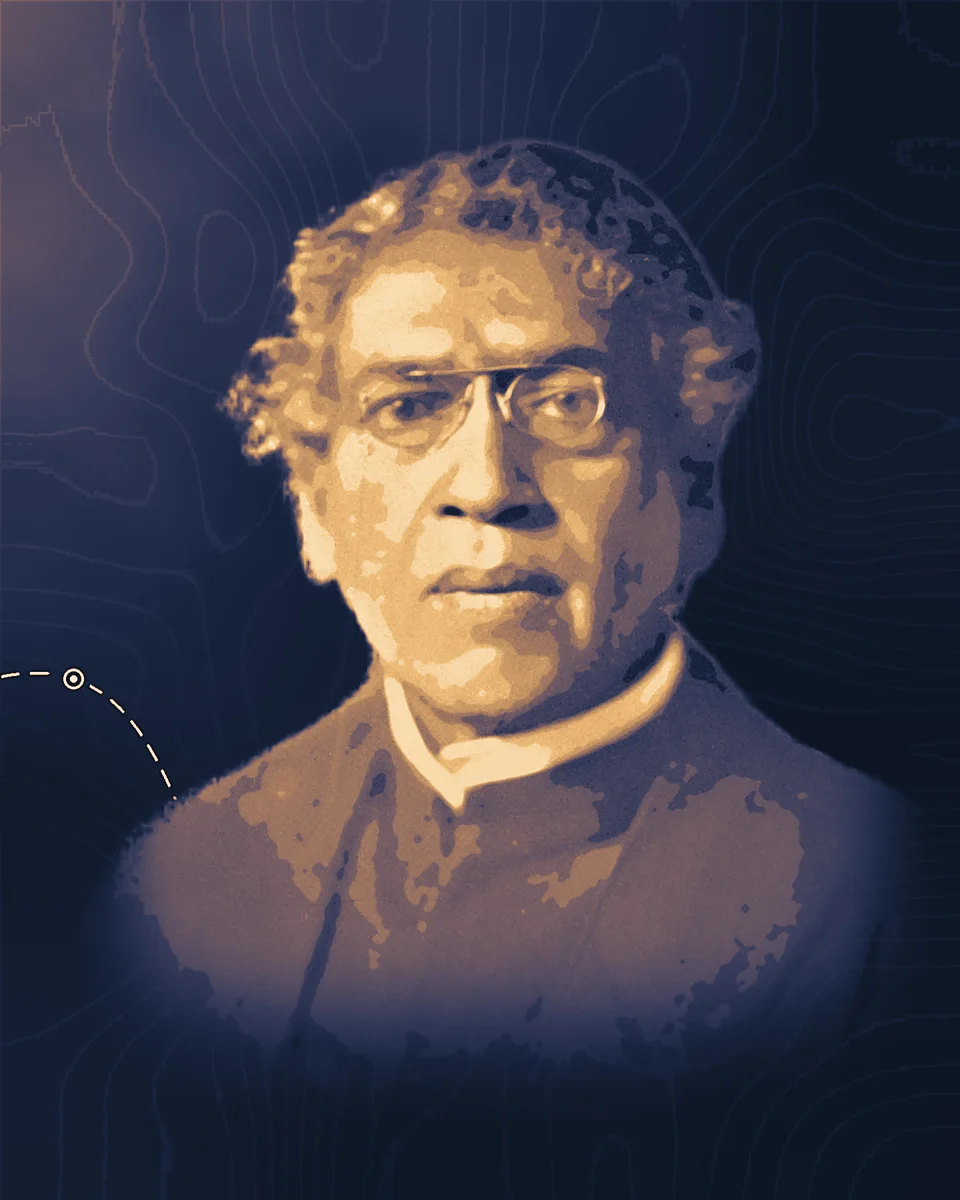
Jagadish Chandra Bose
He detected radio waves with a metal point pressed on a crystal in the 1890s and filed the first patent on a semiconductor crystal detector in 1901.
1858–1937
What they changed
1895
Radio waves through walls
In Calcutta, Bose sent radio waves of very short wavelength through walls and used them to ring a bell and set off gunpowder at a distance. An IEEE Milestone plaque at Presidency College records a frequency of 60 gigahertz, a range of 23 metres and two walls in between.
1897
Parts for millimetre waves
For these waves, a few millimetres long, Bose built the parts a microwave engineer still uses: metal tubes to guide the waves (waveguides), flared horn antennas, lenses and polarizers. He showed them at the Royal Institution in London in January 1897. The radio astronomer D. T. Emerson wrote in 1997 that almost no further work was done at such wavelengths for nearly 50 years.
1890s
A crystal as detector
To pick up the waves Bose pressed a metal point against a surface and passed a small current through the contact. He plotted how current rose with voltage, found the contacts did not obey Ohm's law, and settled on crystals of galena (lead sulfide) among other materials. Emerson's paper says he was the first to use a semiconductor junction to detect radio waves, and that Gerald Pearson and Walter Brattain of Bell Labs gave him that priority in their history of semiconductor research.
1901
The detector patented
On 30 September 1901 Bose applied for a United States patent on a "detector for electrical disturbances" whose claims include a pair of galena contacts. It was granted on 29 March 1904 as number 755,840. The Computer History Museum heads its entry on crystal detectors with this patent.
Life
Jagadish Chandra Bose was born on 30 November 1858 at Mymensingh in Bengal, now in Bangladesh. His father was a deputy collector in the government service, and the family home was the village of Rarikhal near Dhaka. He studied at St. Xavier's College in Calcutta and went to England in 1880. He began medicine in London, gave it up because of ill health, and moved to Christ's College, Cambridge, where Lord Rayleigh was among his teachers. In 1884 he took a Cambridge degree in natural science and a London bachelor of science degree.
He returned to teach physics at Presidency College, Calcutta. Physics Today records that he was the first Indian professor of physics there, was paid less than the British professors and was often denied funds and laboratory space. In 1894 he turned a small room next to a bathroom in the college into a laboratory and began his work on radio waves.
Who was first to signal by radio is disputed. His Calcutta demonstration of 1895 came before Guglielmo Marconi's trials on Salisbury Plain in England, and Emerson's paper gives Bose priority over Marconi for remote wireless signalling. But Bose worked at short range and studied the waves as science, where Marconi set out to make a business of them. On crystal detectors the German physicist Ferdinand Braun had found in 1874 that a metal point on galena passes current one way only, long before radio. The crystal detectors that went into common use were patented in 1906 by the Americans Greenleaf Pickard, who used silicon, and Henry Dunwoody, who used carborundum.
Bose made no money from the work. His biographer Patrick Geddes wrote in 1920 that he had resolved "to seek for no personal advantage from his inventions", and that in 1901 he turned down a paid agreement offered by a maker of wireless apparatus for his new receiver. An American friend then patented the invention in his name, Geddes wrote, but Bose "would not use his rights, and allowed the patent to lapse". The patent itself assigns one half to Sara Chapman Bull of Cambridge, Massachusetts.
From about 1900 he turned from radio to the way plants respond to stimulus, and built instruments to measure it, among them the crescograph, which magnified a plant's growth so it could be recorded. He retired from Presidency College in 1915 and in 1917 founded the Bose Institute in Calcutta, where Emerson found much of his original apparatus still kept in 1985. He was knighted and in 1920 was elected a Fellow of the Royal Society. He died on 23 November 1937.
Read more
5 accounts
The work of Jagadis Chandra Bose: 100 years of mm-wave research, D. T. Emerson, IEEE Transactions on Microwave Theory and Techniques, 1997.
A radio astronomer's account of the apparatus, with photographs he took of the originals in Calcutta.
cv.nrao.edu
The Life and Work of Sir Jagadis C. Bose, Patrick Geddes, Longmans, Green and Co., 1920.
The first full biography, written by a friend during Bose's lifetime.
archive.org
Collected Physical Papers, Jagadis Chunder Bose, Longmans, Green and Co., 1927.
His own papers on electric waves and detectors, gathered in one volume.
archive.org
Detector for electrical disturbances, Jagadis Chunder Bose, United States patent 755,840, 1904.
The patent text and drawings.
patents.google.com
Sir Jagadis Chunder Bose, 1858–1937, Meghnad Saha, Obituary Notices of Fellows of the Royal Society, 1940.
The Royal Society's memoir of his life and work.
royalsocietypublishing.org