Industries / Figureheads
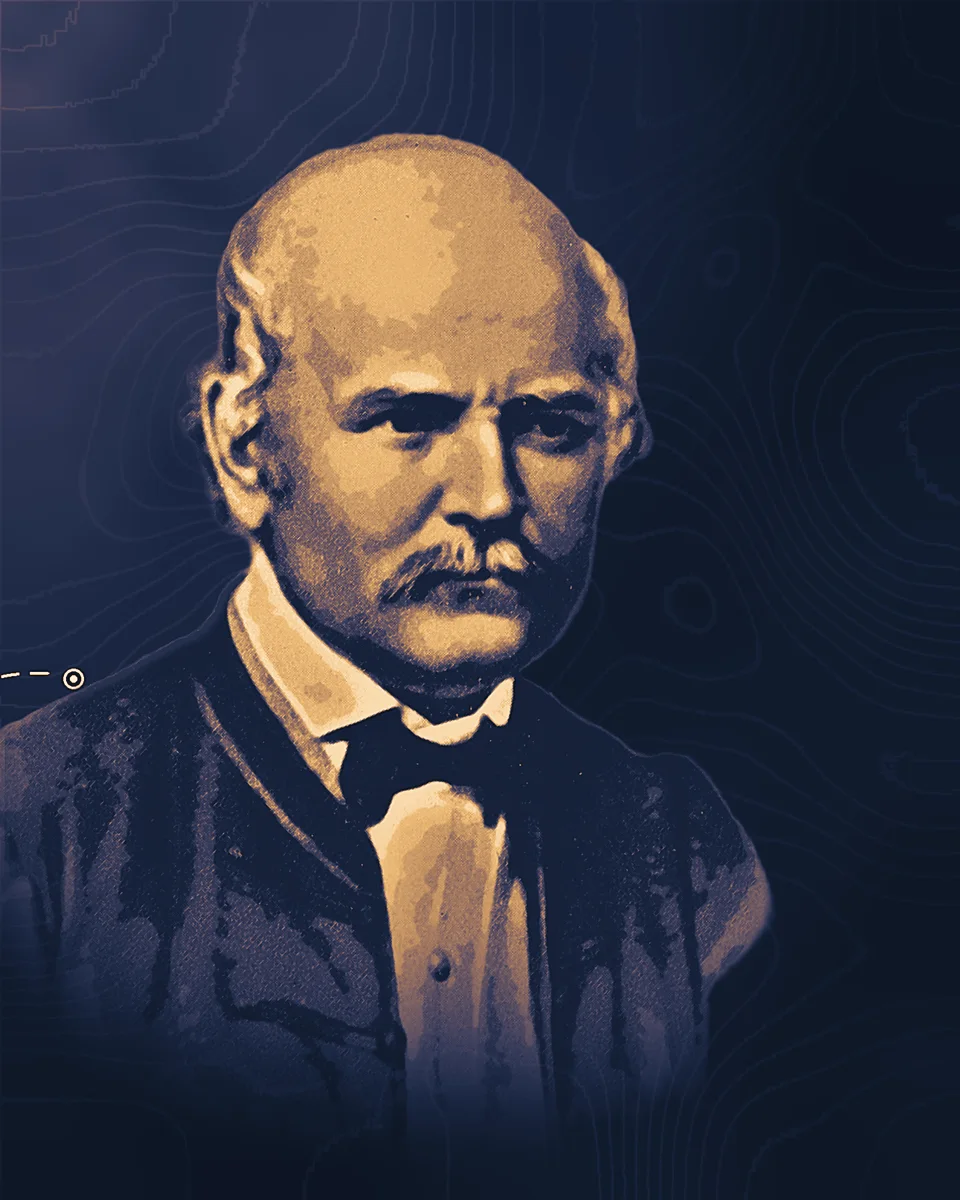
Ignaz Semmelweis
He made the doctors of a Vienna maternity clinic wash their hands in chlorine before examining women in labor, and deaths from childbed fever fell from about one mother in nine to one in fifty.
1818–1865
What they changed
1847
Chlorine on the hands
In mid-May 1847 Semmelweis, an assistant in the First Obstetric Clinic of the General Hospital of Vienna, made its doctors and medical students scrub their hands in a solution of chlorinated lime before they examined women in labor. By his own records, as re-analyzed by Andreas Stang and colleagues in 2022, deaths from childbed fever (puerperal sepsis, an infection after birth) in the clinic fell from 11.3% (2,117 of 18,793 women, July 1840 to October 1846) to 2.0% (122 of 6,189, June 1847 to February 1849).
1847
Clean between every patient
Deaths rose again in October and November 1847. Semmelweis traced them to a woman with a discharging cancer of the uterus and another with an infected knee. From then on he required the chlorine wash between examinations, not only on entering the ward, and kept such patients apart. In 1848 his clinic's death rate from childbed fever was 1.27%, below the 1.33% of the midwives' clinic, by the figures of Nicholas Kadar and colleagues.
1851
The same results in Pest
From 1851 Semmelweis ran the maternity ward of St Rochus Hospital in Pest, now part of Budapest, without pay. Kadar and colleagues give its death rate from childbed fever as 0.85% from 1851 to 1857, against 10% to 15% in Prague and Vienna in the same years. In 1855 he became professor of obstetrics at the University of Pest.
1861
The evidence in one book
His book on the cause, nature and prevention of childbed fever appeared at the end of 1860 with the date 1861. It rested on the Vienna hospital's monthly death records, kept since the clinic opened in 1784. He sent it to obstetricians across Europe, most rejected it, and he answered his critics in open letters in 1861 and 1862.
deutsche-biographie.desciencehistory.orgpmc.ncbi.nlm.nih.gov
Life
Ignaz Philipp Semmelweis, in Hungarian Ignác Fülöp, was born on 1 July 1818 in Buda, now part of Budapest, the son of a grocer. He began to study law at the University of Vienna in 1837, moved to medicine, and in 1844 qualified as a doctor and as a master of obstetrics. In Vienna he learned from the physician Joseph Škoda, the dermatologist Ferdinand von Hebra and the pathologist Carl von Rokitansky, and did autopsies to check what doctors had found in living patients. On 1 July 1846 he became first assistant in the First Obstetric Clinic, under Professor Johann Klein.
deutsche-biographie.desciencehistory.orgpmc.ncbi.nlm.nih.gov
The hospital had two maternity clinics. From 1840 medical students were taught in the first and midwives in the second, and deaths from childbed fever in the first ran about three times higher. In March 1847 his friend Jakob Kolletschka, a professor of forensic medicine, died after a student's scalpel cut him during an autopsy, and Semmelweis saw that Kolletschka's body showed the same findings as the mothers'. He concluded that doctors and students carried "cadaverous particles" from the autopsy room to women in labor. He was not alone in blaming the attendants. The World Health Organization's 2009 guidelines on hand hygiene pair him with Oliver Wendell Holmes in Boston, and English doctors said at the time that he had said nothing new.
The result did not persuade. Klein rejected it, and so did leading doctors elsewhere, among them Rudolf Virchow, Friedrich Scanzoni and James Young Simpson. Škoda, Rokitansky and Hebra backed him, and Hebra published the findings for him in 1847. Semmelweis presented them himself only on 15 May 1850. His post as assistant was not renewed, and he left Vienna for Pest in October 1850. Stang and colleagues list reasons for the failure: the germ theory came some 30 years later, he waited 13 years to publish, his writing was wordy and repetitive, and he defended his view in a "harsh and personally offensive" way. The WHO's guidelines add that he imposed the change without asking his colleagues' opinion.
deutsche-biographie.depmc.ncbi.nlm.nih.govpmc.ncbi.nlm.nih.goviris.who.int
In Pest he published on childbed fever in the Hungarian medical weekly Orvosi Hetilap from 1857. He married Julia Weidenhofer that year, and they had five children. He turned down a chair in Zurich. When his book failed to convince, his open letters grew angry: in one, in the Science History Institute's translation, he wrote that "whoever dares to promote dangerous doctrines about childbed fever will find in me a resolute opponent."
deutsche-biographie.depmc.ncbi.nlm.nih.govsciencehistory.org
In 1865 he fell ill with severe depression, by the account of the Neue Deutsche Biographie, the German national biography, and was taken without a psychiatric assessment to the Lower Austrian state asylum in Vienna. He died there on 13 August 1865, aged 47, of sepsis. Kadar and colleagues write that autopsy records found later show he was probably beaten by attendants when he tried to escape, and died of infection from his injuries. What caused his mental illness is still debated.
deutsche-biographie.depmc.ncbi.nlm.nih.govsciencehistory.org
Acceptance came slowly. Virchow said in a lecture of 1864 that he recognized "the merit of the Vienna school and most specifically that of Semmelweis", and Scanzoni wrote in 1867 that Semmelweis had "rendered a great service to lying-in women". Hand-washing still did not become routine in hospitals for more than a century. The WHO dates the first national hand hygiene guidelines to the 1980s, and says US guidelines made rubbing hands with alcohol the standard of care in 2002. Its 2009 guidelines call Semmelweis's work the first evidence that cleaning heavily soiled hands with an antiseptic cuts the spread of infection better than plain soap and water, and say he "is considered not only the father of hand hygiene, but his intervention is also a model of epidemiologically driven strategies to prevent infection."
Read more
6 accounts
Die Aetiologie, der Begriff und die Prophylaxis des Kindbettfiebers, Ignaz Semmelweis, 1861.
His own book, in German, with the Vienna death tables; the Wellcome Library's copy.
archive.org
Semmelweis, His Life and His Doctrine, William J. Sinclair, Manchester University Press, 1909.
The first full life in English, by a professor of obstetrics.
archive.org
Semmelweis, Ignaz Philipp, Bruno Bauer, Neue Deutsche Biographie, 2010.
The German national biography's entry, with his family, posts and opponents.
deutsche-biographie.de
Ignaz Semmelweis: the "Savior of Mothers", Nicholas Kadar, Roberto Romero and Zoltán Papp, American Journal of Obstetrics and Gynecology, 2018.
A bicentennial account of the work in Vienna and Pest and of his death.
pmc.ncbi.nlm.nih.gov
A twenty-first century perspective on concepts of modern epidemiology in Ignaz Philipp Semmelweis' work on puerperal sepsis, Andreas Stang, Fabian Standl and Charles Poole, European Journal of Epidemiology, 2022.
His monthly data re-analyzed by modern methods.
pmc.ncbi.nlm.nih.gov
WHO Guidelines on Hand Hygiene in Health Care, World Health Organization, 2009.
Part I, section 4 sets his work in the history of hand hygiene in hospitals.
iris.who.int