Industries / Figureheads
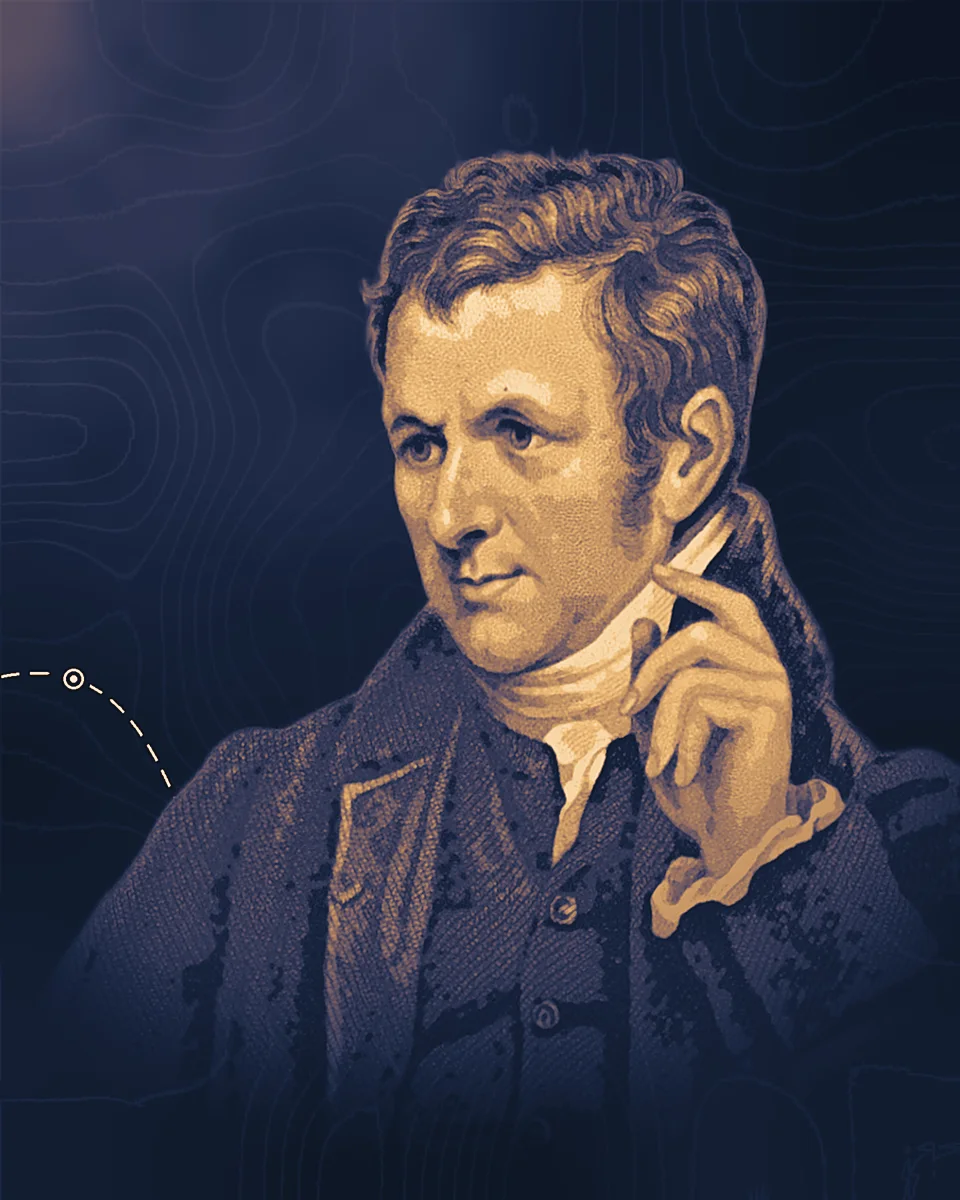
Humphry Davy
He made a lamp whose flame, shut inside wire gauze, could burn in a coal mine without setting off the gas.
1778–1829
What they changed
1815
A flame behind narrow tubes
In the week of 9 October 1815 Davy began work at the Royal Institution in London with the laboratory assistant Michael Faraday. By the end of the month he had a lamp that took its air through very narrow tubes, which cooled the flame's heat below the point that lights firedamp, the methane gas of coal mines. His paper on it was read to the Royal Society on 9 November.
1815
The wire gauze lamp
By the end of December Davy had found that a cylinder of wire gauze around the flame did the same job as the tubes. The holes let light out and air in, and the metal takes up the heat. He wrote that he could "confine this destructive element flame like a bird in a cage".
1816
Tried down a pit
On 9 January 1816 the Reverend John Hodgson and others took Davy's lamps into Hebburn colliery on Tyneside. The Royal Institution says the lamp then went quickly into production. In the coalfield of north-east England, deaths per million tons of coal mined fell steeply after 1815, by figures the historian Frank James cites.
1816
Deeper, gassier seams opened
The lamps of Davy and George Stephenson let owners work deeper seams, where there was more firedamp, and so raise more coal. Explosions did not end: one at Haswell colliery in County Durham killed 95 men and boys in 1844.
Life
Humphry Davy was born in Penzance, Cornwall, in 1778. His father was a small farmer. After his father died he was apprenticed to an apothecary, a maker and seller of medicines. In 1798 the physician Thomas Beddoes made him superintendent of a medical institution in Bristol that tested gases as treatments, and there Davy found the effects of nitrous oxide, laughing gas, by breathing it himself.
In 1801 he joined the Royal Institution in London and became the most popular science lecturer in the city. With large electric batteries he isolated and named potassium, sodium, calcium and magnesium. He was knighted in 1812 and married Jane Apreece, a wealthy widow. The Science History Institute notes that her money came from her father's business in Antigua, a British sugar colony worked by enslaved people.
The lamp began with a disaster. On 25 May 1812 an explosion at Felling colliery near Gateshead killed 92 men and boys. A society to prevent accidents in coal mines was formed at Sunderland in 1813, and in July 1815 it resolved to ask Davy for help through Robert Gray, the Rector of Bishopwearmouth. Davy visited the coalfield, had firedamp bottled and sent to London, and did the work in under three months with Faraday and the instrument maker John Newman.
He was not the only inventor and not the first. William Reid Clanny, a doctor near Sunderland, had described a safety lamp to the Royal Society in 1813. George Stephenson, then engineer at Killingworth colliery, had been building and using a safe lamp since September 1815. Frank James, a historian at the Royal Institution, calls the two inventions "simultaneous, and almost certainly independent". The Royal Institution says the one piece of science in the lamp, that an explosion will not pass through narrow tubes, was found separately by Davy, Stephenson and the chemist Smithson Tennant.
The dispute turned personal. Stephenson accused Davy of taking his idea, which Davy denied. The Science History Institute says Davy treated Stephenson "with complete contempt as someone of lower social standing". In October 1817 a group of mine owners gave Davy silver plate worth £2,500, and the officers of the Royal Society issued a statement rejecting Stephenson's claims. Stephenson's supporters raised 600 guineas for him. Davy took no patent. History Today calls that honourable. James says he held back in case Stephenson mounted a successful challenge, and then spoke of the lamp as a gift to humanity.
Davy was made a baronet in 1818 and was president of the Royal Society from 1820 to 1827. He had a stroke, resigned and went abroad. He died in Geneva in May 1829, aged 50, and was buried there.
Read more
4 accounts
Safety Underground: Mining and the Miners' Lamp, Frank James, Gresham College, 2015.
A lecture by the Royal Institution's historian on how the lamp was made, the fight with Stephenson and the Haswell explosion of 1844.
gresham.ac.uk
Humphry Davy, Science History Institute, undated. A life that follows recent work on his manuscripts and does not flatter him.
sciencehistory.org
Humphry Davy's miner's safety lamp, Royal Institution, undated. The museum's note on the first prototype of 1815, which it holds beside the Stephenson lamps Davy collected.
rigb.org
Davy's lamp described, Richard Cavendish, History Today, 2015.
A short account of the weeks before the Royal Society paper of 9 November 1815.
historytoday.com