Industries / Figureheads
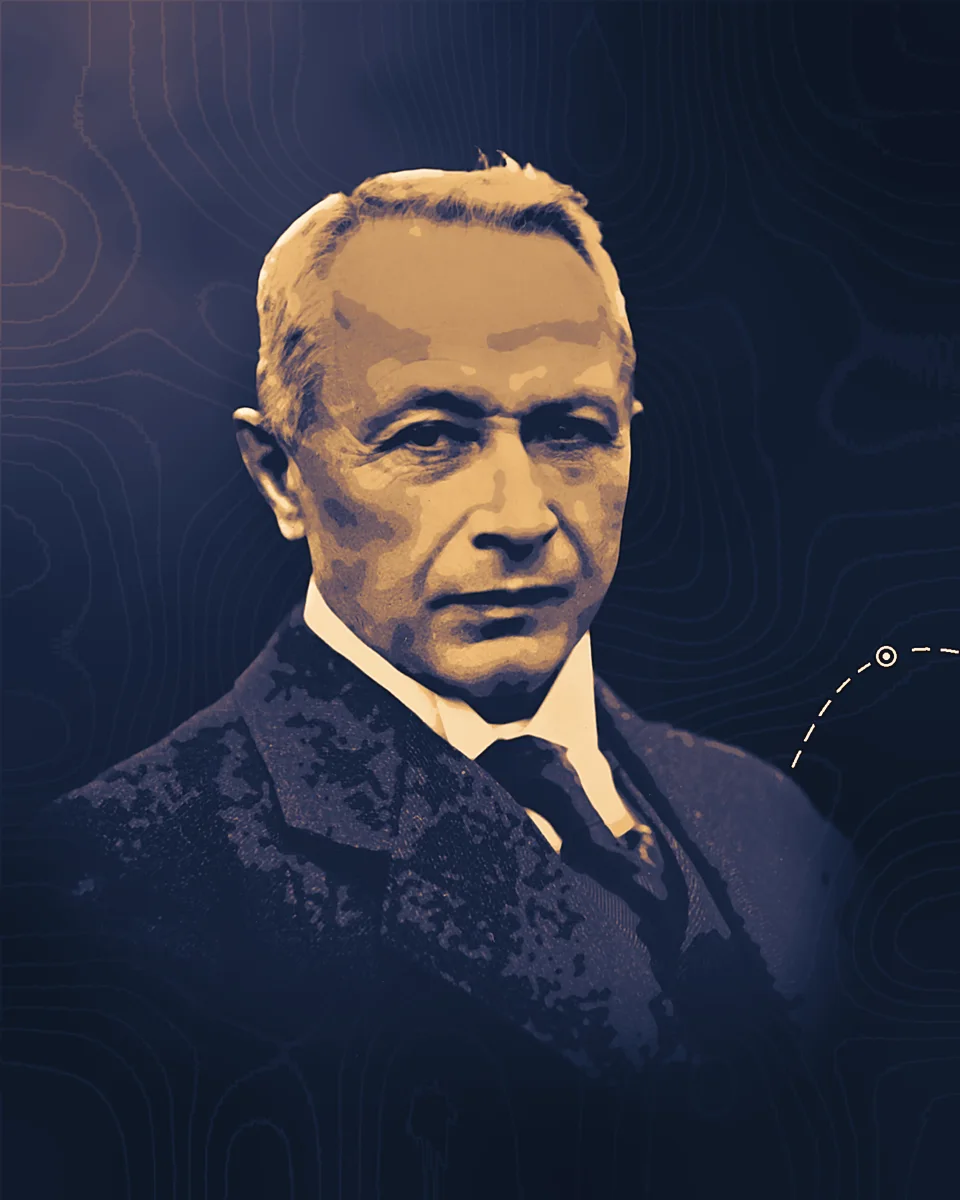
Hugo Junkers
He built the first airworthy all-metal airplane with thick wings that needed no bracing wires, and the metal airliner that later ones were modelled on.
1859–1935
What they changed
1910
A patent for thick wings
On 1 February 1910 Junkers patented a wing thick enough to stand without outside bracing and to hold loads inside it. Aircraft of the time had thin wings held by wires and struts.
1915
An all-metal airplane flies
The Junkers J 1 was built at his gas-appliance works in Dessau from iron sheet 0.1 to 0.2 mm thick, welded to iron ribs so that the skin carried load. It first flew on 12 December 1915 at the army airfield at Döberitz near Berlin. The Hugo Junkers heritage site calls it the world's first airworthy all-metal aircraft without bracing and with thick wings. It was fast, about 170 km/h by the German national biography, but heavy and slow to climb, and only one was built.
1919
A metal airliner
The Junkers F 13 first flew on 25 June 1919. It was a low-wing monoplane of duralumin, a strong aluminium alloy, with an enclosed cabin for four passengers and a wing held by its own structure alone. The engineering association VDI's news site names Otto Reuter as its main designer. About 300 to 350 were built. The Science Museum Group in London calls it "the miniature prototype of many generations of airliners".
1932
The Ju 52 transport
Production of the Ju 52 transport began in 1932. Germany's national history museum says it remained the most-built transport aircraft in the world until the early 1940s.
Life
Hugo Junkers was born on 3 February 1859 in Rheydt, in the Rhineland, the son of a factory owner. He studied at the technical universities of Berlin-Charlottenburg, Karlsruhe and Aachen and qualified in 1883. From 1888 he worked in Dessau with Wilhelm von Oechelhäuser on large gas engines. In 1892 he patented a calorimeter, a device that measures the heat a gas gives off, and from it he developed a gas water heater for baths. In 1895 he founded Junkers & Co. in Dessau to make gas appliances.
From 1897 to 1912 he was professor of mechanical engineering at the technical university in Aachen. He came to aircraft in 1909, at the age of 50, through the work of the engineer Hans Reissner. He was 56 when the J 1 flew. Junkers himself later said the J 1 had been knocked together like plumbing.
His metal aircraft served the German military in the First World War. At the end of 1917 the army command forced him into a joint company with the Dutch builder Anthony Fokker, which broke up after the war. When the peace terms banned aircraft building in Germany, he moved part of his production to Sweden and to a works at Fili near Moscow. He founded an airline in 1921, which was merged into Deutsche Luft Hansa in 1926, and an engine company in Dessau in 1923.
The firm nearly failed in 1932 and was saved by selling the water-heater factory to Robert Bosch. In October 1933 the new Nazi government forced Junkers to hand most of his shares to the German state, after he refused to give up his patents without payment. In November he lost his posts. He left Dessau and spent his last months near Munich, working privately on metal buildings.
He died in Gauting near Munich on 3 February 1935, his 76th birthday. The works kept his name and became a major maker of military aircraft in the Second World War, including the Ju 87 dive bomber. That was after he had been forced out.
Read more
5 accounts
Junkers, Hugo, Gert Behrsing, Neue Deutsche Biographie volume 10, 1974.
The German national biography's entry, in German, with his engines, aircraft and companies in order.
deutsche-biographie.de
Hugo Junkers 1859–1935, Deutsches Historisches Museum, LeMO, read in 2026.
A dated life from Germany's national history museum, in German.
dhm.de
J 1, F 13 und Gegenkolbenmotor, Dominik Hochwarth, ingenieur.de, 2026.
An engineering journalist's account of the designs and of the 1933 takeover, in German.
ingenieur.de
Model of Junkers F.13 all-metal transport aeroplane, Science Museum Group, object 1923-118, read in 2026.
A works model that reached London by 1923, with the museum's judgement of what Junkers changed.
collection.sciencemuseumgroup.org.uk
Junkers J 1, Hugo Junkers heritage site, read in 2026.
The family-run archive's page on the 1915 aircraft, in German.
hugo.junkers.de