Industries / Figureheads
Howard Florey
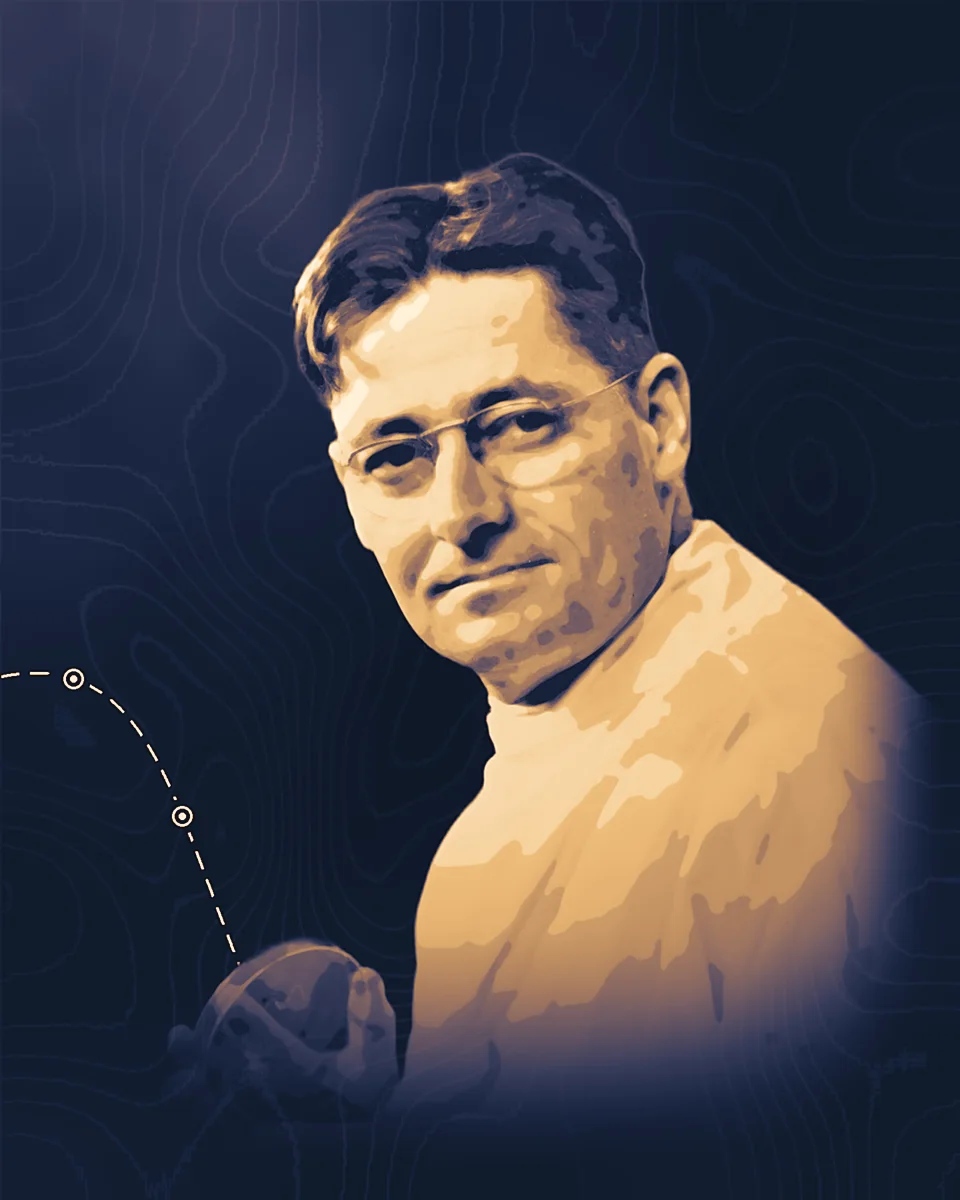
He led the Oxford team that made penicillin into a drug, proved it in mice and then in patients, and carried it to the United States to be made in bulk.
1898–1968
What they changed
1939
A team for penicillin
As professor of pathology at Oxford he put a group to work on penicillin with a grant from the Rockefeller Foundation. Ernst Chain purified the substance, Norman Heatley worked out how to grow the mould in quantity, and Florey ran the animal experiments.
1940
Eight mice
On 25 May 1940 eight mice were given a deadly dose of streptococcus bacteria and four of them were then given penicillin. By the next morning the four untreated mice were dead and the four treated ones were alive. The team published in The Lancet on 24 August 1940.
1941
The first patients
In February 1941 an Oxford policeman with abscesses all over his body was given penicillin and improved within a day. The supply ran out before he was cured, and he died. Other patients then recovered, and the team published the results.
1941
Production moves to America
British drug firms were tied up with war work, so in the summer of 1941 Florey and Heatley flew to the United States. At a Department of Agriculture laboratory in Peoria, Illinois, Andrew Moyer raised the yield by feeding the mould corn steep liquor, a by-product of making cornstarch, while Florey went east to win over the government and drug companies. By September 1943 there was enough penicillin for the Allied armed forces.
1940s
No patent taken
Chain urged him to patent the work. Florey refused, holding that a discovery of this kind should benefit everyone. The American firm Merck and Moyer each patented production methods unopposed, and at the end of the war the British faced paying royalties on a discovery made in England, in the words of the historian Robert Gaynes. When his group developed cephalosporin C in 1954 he urged that it be patented at once.
Life
Howard Walter Florey was born in Adelaide, South Australia, on 24 September 1898. He graduated in medicine from the University of Adelaide in 1921 and went to Oxford on a Rhodes Scholarship. He took a doctorate at Cambridge in 1927, became professor of pathology at Sheffield in 1931, and in 1935 moved to the chair of pathology at Oxford, where he ran the Sir William Dunn School of Pathology.
He hired Chain, a refugee biochemist from Berlin, among his first staff. The two set out in 1938 to study substances that microbes make against other microbes, starting from lysozyme. Penicillin, which Alexander Fleming had described in 1929 and could not purify, was one of the substances on their list. By 1940 about a dozen scientists were on the project.
Florey kept away from the press and told his team to do the same, while Fleming gave interviews. The historian Robert Gaynes writes that many people came to believe Fleming alone was responsible for penicillin. The 1945 Nobel Prize in Physiology or Medicine went to Fleming, Florey and Chain. Heatley, who had grown the mould, improved the extraction and stayed on in America to help scale production up, was not included.
He was knighted in 1944. He was president of the Royal Society from 1960 to 1965, became provost of The Queen's College, Oxford, in 1962, helped to set up the Australian National University and became its chancellor in 1965. He died in Oxford on 21 February 1968.
Read more
5 accounts
Howard Florey: The Making of a Great Scientist, Gwyn Macfarlane, 1979.
A full life, by the haematologist who also wrote Fleming's.
archive.org
Rise Up to Life: A Biography of Howard Walter Florey Who Gave Penicillin to the World, Lennard Bickel, 1972.
A full biography, published four years after his death.
archive.org
The Mold in Dr. Florey's Coat, Eric Lax, 2004.
A history of the Oxford team written for general readers.
archive.org
Nobel lecture, Howard Florey, 1945.
His own account of the Oxford work, taking up where Fleming's lecture stops.
nobelprize.org
The discovery of penicillin: new insights after more than 75 years of clinical use, Robert Gaynes, Emerging Infectious Diseases, 2017.
A short history of the discovery, the production and the patents.
pmc.ncbi.nlm.nih.gov