Industries / Figureheads
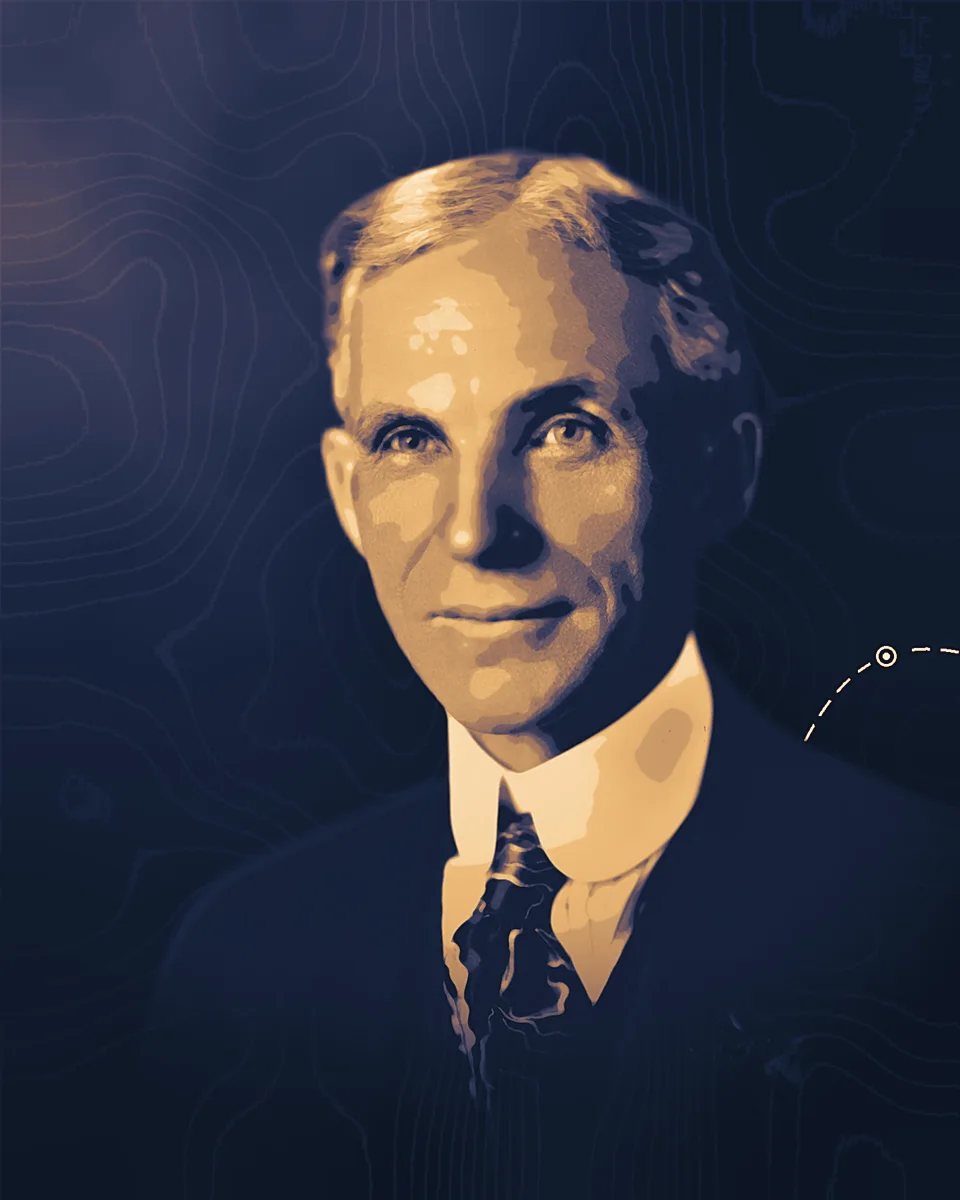
Henry Ford
He built one cheap car in huge numbers on a moving line, and paid the wage that kept workers on it.
1863–1947
What they changed
1908
One car for everyone
Ford put the Model T into production on 1 October 1908 at $850 and kept it in production until 1927. The New York Times counted 10,600 sold the next year and a million Fords within seven. The Henry Ford museum counts more than 15 million Model Ts by 1927.
1913
The moving assembly line
At Highland Park, Michigan, Ford's engineers moved the work past men who each did one small job. The Henry Ford museum says they took the idea from the "disassembly lines" of meatpackers, began with the flywheel magneto in 1913, and cut the labor in a Model T from about 12½ man-hours to about 1½.
1914
Five dollars a day
The line was hard to bear: by late 1913 labor turnover at Ford was 380 percent a year. In January 1914 Ford set a minimum of $5 for an eight-hour day, where the average had been about $2.40 for nine hours.
1926
Price cut as policy
Ford passed the savings on. The New York Times gives the Model T's price as $310 by 1926, and The Henry Ford museum says it fell as low as $260. His share of the American market reached half.
1927
Ore in, cars out
At the River Rouge plant Ford made his own iron, steel, glass and tires and assembled the cars beside them. The Henry Ford museum says the Rouge achieved "ore to assembly" in 1927, with the Model A that replaced the Model T. One company owning every step from raw material to finished car is called vertical integration.
Life
Henry Ford was born on 30 July 1863 on a farm near Dearborn, Michigan, the eldest of six children. He left for Detroit as a youth to learn the machinist's trade. He built his first car in his spare time and sold it in 1896 for $200 to pay for a lighter one. Two racing cars brought him backers, and the Ford Motor Company was formed with $28,000 actually paid in. In 1919 he and his son Edsel bought out the other shareholders for $70 million.
The line at Highland Park was the work of many hands. The Henry Ford museum credits "Henry Ford and his assistants" and "Ford's engineers" without naming them, and says the system rested on interchangeable parts, machine tools placed in the order of the work, and the steady movement of materials. The architect Albert Kahn designed the plant. The wage of 1914 was a remedy for the turnover the line had caused, and the museum says it led workers to accept the line's "relentless discipline".
Ford used his money and his newspaper against Jews. His weekly, the Dearborn Independent, began a front-page series called "The International Jew: The World's Problem" on 22 May 1920, drawn from the forged Protocols of the Elders of Zion. Ford Motor Company pressed its dealers to buy and hand out the paper. He stopped the series in January 1922 and started it again within a year. When the lawyer Aaron Sapiro sued for libel and the trial opened in March 1927, Ford closed the paper, paid Sapiro and issued an apology that the Jewish leader Louis Marshall had written for him. The museum that bears his name writes that he "saw Jews present in everything that he viewed as modern and distasteful".
He fought unions longer than any other large American car maker. He put Harry Bennett in charge of a Service Department that watched workers and fired union sympathizers. On 26 May 1937 its men beat Walter Reuther, Richard Frankensteen and other organizers of the United Automobile Workers on a footbridge at the Rouge plant, in front of press photographers. Ford recognized the union in May 1941, after a strike and a federal election, the last of the three big makers to do so.
Edsel Ford died on 26 May 1943 and his father, nearly eighty, took back the presidency. In 1945 he handed the company to his grandson, Henry Ford II. He died at his estate in Dearborn on 7 April 1947, aged 83. The New York Times called him "the founder of modern American industrial mass production methods".
Read more
5 accounts
Henry Ford Is Dead at 83 in Dearborn, Associated Press in The New York Times, 8 April 1947.
The long obituary, with the figures of the company's rise and his public quarrels.
archive.nytimes.com
Henry Ford: Assembly Line, The Henry Ford, undated. The museum's set of photographs and notes on how the line worked and where the idea came from.
thehenryford.org
Henry Ford and Anti-Semitism, The Henry Ford, undated. The museum's own account of the Dearborn Independent, the lawsuit and the apology.
thehenryford.org
The Battle of the Overpass, Walter P. Reuther Library, Wayne State University, undated. The labor archive's account of the beating of 26 May 1937, with the photographs.
reuther.wayne.edu
From the American System to Mass Production, 1800–1932, David A.
Hounshell, Johns Hopkins University Press, 1984. The standard history of how the methods at Highland Park were arrived at, and by whom.
archive.org