Industries / Figureheads
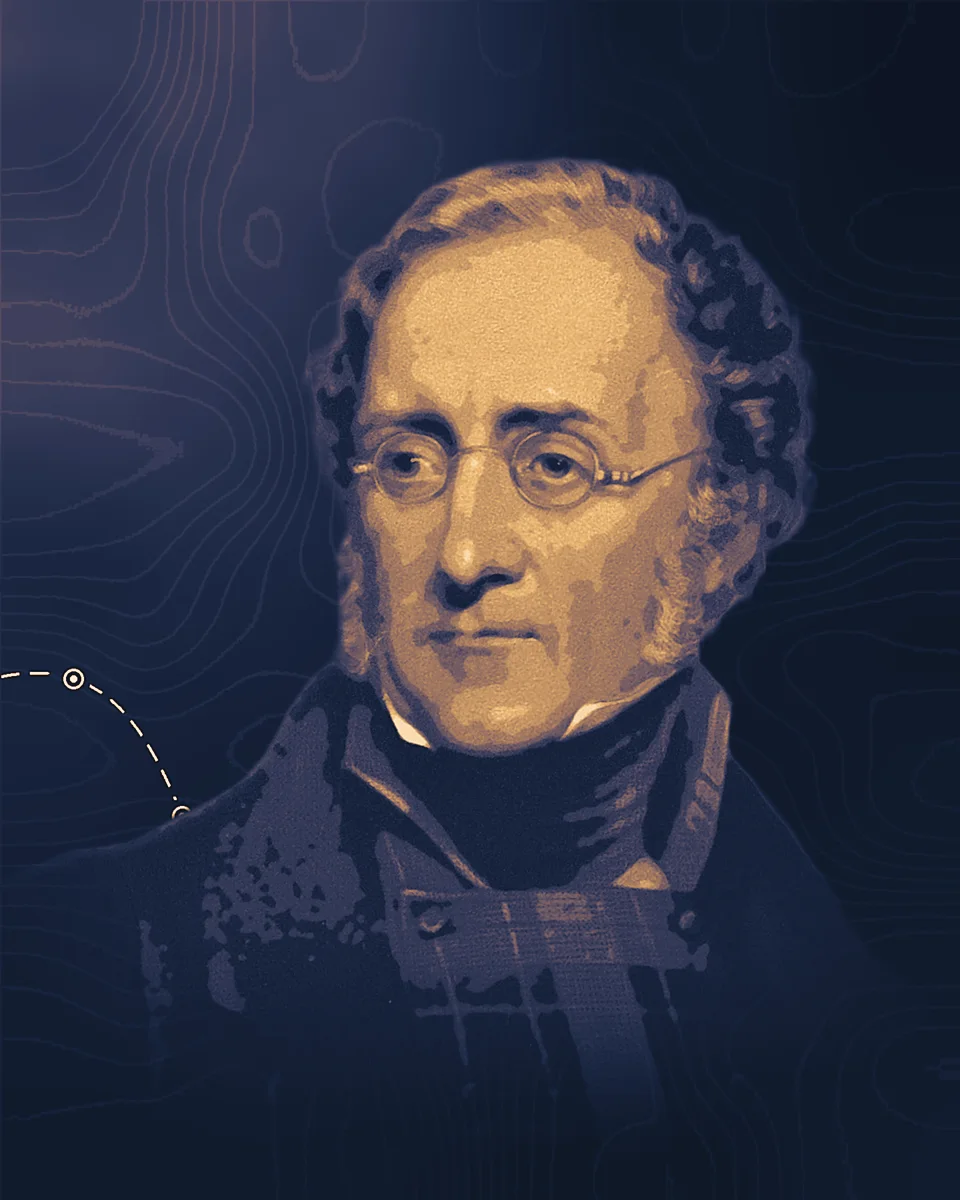
Henry De la Beche
He persuaded the British government to pay for geological maps, and built the first national geological survey, a mine plans office and a school of mines around them.
1796–1855
What they changed
1832
Geology on the government map
De la Beche had begun colouring the rocks of Devon onto the Ordnance Survey's one-inch maps at his own cost. In 1832 the Board of Ordnance, the army department that made the maps, took him on to finish the job and granted £300. The idea of using the government map as the base for a county-by-county geological survey was his.
1835
A national geological survey
The Devon work led to the Ordnance Geological Survey in 1835, with De la Beche as its first director. From 1835 to 1839 he was its whole scientific staff. It is now the British Geological Survey, which calls itself the world's oldest national geological survey.
1839
Plans of abandoned mines
In 1836 men died in a County Durham coal mine when water broke in from old, forgotten workings. The British Association pressed the government, which in 1839 put De la Beche in charge of collecting and keeping the plans of abandoned mines. The Mining Record Office opened beside his museum, and from about 1847 the survey also published mineral production statistics, which it still does.
1841
A museum of useful rocks
The Museum of Economic Geology opened in London in 1841 with De la Beche as director. Its exhibits were building stones, ores, coal and metal products, and it had a laboratory where the public could have rocks, minerals and soils analysed.
1851
A government school of mines
The Government School of Mines and of Science Applied to the Arts opened in November 1851 in his new museum building in Jermyn Street, London, with De la Beche presiding. It became the Royal School of Mines, now part of Imperial College London.
Life
Henry Thomas De la Beche was born in London in 1796. His father, an army officer, died when he was a small child, and he grew up in Devon and at Lyme Regis in Dorset, where he began to collect fossils. He entered the military school at Great Marlow in 1810. The Geological Society of London says he was thrown out in 1811, accused of encouraging "a dangerous spirit of Jacobinism" among the cadets. He joined the Geological Society in 1817 and was elected to the Royal Society two years later.
The money that let him work as a gentleman geologist came from slavery. He inherited from his father the Halse Hall estate and Hanbury Pen in Clarendon, Jamaica, with the enslaved people who worked them. University College London's Legacies of British Slavery project, quoting the Oxford Dictionary of National Biography, records that he spent a year on the estate in 1823 and 1824, "supported paternalistic reforms of slavery, but opposed abolition", and published a pamphlet in 1825 that "idealized the situation". When Britain paid compensation to slave owners, the money for both properties went to the Hibbert family firm, which held the mortgage.
In the early 1830s the income from Jamaica failed entirely, by the same account. He was then mapping Devon at his own cost, and the government grant of 1832 and the directorship of 1835 followed. When he was told to begin on Cornwall, it was at a salary of £500 a year with about £1,000 a year for expenses. Thomas Colby, who ran the Ordnance Survey, backed the work.
He was not always right about the rocks. In Devon he held out against Adam Sedgwick and Roderick Murchison, who used fossils to match the coal-bearing Culm rocks to the Carboniferous rocks of the rest of England. The survey's own historian, Edward Bailey, wrote in 1952 that the view of Sedgwick and Murchison is the one generally adopted.
Around the survey he gathered a staff that included the chemist Lyon Playfair, the naturalist Edward Forbes, the mining geologist Warington Smyth, Andrew Ramsay and Robert Hunt, who kept the mining records. An Act of 1845 gave the survey a legal footing. Prince Albert opened the new museum in Jermyn Street on 12 May 1851.
De la Beche drew well. In 1830 he made Duria Antiquior, a print of ancient Dorset full of the sea reptiles that Mary Anning had found at Lyme Regis, and sold it to raise money for her. He was president of the Geological Society from 1847 to 1849 and received its Wollaston Medal in 1855. He was ill for his last three years and worked until a few hours before he died, on 13 April 1855.
Read more
5 accounts
1835 De la Beche starts alone, Edward Bailey, in Geological Survey of Great Britain, 1952.
The survey's first twenty years told by a later director, with the money, the staff and the Devon dispute.
earthwise.bgs.ac.uk
The Geological Survey under Sir Henry Thomas De la Beche, John Flett, in The History of the Geological Survey of Great Britain, 1937.
The chapter on his directorship from an earlier history of the survey, published by the Stationery Office.
earthwise.bgs.ac.uk
Beche, Sir Henry Thomas de la, William Jerome Harrison, Dictionary of National Biography, 1885.
The Victorian national biography's life, with a list of his main writings.
en.wikisource.org
Sir Henry Thomas De la Beche, Legacies of British Slavery, University College London, 2019.
His Jamaican estates, the compensation records and his will.
lbs.ucl.ac.uk
Portrait of Sir Henry Thomas De la Beche, Geological Society of London, undated. A short life from the society's picture collection, with Duria Antiquior and Mary Anning.
geolsoc.org.uk