Industries / Figureheads
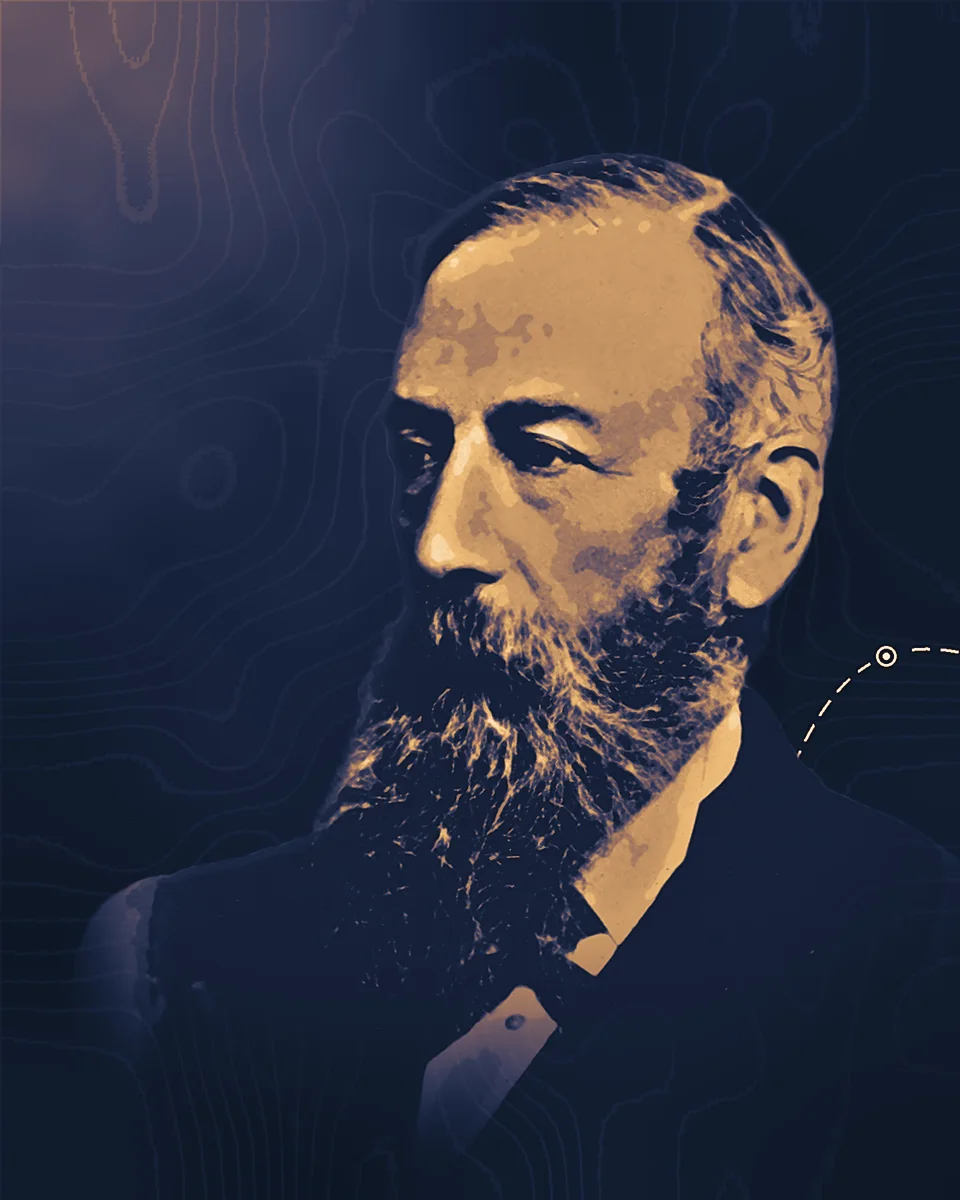
Henry Clifton Sorby
He ground, polished and etched steel and looked at it under a microscope, which is how the inner structure of metals has been examined ever since.
1826–1908
What they changed
1849
Rock sliced thin for light
Sorby learned from William Crawford Williamson how hard materials are cut into thin slices, and in 1849 he applied the method to rock. With polarized light under the microscope he named the mineral grains in a slice and measured how much of each the rock held. Geologists at the Geological Society's centenary called him the "Father of Microscopical Petrography", by the account of J. W. Judd, who knew him.
1863
Steel under the microscope
In the summer and autumn of 1863 he ground and polished pieces of iron and steel, etched them with dilute nitric acid and examined them by reflected light. The first pieces came from a broken axle he was studying with Graham Stuart, curator of a Sheffield museum. He showed the specimens at the British Association meeting in Newcastle that year. In his own words he proved that irons and steels are "varying mixtures of well-defined substances".
1864
Photographs of metal structure
With the Sheffield photographer Charles Hoole he photographed etched cast iron, armour plate, cast steel and meteoric iron at nine times their size, and showed the pictures at the British Association meeting in Bath in September 1864. He also inked etched steel and printed from it directly, as from type.
1886
The plates inside pearlite
In autumn 1885 he looked again at his old specimens at up to 650 times, using an illuminator Richard Beck had made twenty years before. The "pearly constituent" of steel turned out to be alternate plates about 1/60,000 of an inch apart. He supposed that a compound stable at high temperature breaks down on cooling into soft iron and a hard substance holding the carbon, and that fast cooling might stop the breakdown and leave the steel hard.
1887
The full account in print
The Journal of the Iron and Steel Institute printed his paper "On the microscopical structure of iron and steel" in 1887, with the 1864 photographs reproduced by a process Henry Bessemer proposed. Sorby said his 1864 account had "attracted no attention for 22 years".
Life
Henry Clifton Sorby was born on 10 May 1826 at Woodbourne, near Sheffield. He went to the Sheffield Collegiate School and then to a private tutor, the Rev. Walter Mitchell, who taught him mathematics, chemistry and anatomy. His father died in 1846 and left him enough to live on. He never took a post or a profession, and wrote of himself: "My entire life has been spent either in scientific research or in preparation for it".
Rocks came first and stayed first. His 1857 memoir on the microscopical structure of crystals was, in Judd's words, "neglected, and even ridiculed at the time". The Royal Society elected him a Fellow on 11 June 1857. The Geological Society gave him its Wollaston medal in 1869 and the Royal Society a Royal medal in 1874.
The work on steel was a small part of his life. He came to it through meteorites: polished and etched iron meteorites show a pattern of crossing plates, first described by Aloys von Widmanstätten in Austria and William Thomson in England, and Sorby wanted to explain it by looking at man-made iron. Two Sheffield historians of his specimens, R. G. J. Edyvean and C. Hammond, count 115 metal specimens of his against 1,400 of rock, and date nearly all the metal work to the months between summer 1863 and early 1865. He then turned to fitting a spectroscope to the microscope and did not write the steel work up. When a newspaper correspondent pointed out that prints had been taken from etched meteoric iron in Vienna years earlier, Sorby answered that he claimed novelty only "as far as iron and steel are concerned".
Others built the method into a trade. The quarterly The Metallographist wrote in 1900 that for fourteen years after his first paper nobody else took the subject up, until Adolf Martens of Berlin began publishing in 1878. In Russia, Dmitry Chernov read a paper in 1868 on the temperatures at which steel changes, and the Iron and Steel Institute's obituary of him calls that paper the starting point of the same science. The names now used for what Sorby saw, pearlite, ferrite and cementite, were suggested to him by the American metallurgist Henry Marion Howe about ten years after the 1887 paper, and the Frenchman Floris Osmond named a structure "sorbite" after him in 1895. When Professor Arnold took a chair at Firth College in Sheffield in 1889 he asked Sorby to start again. Sorby's eyesight was failing and he declined, but he showed Arnold his methods and lent him the specimens.
After his mother died he bought a yacht, the Glimpse, and spent his summers aboard it with his microscopes, collecting sea animals and plants, mostly off East Anglia. He was president of the Royal Microscopical Society, the Mineralogical Society and the Geological Society in turn, and president of Firth College, which grew into the University of Sheffield. Judd calls him "the leading spirit" in founding it. In 1906 he wrote to the steelmaker Robert Hadfield that it was hard to believe "that for so long a time no one seemed to think it of any practical value".
An accident left him partly paralysed and he spent most of his last five years in bed, still writing. He died in Sheffield on 9 March 1908. His will left money for a chair at the University of Sheffield and for research funds at the Royal Society and the Geological Society, and his metal specimens went to the university.
Read more
4 accounts
The metallurgical work of Henry Clifton Sorby and an annotated catalogue of his extant metallurgical specimens, R. G. J. Edyvean and C. Hammond, Historical Metallurgy, 1997.
The fullest account of what he did with steel and when, drawn from his diaries, letters and the surviving specimens.
hmsjournal.org
Obituary of Henry Clifton Sorby, John Wesley Judd, Journal of the Royal Microscopical Society, 1908.
A friend and fellow geologist on his methods and character, with the portrait used here.
zenodo.org
Obituary of Henry Clifton Sorby, John Wesley Judd, Mineralogical Magazine, 1908.
The same writer on the rock and mineral work, his schooling, his yacht and his will.
cambridge.org
Henry Clifton Sorby, a biographical sketch, The Metallographist, April 1900.
Written in his lifetime from facts supplied by Robert Hadfield, with Sorby's own account of the steel work and a list of his papers on iron and steel.
archive.org