Industries / Figureheads
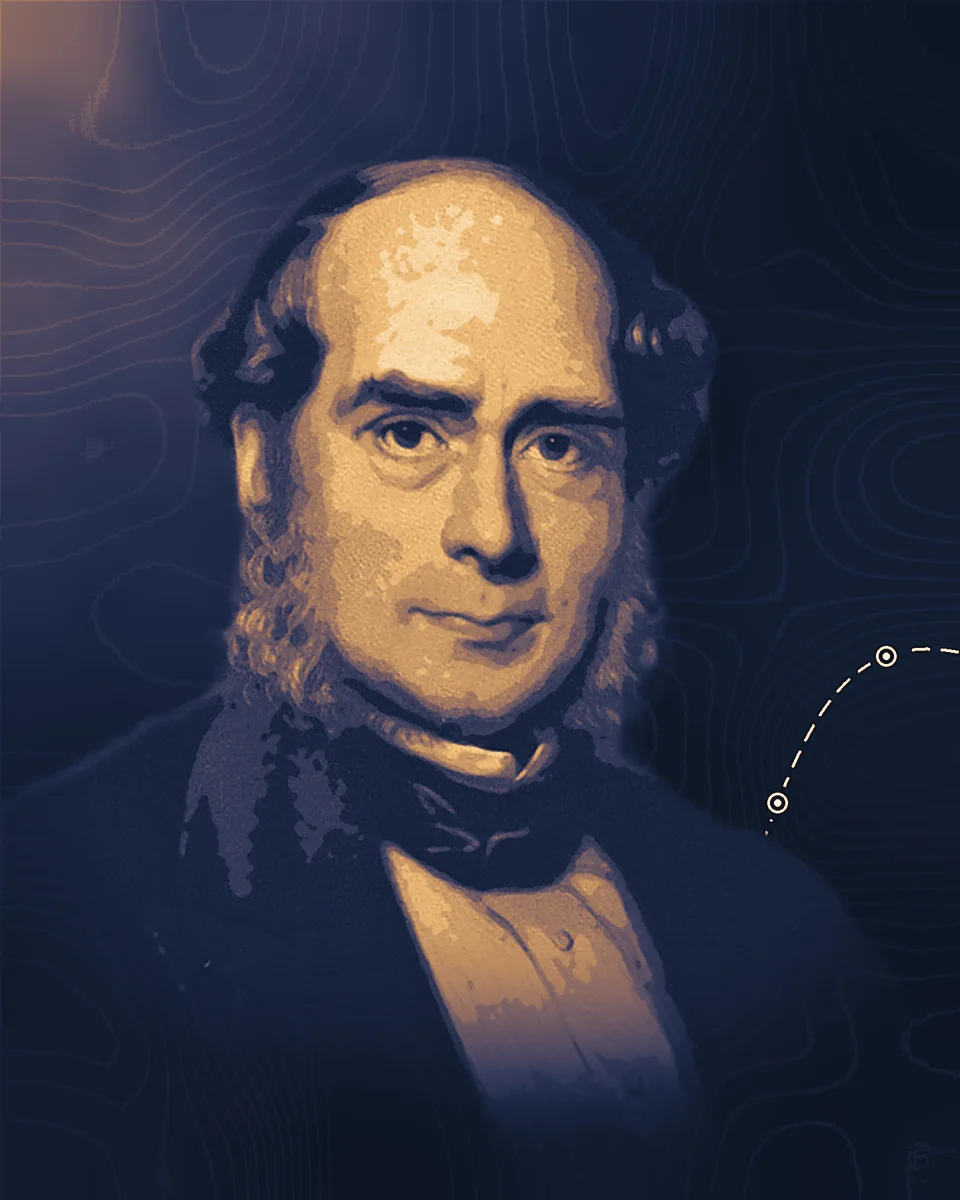
Henry Bessemer
He showed that air blown through molten pig iron turns it into steel in minutes with no added fuel, and built the business that made steel cheap.
1813–1898
What they changed
1856
Steel made without fuel
Bessemer told the British Association at Cheltenham in August 1856 that a blast of cold air forced through molten pig iron would turn it into malleable iron or steel. The oxygen in the air burns the silicon and carbon in the metal, and the burning heats the metal by itself, so no fuel is added. The Dictionary of National Biography says he sold licences worth £27,000 within a month.
1856
The process fails elsewhere
The ironmasters who bought licences could not make good metal. An obituary reprinted by Grace's Guide gives the reason: "the amount of phosphorus in ordinary pig iron prevented the successful production of malleable iron by this process". Phosphorus makes steel brittle, and Bessemer's converter did not remove it. He had run his own trials on an iron that happened to hold very little.
1858
A works of his own
With the trade against him, Bessemer decided at the end of 1857 to make the steel himself. His Sheffield works, started with the Manchester engineers Galloway, was under way by April 1858, by the Smithsonian historian Philip Bishop's account, and the trade press first quoted a price for his tool steel on 4 June 1859. It ran on low-phosphorus iron from Sweden and from the hematite ores of north-west England.
1870s
Most of America's steel
From 1870 through 1907 the Bessemer process made at least half of the steel produced in the United States, and from 1880 through 1895 it made 80 percent, by the census figures Bishop cites. Bessemer's royalties came to more than £1 million, by his obituaries.
Life
Henry Bessemer was born on 19 January 1813 at Charlton, near Hitchin in Hertfordshire. His father, Anthony Bessemer, was an engineer and type-founder who had worked in Paris before the French Revolution. The family business moved to London in 1830. About 1833 Bessemer devised dies that stamped the date into each government stamp, which ended a fraud the Dictionary of National Biography says cost the revenue about £100,000 a year. He was given no post for it, and the knighthood of 1879 came as late recognition. About 1840 he worked out a way to make bronze powder, the metallic dust used in gold paint, by machine. He kept the method secret and ran it as a business for decades.
During the Crimean War he designed a spinning artillery shell and showed it to French officers at Vincennes. By his own account one of them, Commandant Minié, doubted that any cast-iron gun could safely fire so heavy a shot, and that remark set him looking for a stronger metal. He began experiments on iron and steel in 1854 and took his first patent in January 1855. A patent of 17 October 1855 covered blowing air through the molten metal. After the Cheltenham paper the licensees' failures turned the trade against him, and he did not speak in public on the subject again until May 1859.
Two other men have a claim on the working process. Robert Mushet patented in September 1856 the addition of spiegeleisen, an iron rich in manganese, to the blown metal, which removes the oxygen the blast leaves in it. Mushet's patent lapsed in 1859 when the stamp duty went unpaid. Bessemer paid him no royalty and always denied that he owed him one. From about 1867 he paid Mushet £300 a year until Mushet died in 1891, and wrote that he did it from "a strong desire on my part to make him my debtor rather than the reverse" and to quiet attacks in the press. The other man was Göran Fredrik Göransson, a Swedish licensee, who was making good steel at Edsken by July 1858, while Bessemer was still remelting his own product in crucibles. Bishop's judgment is that "Bessemer owed more to the development work of his Swedish licensees than to Mushet."
In the United States the credit was disputed outright. William Kelly, an ironmaster at Eddyville, Kentucky, told the Patent Office that he had blown air through molten iron as early as 1847. The office awarded him priority on 13 April 1857 and granted him a patent that June, which left Bessemer's American patent of little use. Bishop went back to the file in 1959. He found that only five of Kelly's eighteen witnesses said they had seen the furnace work, that Kelly "never had the objective of making steel", and that his right to be called joint inventor "is questionable". A Commissioner of Patents had written in 1870 that it might be doubted whether Bessemer was first to find the principle, but that "we owe its reduction to practice to his untiring industry and perseverance".
The phosphorus problem outlasted his patents. It was solved in the late 1870s by Sidney Gilchrist Thomas and his cousin Percy Gilchrist, who changed the lining of the converter. Bessemer was president of the Iron and Steel Institute from 1871 to 1873, and its Bessemer gold medal dates from 1873. He was knighted and elected a Fellow of the Royal Society in 1879. Not everything he tried worked: a Channel steamer with a swinging saloon meant to prevent seasickness was tried in 1875 and abandoned. He died at Denmark Hill, London, on 15 March 1898.
Read more
5 accounts
Sir Henry Bessemer, F.R.S.: An Autobiography, Henry Bessemer, 1905.
His own account, finished by his son and published by the journal Engineering, with his side of the Mushet and Ebbw Vale quarrels.
archive.org
The Beginnings of Cheap Steel, Philip W. Bishop, Smithsonian Institution, 1959.
A curator's re-reading of the trade press and the patent files on the claims of Bessemer, Mushet, Martien and Kelly.
gutenberg.org
The Creators of the Age of Steel, William T. Jeans, 1884.
Five chapters on Bessemer written while he was alive, beside lives of Siemens, Thomas and Snelus.
archive.org
Bessemer, Henry, James Dredge, Dictionary of National Biography, 1901.
The national biography's entry, by the editor of Engineering, who knew him.
en.wikisource.org
Henry Bessemer, Grace's Guide to British Industrial History, undated. Reprints the obituaries of 1898 from the Institution of Mechanical Engineers, the Institution of Civil Engineers, The Engineer and the Iron and Steel Institute.
gracesguide.co.uk