Industries / Figureheads
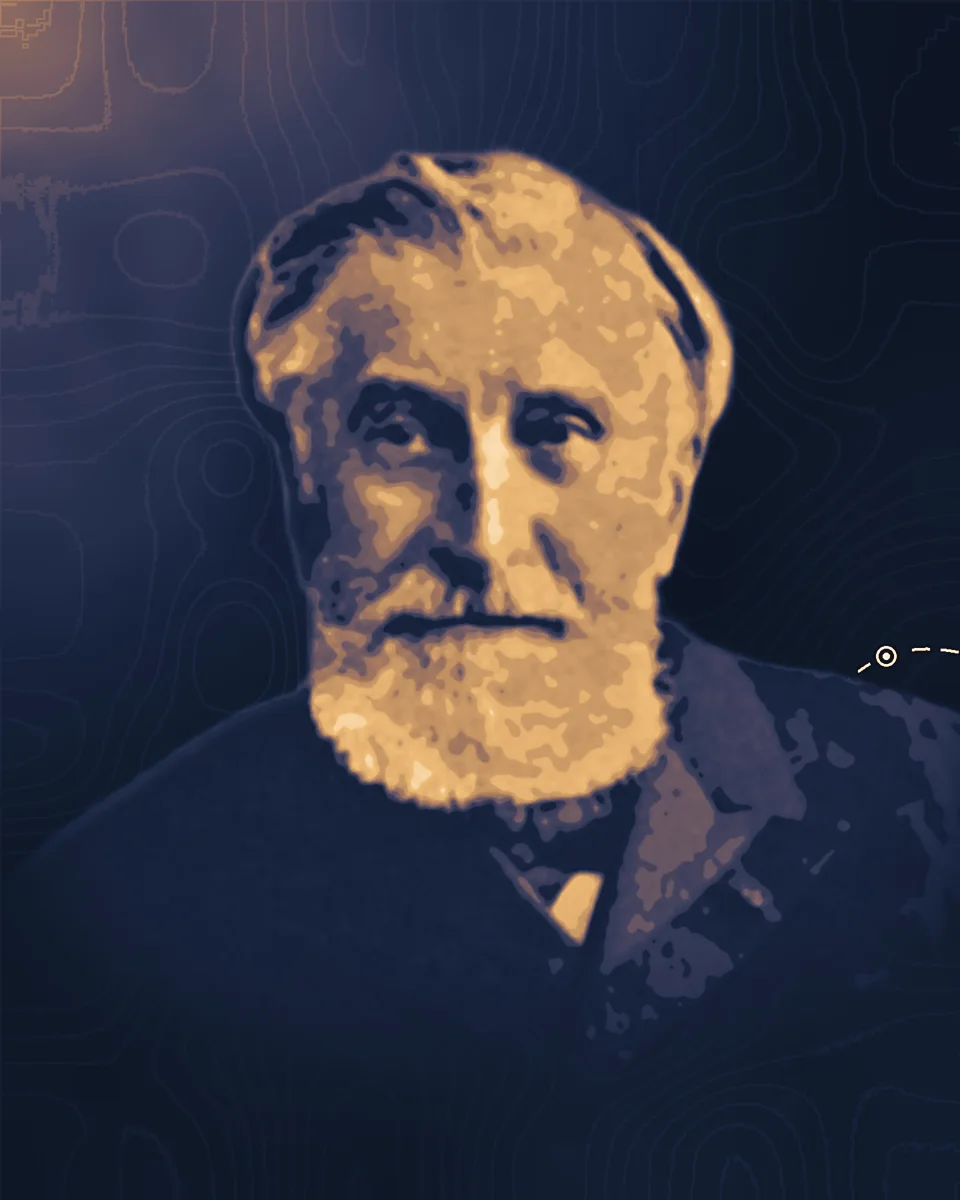
Gustave Moynier
A Geneva lawyer, he turned Henry Dunant's idea into a working organization and led the International Committee of the Red Cross for its first 46 years.
1826–1910
What they changed
1863
A committee to act
Moynier, a young lawyer, presided over the Geneva Public Welfare Society when Henry Dunant's A Memory of Solferino appeared. At his instance, by the account of the American Journal of International Law in 1911, the society appointed a committee of five to study Dunant's plans, with Moynier as its vice-chairman. The Nobel Foundation's history says the committee was "guided by Moynier's talent for organization" when it called the conference of October 1863.
1864
Forty-six years in charge
Moynier became president of the committee in 1864 and held the post until he died in 1910, as it took the name International Committee of the Red Cross. The same 1911 account says the organizing of national Red Cross societies in the states that signed the Geneva Convention "was the splendid work of M. Moynier almost unaided", and that he saw 43 of them formed.
1873
An institute for international law
In 1873 Moynier prompted the founding of the Institute of International Law, by the account of Belgium's Royal Academy for Overseas Sciences. He wrote a study of the Geneva Convention's first years of use, published in 1870.
Life
Gustave Moynier was born in Geneva on 21 September 1826. He trained as a lawyer and turned to philanthropy, and in the early 1860s he was president of the Geneva Public Welfare Society. From 1863 the Red Cross was the main work of his life.
The credit for the Red Cross was argued over in his lifetime and after. The American Journal of International Law wrote in 1911 that Dunant "seems to have been an idealist in whose brain originated a grand humanitarian conception, while Moynier was an organizer and builder", and that Moynier had "fully and frankly admitted" that the idea was Dunant's. The committee's own circular on his death called Moynier "le véritable fondateur de la Croix-Rouge", the true founder of the Red Cross.
He also pushed Dunant out. After Dunant's bankruptcy in 1867, his biographer Gérard Jaeger told swissinfo, Moynier judged that the scandal would damage the young Red Cross and distanced Dunant from the committee. Dunant spent the next decades in obscurity.
Moynier backed King Leopold II's venture in central Africa. He joined the Swiss national committee of Leopold's International African Association in 1876 and was its delegate to the central committee in Brussels in 1877. In 1883 he urged the Institute of International Law to press governments toward a conference on the Congo, and in an 1887 study he argued that every power, "in the name of civilisation", had an interest in supporting the new Congo Free State. Belgium's AfricaMuseum writes that Leopold ruled the Free State from 1885 to 1908 as "a capitalist colony", where the taking of rubber and ivory came with "excessive violence", forced labour and the deaths of many Congolese.
He died at his property at Sécheron, near Geneva, on 21 August 1910, the same year as Dunant. The committee wrote that he had given fifty years of his life to the work. He is buried in Geneva's Cemetery of Kings, kept for people who served the city and its international role.
Read more
5 accounts
Décès de M. G. Moynier, International Committee of the Red Cross, Bulletin international des Sociétés de la Croix-Rouge, 1910.
The committee's circular on his death, with the portrait plate.
archive.org
Gustav Moynier, 1829–1910.
Henri Dunant, 1828–1910, The American Journal of International Law, 1911. A joint obituary that weighs the two men's parts in founding the Red Cross.
archive.org
Moynier (Gustave), Marthe Coosemans, Biographie Belge d'Outre-Mer, Royal Academy for Overseas Sciences, 1952.
A short entry on his part in the founding of the Congo Free State.
kaowarsom.be
La Croix-Rouge, son passé et son avenir, Gustave Moynier, 1882.
His own account of the Red Cross's first two decades and its prospects.
archive.org
International Committee of the Red Cross: history, Nobel Lectures, Peace 1926–1950, edited by Frederick W.
Haberman, 1972. The Nobel Foundation's account of the committee of five and of Moynier's presidency.
nobelprize.org