Industries / Figureheads
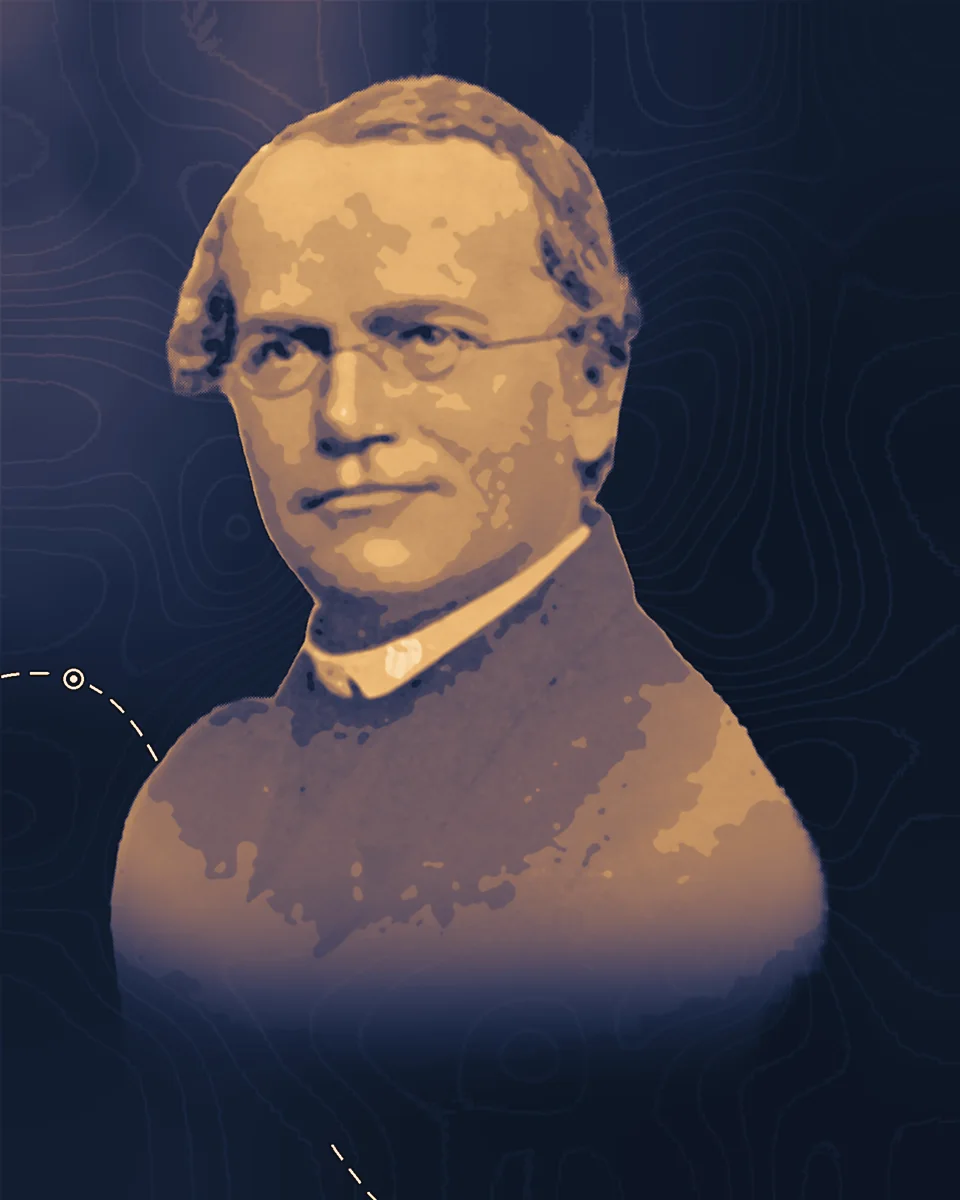
Gregor Mendel
He showed with pea crosses that traits pass from parents to offspring in fixed, countable ratios.
1822–1884
What they changed
1865
Pea crosses read in Brno
In February and March 1865 Mendel told the natural science society in Brno what his crosses of garden peas had shown. Each trait is passed on by a pair of what he called factors, one from each parent, and a plant can carry a factor that does not show. He named the form that shows dominant and the hidden one recessive.
1866
The counts go into print
His paper gave the numbers. In one cross the second generation held 5,474 round seeds and 1,850 wrinkled ones, a ratio of 2.96 to 1. He had tested 34 pea varieties for two years and kept 22 that bred true, so a change in the offspring could be put down to the cross.
1900
Breeders get a rule
Hugo de Vries, Carl Correns and Erich von Tschermak-Seysenegg each reported crosses that agreed with Mendel's, sixteen years after his death. Plant breeders then moved from picking the best plants in a field to planning crosses, and at the Swedish Seed Association Herman Nilsson-Ehle showed that traits set by several genes, such as yield, follow the same laws (Solberg and colleagues, 2022).
2025
His seven traits traced
Feng and colleagues (Nature, 2025) found the DNA changes behind the last three of the seven pea traits Mendel studied. They wrote that the seven forms still mark different farm types and market types of pea, and that the work is a base for pea breeding.
Life
Johann Mendel was born in 1822 into a German-speaking family in Hynčice, in Austrian Silesia, now part of the Czech Republic. He grew up working on the family farm. His parents could not pay for his schooling, so he earned his keep by tutoring classmates. In 1843 he entered the Augustinian abbey in Brno and took the name Gregor.
He taught school as a substitute and twice failed the examination for a teaching certificate, the second time in 1856. Between the two attempts the abbey sent him to the University of Vienna, where from 1851 to 1853 he studied mathematics, chemistry and plant physiology. The Mendel Museum says that is where he learned to plan experiments and to analyze counts.
He came to the peas as a plant breeder. In 1846 he had taken a course on fruit and vine growing that taught how to pollinate plants by hand to raise new varieties. A Brno newspaper reported in July 1861 that his experiments were "aimed at improving the vegetable and flower varieties cultivated in our region." Four days later another Brno paper answered that the report had overstated their value. Van Dijk, Weissing and Ellis, who found both articles, argue that he began with crop improvement and moved toward the rules of inheritance.
The pea crosses ran from 1856 to 1863 in the abbey garden, on almost 30,000 plants by the Embryo Project's count. He read the results to the Brno society in 1865 and published them in its proceedings in 1866. The Mendel Museum says the work "was barely noted." In 1868 he was elected abbot, which left little time for experiments, though he kept bees and took weather readings three times a day. He died on 6 January 1884.
Two parts of the usual story are disputed. Tschermak is often named as one of three men who rediscovered the laws in 1900, but Monaghan and Corcos (Journal of Heredity, 1987) read his two papers of that year and concluded that he had not understood Mendel's. And in 1936 the statistician R. A. Fisher wrote that most of Mendel's data had been "falsified so as to agree closely with Mendel's expectations." Hartl and Fairbanks (Genetics, 2007) went back through the two experiments Fisher relied on and found the charge "not justified" by the paper or its data. They put much of the too-close fit down to unconscious bias: sorting unclear seeds toward the expected class, and stopping or repeating a count.
Read more
6 accounts
Experiments in Plant Hybridization, Gregor Mendel, 1866.
His own paper in English translation, with every count.
mendelweb.org
Life of Mendel, Hugo Iltis, W. W. Norton, 1932.
A full biography, translated from the German edition of 1924.
archive.org
Gregor Mendel: The First Geneticist, Vítězslav Orel, Oxford University Press, 1996.
A full scholarly biography.
archive.org
How Mendel's Interest in Inheritance Grew out of Plant Improvement, Peter van Dijk, Franz Weissing and Noel Ellis, Genetics, 2018.
Two newspaper reports from 1861 and what they show of Mendel as a breeder.
pmc.ncbi.nlm.nih.gov
Mud Sticks: On the Alleged Falsification of Mendel's Data, Daniel Hartl and Daniel Fairbanks, Genetics, 2007.
The case against Fisher's charge, experiment by experiment.
pmc.ncbi.nlm.nih.gov
Gregor Johann Mendel, Mendel Museum of Masaryk University. The museum's account of his life, with dated milestones.
mendelmuseum.muni.cz