Industries / Figureheads
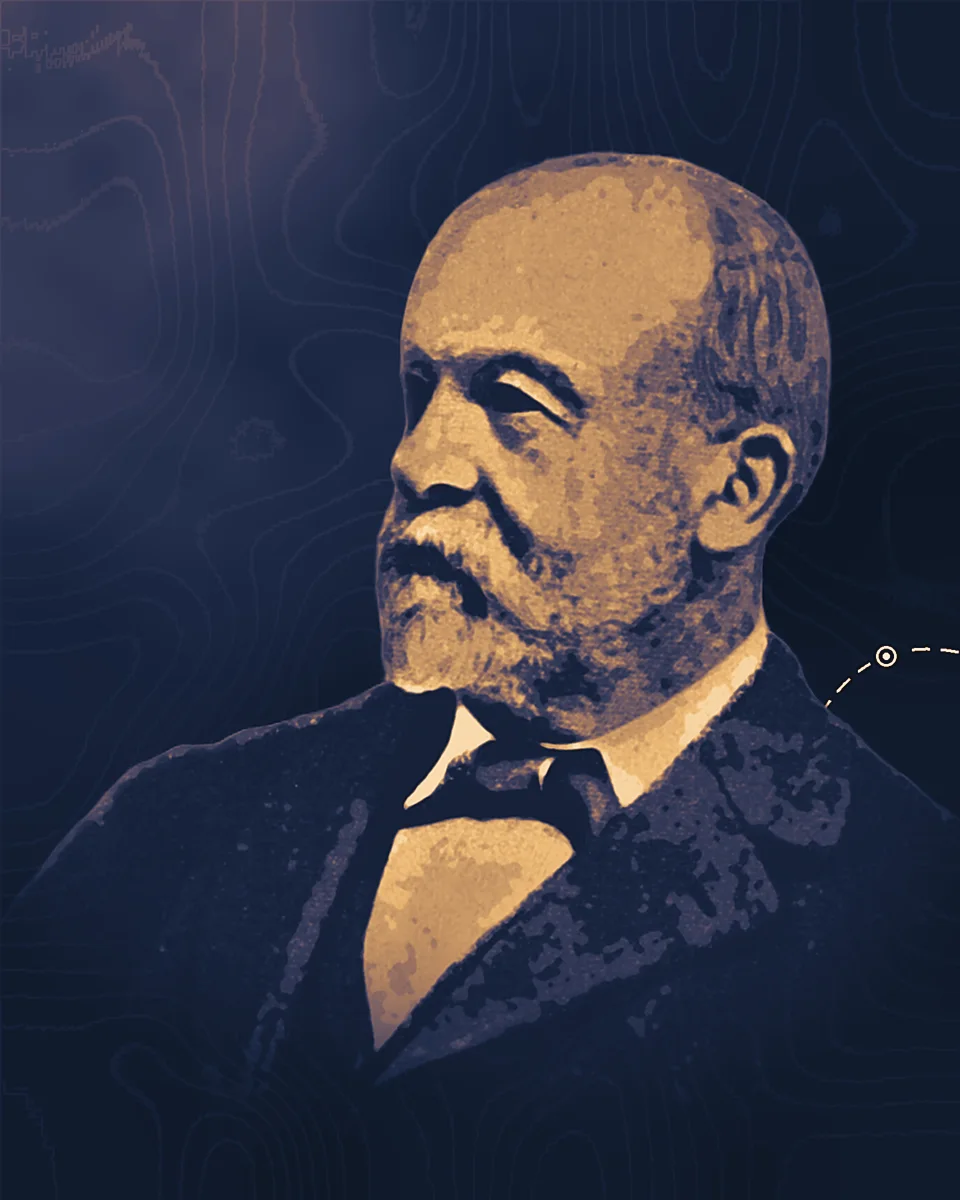
Gottlieb Daimler
He made the petrol engine small, light and fast enough to drive a vehicle, and put it into a cycle, a carriage and a boat.
1834–1900
What they changed
1883
An engine fast enough
Gas engines of the time were slow, heavy and fixed to a floor. At his workshop in Cannstatt, with Wilhelm Maybach as designer, Daimler built a small petrol engine that Maybach's biography says ran at about 900 turns a minute where others ran at about 110. It was lit by a hot tube, a small tube kept glowing by a flame, which Daimler patented in 1883.
1885
Upright engine and motorcycle
In 1885 came an enclosed, upright engine, which Germany's national biography calls a basis for the car engines that followed. The same year it drove a two-wheeled wooden "riding car", which the biography calls the first motorcycle in the world. Daimler's son Paul and Maybach rode it.
1886
Carriage, boat and rail
In 1885 to 1886 the engine went into a four-wheeled carriage, then into motorboats, rail vehicles and an airship. Daimler meant it as a power unit for any vehicle, where Carl Benz in the same years designed a car as one machine.
1890
A company and its licences
The workshop of 1882 and a factory of 1887 became the Daimler-Motoren-Gesellschaft on 28 November 1890. The national biography says building Daimler engines in France from about 1890 started the French car industry, and that his work also shaped the English and American ones.
1894
Proof in a race
Cars with Daimler engines won what the national biography calls the first car contest in the world, from Paris to Rouen in 1894, and public interest followed.
Life
Gottlieb Daimler was born on 17 March 1834 in Schorndorf, Württemberg, the son of a baker. He was apprenticed to a gunsmith in 1848 and passed as a journeyman in 1852. He worked in a machine works at Grafenstaden in Alsace, studied at the Stuttgart polytechnic from 1857 to 1859, and went to Paris in 1860 to see the gas engine of Étienne Lenoir. He then worked in Leeds, Manchester and Coventry.
In 1865 he took charge of the machine works of the Bruderhaus, a charitable home in Reutlingen. There he met Wilhelm Maybach, a young draughtsman who had grown up in the home. The two worked together until Daimler's death. Maybach followed him to a machine builder in Karlsruhe in 1869 and to the Deutz gas engine works near Cologne, where Daimler ran the workshops from 1872 and Maybach the design office.
At Deutz they put Nicolaus Otto's engines into production. Germany's national history museum says disputes with Otto led Daimler to leave in 1882. He left with Deutz shares of a face value of 112,000 marks, and set up a test workshop at Cannstatt, near Stuttgart. Maybach went with him.
The credit is shared. The national biography of Maybach says he was Daimler's "personal designer" from 1883 to 1888 and developed the fast engine, and the history museum says Maybach designed the riding car and the motor carriage under Daimler's direction, while Daimler took the patents.
Daimler founded the Daimler-Motoren-Gesellschaft in 1890 to rescue the struggling business, and held a third of its shares. He fell out with the other shareholders and left with Maybach; in 1894 to 1895, with the backing of a British industrialist, he came back as a partner. He died at Cannstatt on 6 March 1900. The next month a New York magazine called him "the father of the modern automobile". The Mercedes cars that made the firm's name were designed by Maybach after his death, and in 1926 the company merged with Benz & Cie. to form Daimler-Benz.
Read more
4 accounts
Daimler, Gottlieb Wilhelm, Friedrich Schildberger, Neue Deutsche Biographie, volume 3, 1957.
The German national biography's entry, strongest on his training and the engines.
deutsche-biographie.de
Gottlieb Daimler 1834–1900, Deutsches Historisches Museum, LeMO, undated. A year-by-year life that is plain about what Maybach did.
dhm.de
The Father of the Automobile, Edwin Emerson Jr., The Automobile Magazine, April 1900.
An American obituary written the month after his death, with the portrait used here.
archive.org
Maybach, Wilhelm, Hans Christoph Graf von Seherr-Thoß, Neue Deutsche Biographie, volume 16, 1990.
The life of his designer, to be read beside his own.
deutsche-biographie.de