Industries / Figureheads
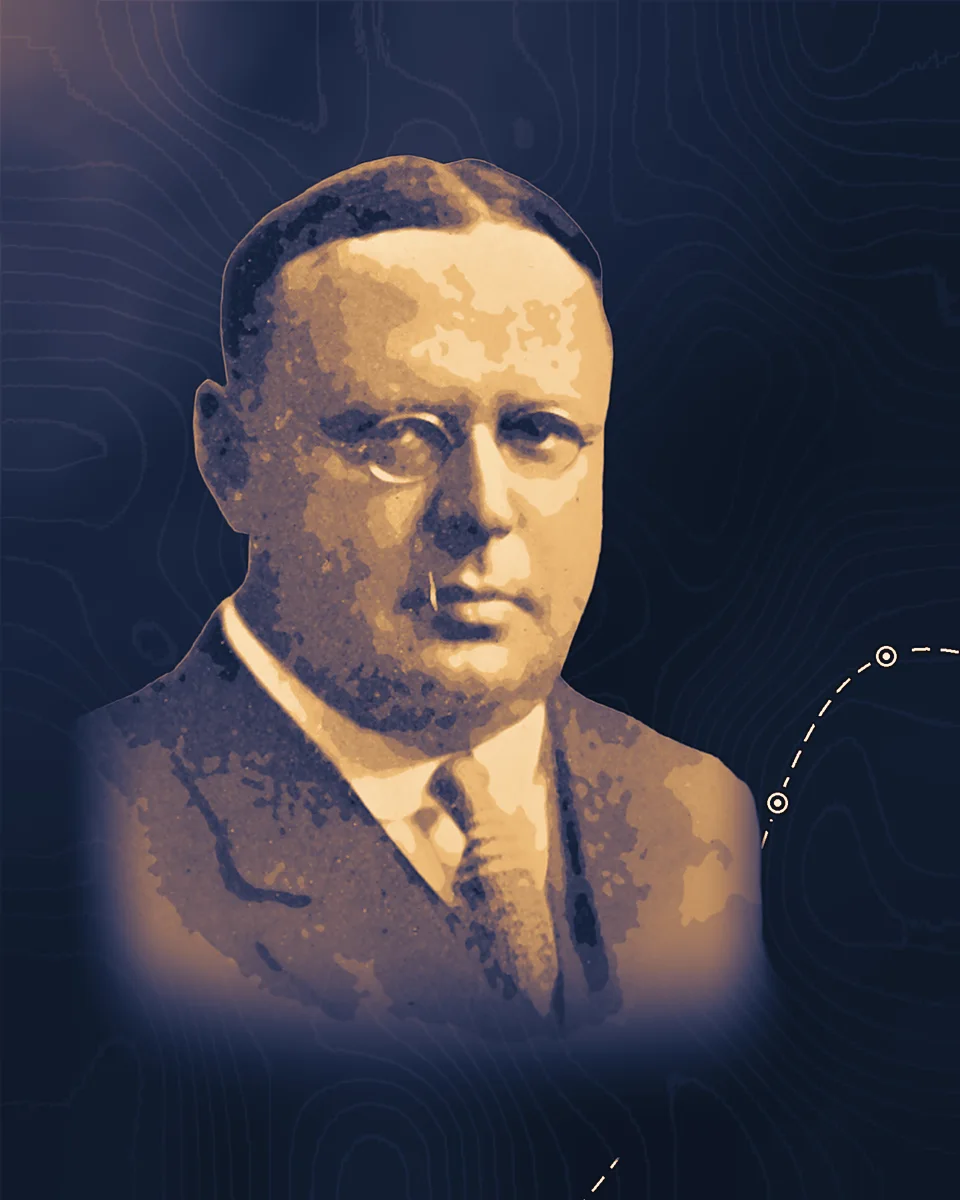
George Warren Fuller
He worked out at Louisville how to clean a muddy river by settling, alum and fast sand filters, and with John L. Leal he put chlorine into a large American city's water for good.
1868–1934
What they changed
1896
Testing filters on the Ohio
From late 1895 Fuller ran the Louisville Water Company's trials of filters on the muddy Ohio River, as its chief chemist and bacteriologist. Four companies tested their devices for a year and he tested the water from each for bacteria and other matter, then carried on alone through 1897. The Kentucky Historical Society's marker on the site calls it "the first scientific testing of water filtration".
1898
Settle, coagulate, then filter
Slow sand filters clogged on muddy water. Fuller concluded that the Ohio needed three steps: settling to drop most of the mud, a dose of alum to make the fine particles clump (coagulation), and filters of sand and gravel washed by machine rather than scraped by hand, which is called rapid sand filtration. He published the results in 1898. Louisville's water company says its plants still put coagulation and settling ahead of filtration on his principles.
1908
Chlorine for Jersey City
A court had found Jersey City's new supply from the Boonton Reservoir impure and set the water company a short deadline to fix it. John L. Leal, the company's sanitary adviser, brought in Fuller, who designed and built a plant in 99 days to dose about 50 million gallons a day with chloride of lime, a powdered chlorine compound. It started on 26 September 1908, supplying some 200,000 people. On 9 May 1910 the court found the device made the water "pure and wholesome".
1909
Louisville filters its river
The Crescent Hill plant built on his findings began filtering on 13 July 1909. The Kentucky Historical Society records that deaths from typhoid fever in the city then fell by 60%.
1910
Other cities follow
By the account of the water historian Michael McGuire, utilities across the country had been waiting on the Jersey City ruling and began chlorinating within weeks of it, and within a few years 75% to 80% of city supplies used chlorine.
Life
George Warren Fuller was born in Franklin, Massachusetts, on 21 December 1868. He was accepted at the Massachusetts Institute of Technology at 16 and graduated in chemistry in 1890, then studied sanitary science in Berlin, where he heard lectures by Piefke, whom the sketch calls famous among Germany's sanitary engineers. Back home he was put in charge of the Massachusetts State Board of Health's experiment station at Lawrence, which studied how to purify water and sewage.
The Louisville work built on Charles Hermany, the company's chief engineer, who had pressed since 1865 for a way to filter the Ohio and had run his own trials with slow sand filters. After Louisville, Fuller ran similar trials for Cincinnati and in 1899 opened a private practice in New York. From 1901 to 1911 he was in partnership with Rudolph Hering, an engineer of sewerage, as Hering and Fuller. By the Louisville company's count he worked for more than 150 cities and companies on water and sewage, among them New Haven, Washington, St. Louis, New Orleans and Montreal.
At Jersey City the decision was Leal's. A physician and former public health officer in Paterson, he seized on the court's allowance of "other plans or devices" in place of the sewers it had ordered for the reservoir's watershed. McGuire says Fuller "would never have done it on his own". The two put the chemical into a city's drinking water without large-scale testing or approval, and by McGuire's account Leal did not even tell the city. Newspapers learned of it that December. The dose was less than one milligram per liter; in the hearings that followed, experts called for the city questioned whether it was safe.
He was as much an engineer of sewage as of water. In New Jersey he worked on the Passaic Valley trunk sewer and the joint trunk sewer of the Plainfield district, and in 1912 he published Sewage Disposal, a textbook on treating it. He died in 1934, when the American Journal of Public Health marked his death as "A Sad Milestone in Sanitary Engineering Progress".
Read more
5 accounts
Report on the Investigations into the Purification of the Ohio River Water at Louisville, Kentucky, George W. Fuller, 1898.
His own report on the Louisville trials.
archive.org
Sewage Disposal, George W. Fuller, McGraw-Hill, 1912.
His textbook on sewage treatment.
archive.org
Jersey City's Secret Water Experiment, Science History Institute, Distillations, 2026.
A documented episode, with its sources listed, on Leal, Fuller and the Boonton plant, with the historian Michael McGuire.
sciencehistory.org
Louisville Water engineer led the world in water treatment advances, Louisville Water Company. The company's account of his trials and what its plants still take from them.
louisvillewater.com
George Warren Fuller, Scannell's New Jersey's First Citizens, 1917.
A contemporary sketch of his life and practice, with the portrait used here.
archive.org