Industries / Figureheads
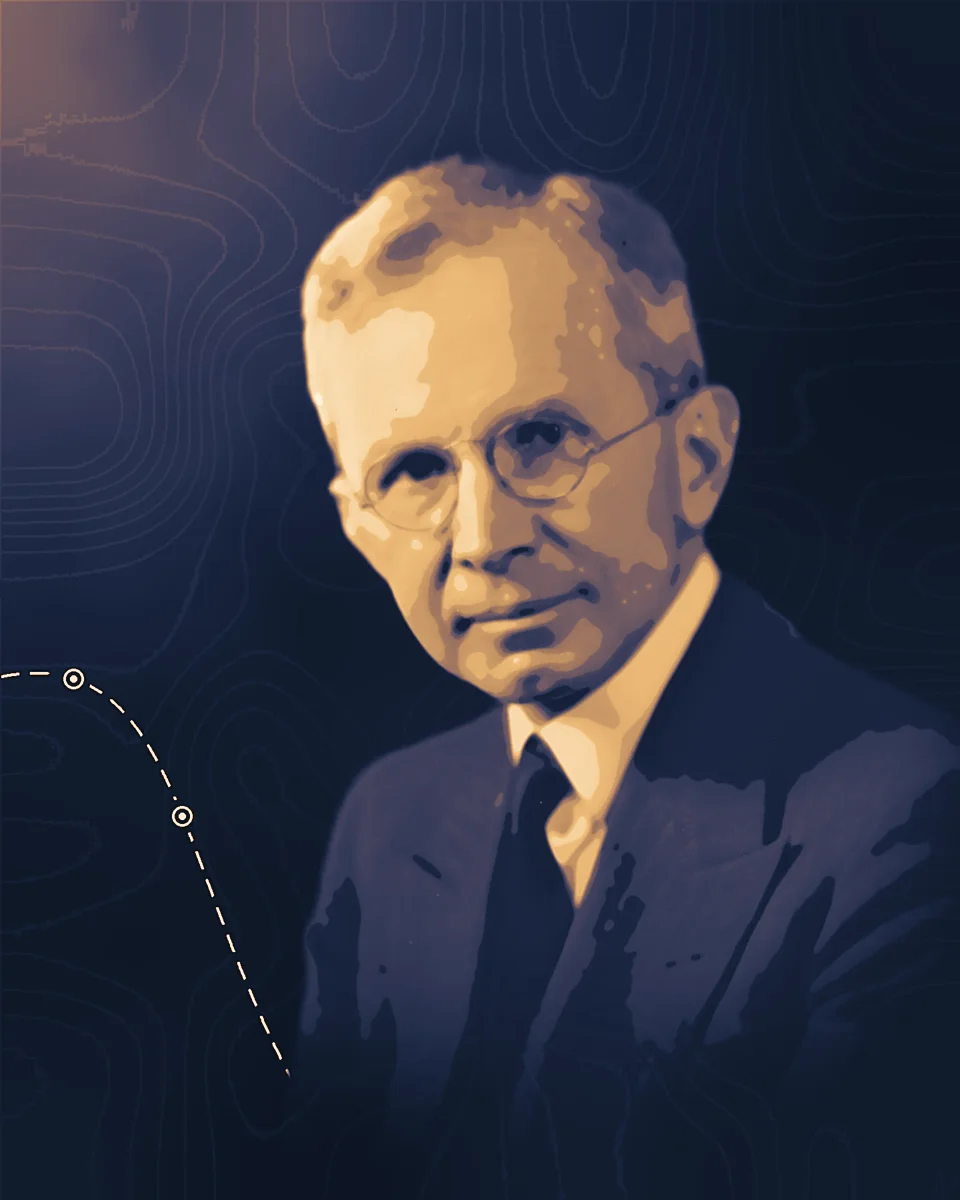
George Oenslager
He found that small amounts of organic chemicals make rubber cure much faster and stronger, the accelerators that every rubber factory has used since.
1873–1956
What they changed
1906
Organic accelerators
Rubber makers sped up vulcanization with minerals such as lime, litharge (a lead oxide) and magnesia. Oenslager, hired in 1905 by the Diamond Rubber Company of Akron, Ohio, to improve cheap grades of rubber, reasoned that these were all bases, and that an organic base that dissolved in rubber might work better. Aniline did. The first commercial use of organic accelerators followed in 1906.
1906
A factory for thiocarbanilide
The same year he started the first factory to make thiocarbanilide, an accelerator made by letting aniline and carbon disulfide react for five days. It began in a shed of corrugated iron and grew, by his colleague Harlan Trumbull's account, to 2,000,000 pounds (about 900 tonnes) a year.
1910s
Carbon black in the tread
The Perkin Medal of 1933 honored him for the accelerators "and of the carbon-black type of tire tread": tread rubber filled with carbon black, a fine black powder that makes it wear far longer. Credit for carbon black is disputed, as the industry file records.
1933
The Perkin Medal
The Society of Chemical Industry gave him its Perkin Medal in New York on 6 January 1933. The Science History Institute calls his accelerators "compounds crucial to the commercialization of natural and synthetic rubber".
Life
George Oenslager was born in Harrisburg, Pennsylvania, on 25 September 1873. He prepared for college at Phillips Exeter Academy, entered Harvard in 1890, graduated in 1894 and spent two more years on chemistry in the graduate school. From 1896 he worked for nine years as a chemist in the pulp and paper mills of S. D. Warren and Company in Maine.
In 1905 he became research chemist to the Diamond Rubber Company, which the B. F. Goodrich Company later bought. In his medal address he described the search in order. He tried inorganic compounds first and found that mercuric iodide worked in small amounts, but it was poisonous, and he wanted "something less injurious to workmen". He then turned to organic compounds and tested one nitrogen base after another to learn which part of the molecule did the work.
When the First World War cut off imported aniline, he laid out and helped run a plant that made about 4,000 pounds (1,800 kg) of it a day. He spent all his working years in research, apart from two years as technical adviser to the Yokohama Rubber Company in Japan.
He received an honorary doctorate from the University of Akron in 1939 and the Charles Goodyear Medal of the American Chemical Society's rubber division in 1948. He died in Akron on 5 February 1956.
Read more
3 accounts
Organic Accelerators in the Rubber Industry, George Oenslager and Harlan L. Trumbull, Oil, Paint and Drug Reporter, 9 January 1933.
Excerpts from his Perkin Medal address and from Trumbull's account of his work, with a short life.
archive.org
Portrait of George Oenslager (1873–1956), Science History Institute, undated.
The archive record, with a biographical note.
digital.sciencehistory.org
This Chemical Age: The Miracle of Man-Made Materials, Williams Haynes, Knopf, 1942.
A history of the chemical industry for general readers, with the story of how Diamond Rubber hired him.
archive.org