Industries / Figureheads
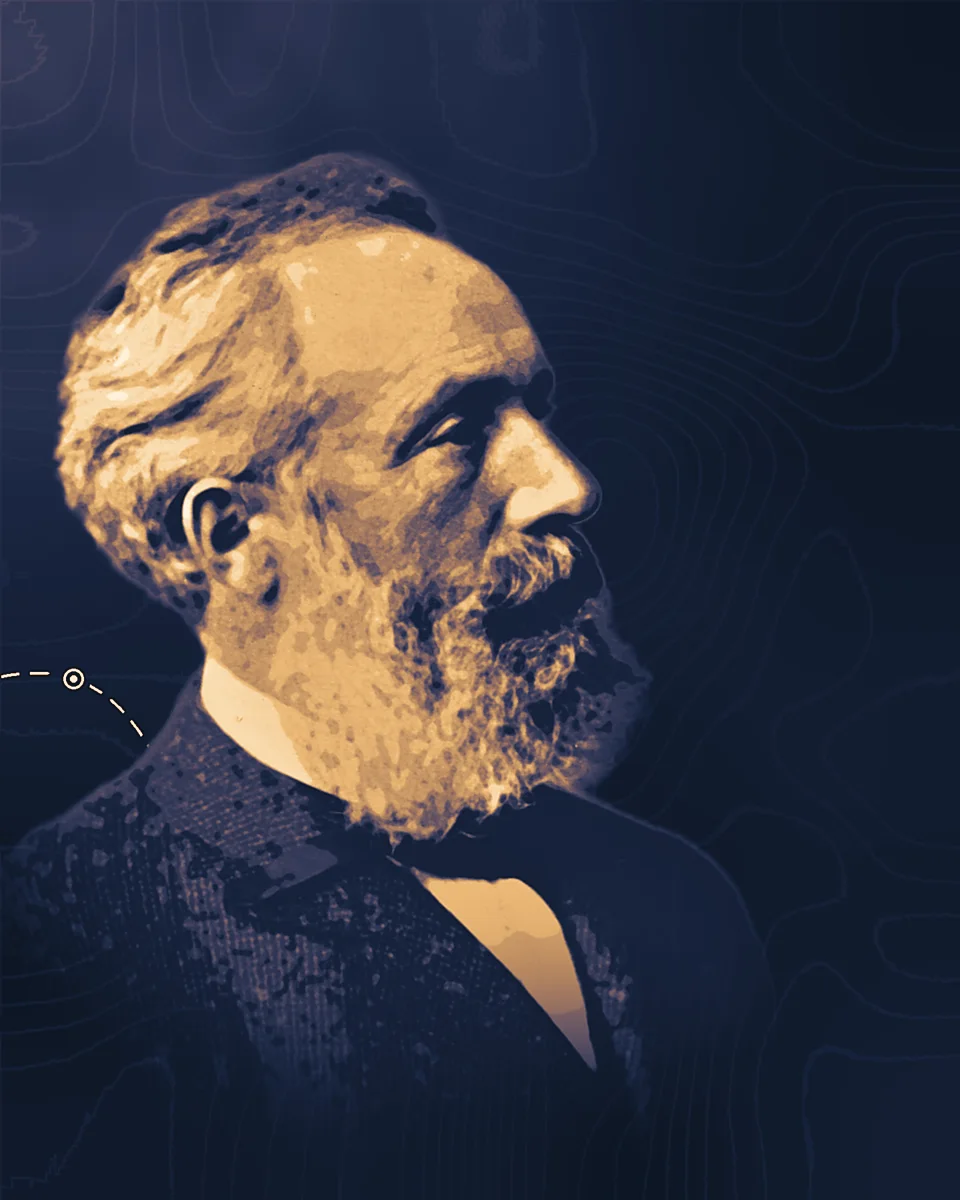
Friedrich Siemens
He patented the furnace that heats its incoming air with its own exhaust, and in Dresden turned it into a tank in which glass melts without stopping.
1826–1904
What they changed
1856
Heat back from the flue
In a regenerative furnace the hot exhaust passes through a chamber stacked with brick and heats it; the flow is then reversed, so the incoming air passes through the hot brick and carries the heat back to the fire. Friedrich Siemens was granted British patent No. 2861 for it on 2 December 1856, in his name alone. His national biography calls him the first to apply the principle to industrial furnaces.
c. 1860
First used to melt glass
After several false starts, the brothers built the world's first regenerative furnace in a glassworks at Rotherham, in England, about four years after the patent, by The Chemical Engineer's account. A Saxon patent of 1858 covered firing the furnace with gas, which raised its efficiency further.
1867
A glassworks in Dresden
After his brother Hans died in 1867, Friedrich took over the glassworks Hans had founded at Dresden in 1862. A tank furnace that worked without a break let it make bottles as well as window glass, and his national biography calls him the largest glassmaker in Europe.
1879
A tank that never empties
Glass had been melted in clay pots, batch by batch. Siemens patented, in England in 1879 and in the United States in 1882, a deep tank for "the continuous melting of glass", which stayed full of molten glass as raw batch was fed in and finished glass drawn off. Tanks of this kind later fed the automatic bottle machines.
Life
Friedrich Siemens was born on 8 December 1826 at Menzendorf in Mecklenburg, near Lübeck, one of the brothers of the electrical engineer Werner Siemens. He went to school at the Katharineum in Lübeck from 1838 to 1842 and then went to sea as a ship's boy, staying at sea until 1845.
At Werner's urging he took private lessons in Berlin and helped build Werner's pointer telegraph. In 1848 he laid electrically fired mines in the Schleswig-Holstein rising against Denmark and helped sell the telegraph in England. From 1849 he worked with his brother Wilhelm, later Sir William Siemens, in Birmingham, on apparatus that reused heat in evaporating liquids, and began the work on heat that led to the furnace.
The furnace was patented in Friedrich's name, and William, who took it up for steel on the open hearth, is said by his biographer to have credited the idea to his brother. The Iron and Steel Institute's obituary of Friedrich in 1904 said that "the glass furnace invented by him forms the basis of the modern system of glass manufacture."
In Dresden he built the glass business into a group. He also founded a glassworks at Charleroi in Belgium, and in 1888 the firm became the Aktiengesellschaft für Glasindustrie vorm. Friedrich Siemens. He applied his heat work beyond glass: a furnace for cremation in 1877, a regenerative gas lamp in 1879, and changes to the Siemens-Martin steel furnace. He put money into the Mannesmann brothers' process for rolling tubes without a welded seam in 1887.
He married Elise Witthauer in Lübeck in 1864, and they had four sons. The Technical University of Dresden made him an honorary doctor of engineering in 1900. He died at his home in Dresden on 24 May 1904.
Read more
5 accounts
Siemens, Friedrich, Frank Wittendorfer, Neue Deutsche Biographie volume 24, 2010.
The German national biography, with his patents, works and a reading list.
deutsche-biographie.de
Friedrich Siemens, Grace's Guide to British Industrial History. Carries the Iron and Steel Institute's obituary of 1904 and other notices from the engineering press.
gracesguide.co.uk
Construction and Method of Working Glass-Melting Furnaces, Frederick Siemens, US Patent 261,054, 1882.
His own description of the continuous tank.
patents.google.com
Glass in all its glory, part 2, Martin Pitt, The Chemical Engineer, 2024.
A history of glassmaking that places the regenerative furnace and the tank in the move to mass production.
thechemicalengineer.com
The Life of Sir William Siemens, William Pole, John Murray, 1888.
The authorised life of his brother, with the furnace patents and the brothers' letters.
archive.org