Industries / Figureheads
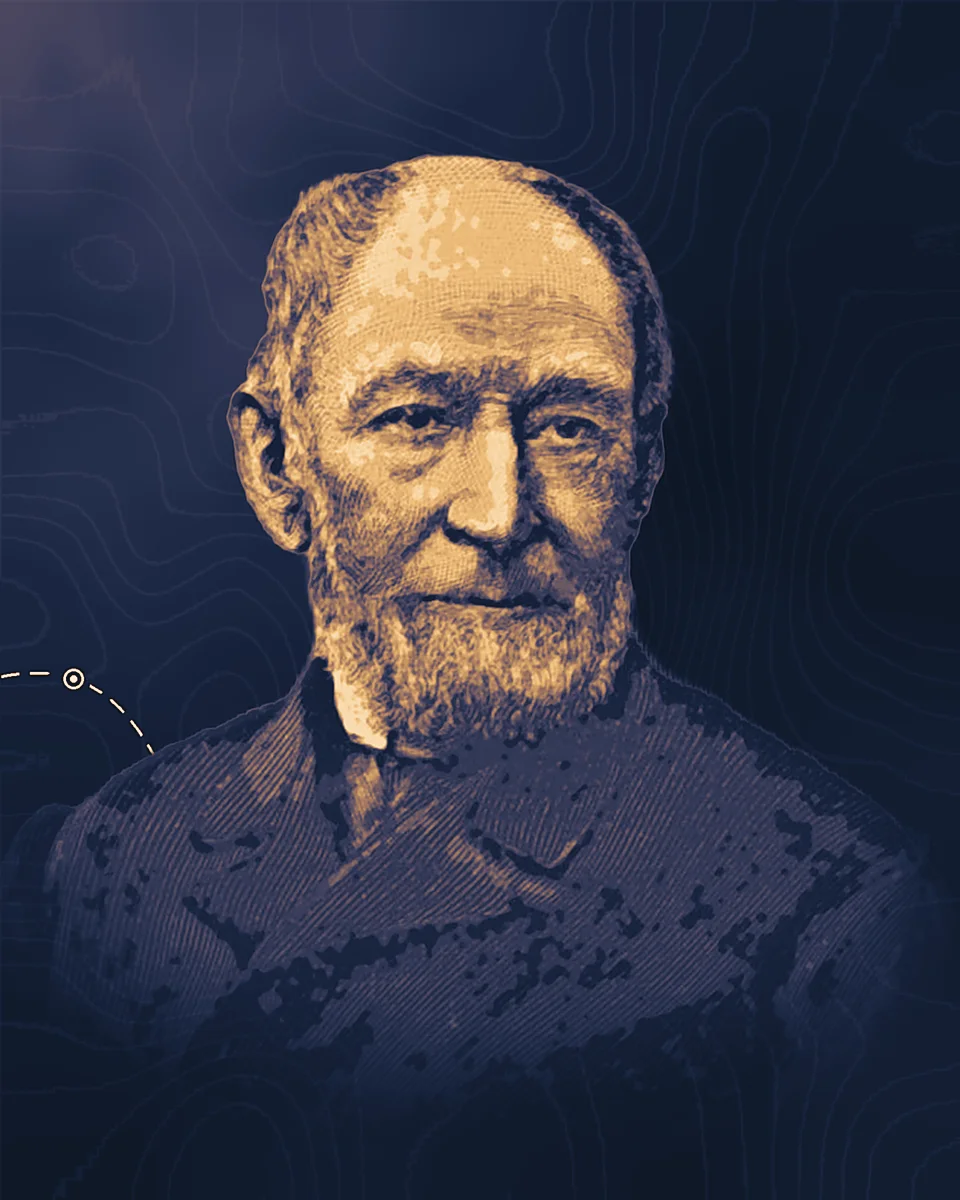
Friedrich Gottlob Keller
A Saxon weaver who ground wood against a wet grindstone and showed that the fibre it gave could be made into paper.
1816–1895
What they changed
1843
Paper from ground wood
Keller pressed a piece of wood against an ordinary grindstone turning in water and collected the white fibre that came off. That evening he dried a little of it and had a scrap of coarse paper the size of a small coin. Until then European paper was made from rags, and rags were running short. Die Gartenlaube dated the first trial to 1843; other accounts give 1844.
1845
A newspaper on wood paper
With his wife he ground about 100 kg of wood pulp by hand at night and had the paper mill at Alt-Chemnitz mix it with rag pulp and make six reams of paper. Part of it was used to print a local paper at Frankenberg in 1845, the first printing on paper that held ground wood, by the Gartenlaube's account.
1845
A Saxon patent
Saxony granted a patent on the invention on 26 August 1845. The product, called groundwood or mechanical pulp, was cheaper than rag pulp, and by 1892 Die Gartenlaube counted more than 300 grinding mills in Germany and about 1,000 in the world.
1846
The rights go to Voelter
Keller had no money to build a machine. He passed his rights to Heinrich Voelter, the director of the paper mills at Bautzen, who paid him 700 thalers and undertook to share later profits. Voelter and the mechanic Johann Matthäus Voith turned the idea into a grinder that a mill could run.
1852
He loses his share
When the patents came up for renewal Keller could not pay his part of the fees. Voelter carried on alone and at a large profit, and the grinders that spread through the industry carried Voelter's name.
Life
Friedrich Gottlob Keller was born on 27 June 1816 at Hainichen in Saxony, the son of a weaver. He wanted to be a mechanic, but his father could not pay for a trade school, so he learned weaving and reed making, travelled as a journeyman through Prussia, Saxony and Austria, and became a master weaver in his home town in 1839. He kept a notebook of ideas for machines, which the museum at Hainichen held when the national biography was written in 1977.
By his own account the idea came from two things: watching wasps build their nests from wood fibre, and a memory of grinding cherry stones on a grindstone as a child and seeing fibre in the water. He was not the first to think of wood. The French scientist Réaumur had pointed to wasps' nests a century earlier, and Jacob Christian Schäffer of Regensburg had made trial papers from plants. In Nova Scotia, Charles Fenerty sent a newspaper a sample of paper made from spruce pulp on 26 October 1844, and the Dictionary of Canadian Biography says tradition puts his first sample at 1838 or 1839. Nothing was built on Fenerty's work.
deutsche-biographie.decapybera-pepper-njwx.squarespace.combiographi.ca
Keller asked the Saxon government for money to develop the process and got praise but no grant. In November 1845 he leased a paper mill at Kühnhaide to work the invention himself. The owner went bankrupt weeks later, and Keller lost his deposit. A letter he had written on his own wood paper reached Heinrich Voelter, who tested the process at Bautzen and bought into it.
He made little from it. After he lost his share of the patents, floods and want of money forced him to sell the Kühnhaide mill. He settled at Krippen on the Elbe, ran a small workshop making measuring calipers for foresters, and kept inventing. From 1870 German and foreign pulp and paper makers sent him gifts of money, and in his last years they paid him a pension of 200 marks a month. In 1893 he received a Saxon order of merit and the freedom of Hainichen. He died at Krippen on 8 September 1895.
Read more
5 accounts
Friedrich Gottlob Keller und das Holzschliffpapier, Eduard Grosse, Die Gartenlaube, 1892.
A long article written while Keller was alive, with his own account of the first trials. In German.
de.wikisource.org
Keller, Friedrich, Herbert Pönicke, Neue Deutsche Biographie, 1977.
The national biography's entry, with the older entry by F. M. Feldhaus (1907) on the same page. In German.
deutsche-biographie.de
Friedrich Gottlob Keller, Paper Industry International Hall of Fame, inducted 2010.
The trade's own short life of him, in English.
capybera-pepper-njwx.squarespace.com
The pulp grinding industry, Verla Mill Museum, undated. A timeline from Keller's grindstone to Voelter's machines, from a preserved Finnish groundwood mill.
verla.fi
Fenerty, Charles, Dictionary of Canadian Biography, 1990.
The life of the Nova Scotian who made paper from spruce pulp in the same years.
biographi.ca