Industries / Figureheads
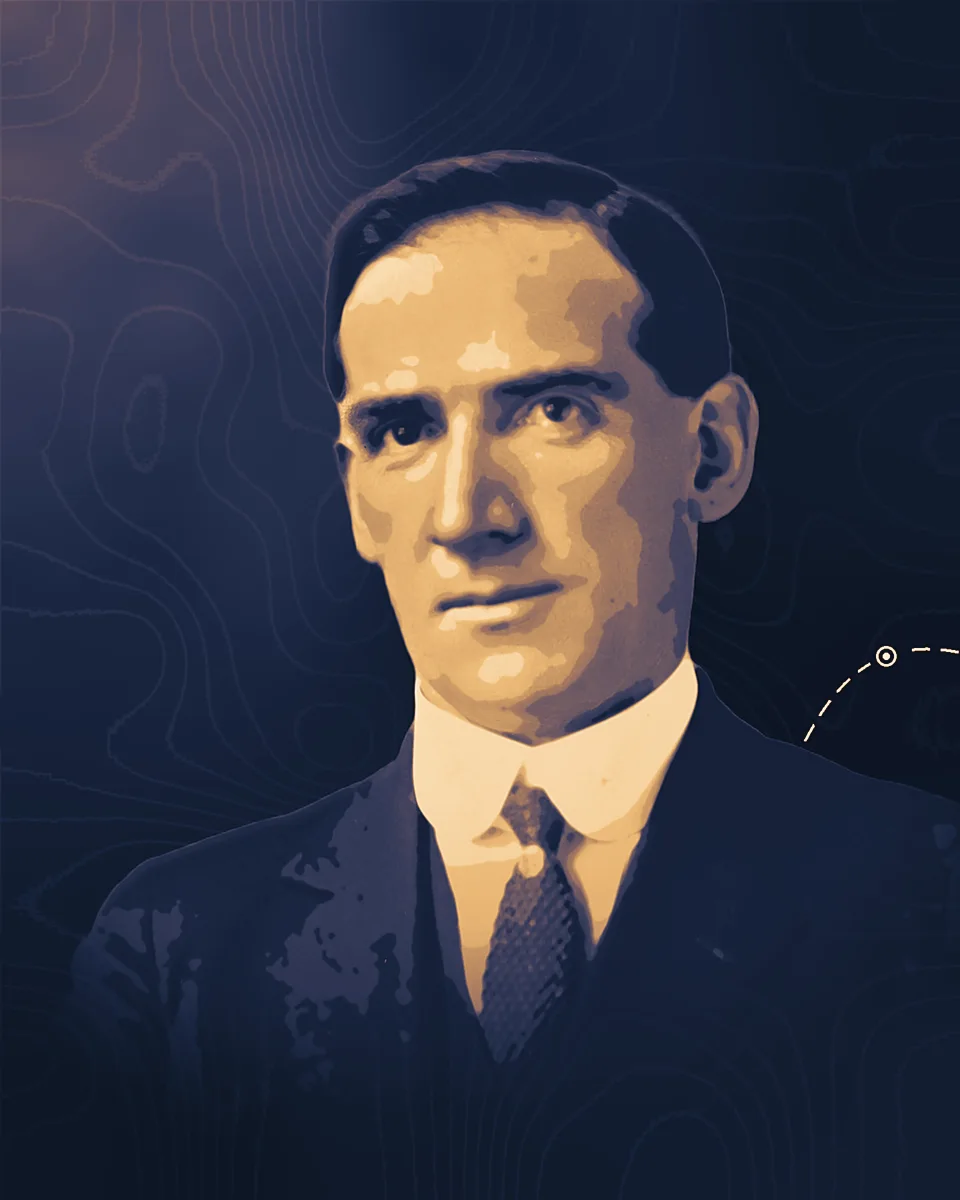
Frederick Gardner Cottrell
With James Speed he found that an electric field draws water out of crude oil, the principle of the refinery's electrostatic desalter, and he gave his smoke precipitator's patents to fund science.
1877–1948
What they changed
1907
Charged wires clean smoke
Cottrell, a chemistry teacher at the University of California, applied on 9 July 1907 for a patent on taking particles out of gas with electric charges. His precipitator charges the particles and draws them onto plates; it was declared a success at the Selby smelter near San Francisco by October 1907. The National Inventors Hall of Fame says it removed 90 to 98% of the particles in smoke.
1909
Electricity breaks oil emulsions
Much crude comes from the well as "cut oil", an emulsion of tiny water droplets each trapped in a film of oil. Cottrell and James Buckner Speed found at the university that an alternating electric field makes the droplets join and settle. A plant on the Lucile Oil Company's lease in the Coalinga field, California, cut 14% emulsion to under 2% early in 1909, by a 1924 paper to the mining engineers' institute.
1911
The dehydration patent
Cottrell and Speed's patent, filed in May 1909 and granted on 21 March 1911, describes water droplets lining up in chains between electrodes and merging until the water drops out, and prefers alternating current. It was assigned to the Petroleum Rectifying Company of San Francisco.
1912
Patents that fund research
Cottrell founded Research Corporation in New York in 1912 and assigned his precipitator patents to it as an endowment. The nonprofit used the income from his patents, and later from other scientists' patents, to pay for research.
1930
Petreco carries it on
The Petroleum Rectifying Company of California, formed around his oil work, merged with the Tretolite Company in 1930 to form Petrolite, whose Petreco division later developed electrostatic desalting for crude inside refineries. A 2016 patent filing says a desalter invented by Petreco in 1980 is used by many of the world's refiners.
Life
Frederick Gardner Cottrell was born in Oakland, California, on 10 January 1877. He entered the University of California at 16, after four semesters of high school, and finished his bachelor's degree in three years, in 1896. He taught high school chemistry, studied briefly at Harvard, then went to Germany, where he took an advanced degree at Berlin in 1901 and a doctorate at Leipzig in 1902.
He came back to Berkeley to teach physical chemistry and began trying electricity on sulfuric acid mist in 1906. The first trials at the DuPont powder works at Pinole went badly, and at the Selby smelter the precipitator cleaned the acid plant's plume but more than two years of work on the roaster stack failed, so the smelter had to install new roasters. He set up two companies, International Precipitation to hold the patents and Western Precipitation to build the plants.
The oil work came from the same idea of using a high-voltage field on a mixture. The 1924 account by F. D. Mahone describes the action as many small condensers in series, with the water droplets as the plates and the oil between them as the insulator. The credit belongs to two men: the patent and the 1924 paper both name James Buckner Speed with Cottrell.
In 1912, at 34, he decided that science should benefit from his invention, because he knew how hard it was for young scientists to find money for their ideas, and he set up Research Corporation. He then spent about ten years with the US Bureau of Mines, in several posts up to director, and helped make helium production possible during the First World War. After 1921 he worked with the National Research Council and the US Department of Agriculture's Fixed Nitrogen Laboratory.
He was elected to the National Academy of Sciences in 1939. He died on 16 November 1948 while attending a meeting of the Academy at Berkeley, his old university.
Read more
5 accounts
Frederick Gardner Cottrell, 1877–1948, Vannevar Bush, National Academy of Sciences Biographical Memoir, 1952.
A short life by the engineer who ran US wartime research.
nasonline.org
Cottrell, Samaritan of Science, Frank Cameron, Doubleday, 1952, reprinted by Research Corporation, 1993.
The full biography.
archive.org
The Electrical Dehydration of Cut Oil, F. D. Mahone, American Institute of Mining and Metallurgical Engineers, 1924.
How the Cottrell treater dried emulsified crude in the oil fields.
onemine.org
Separating and collecting particles of one liquid suspended in another liquid, F. G. Cottrell and J. B. Speed, US Patent 987,115, 1911.
The patent itself, with the droplet chains described.
patents.google.com
About Frederick Cottrell, Research Corporation for Science Advancement, undated. The foundation's own account of his life and why he gave his patents away.
rescorp.org