Industries / Figureheads
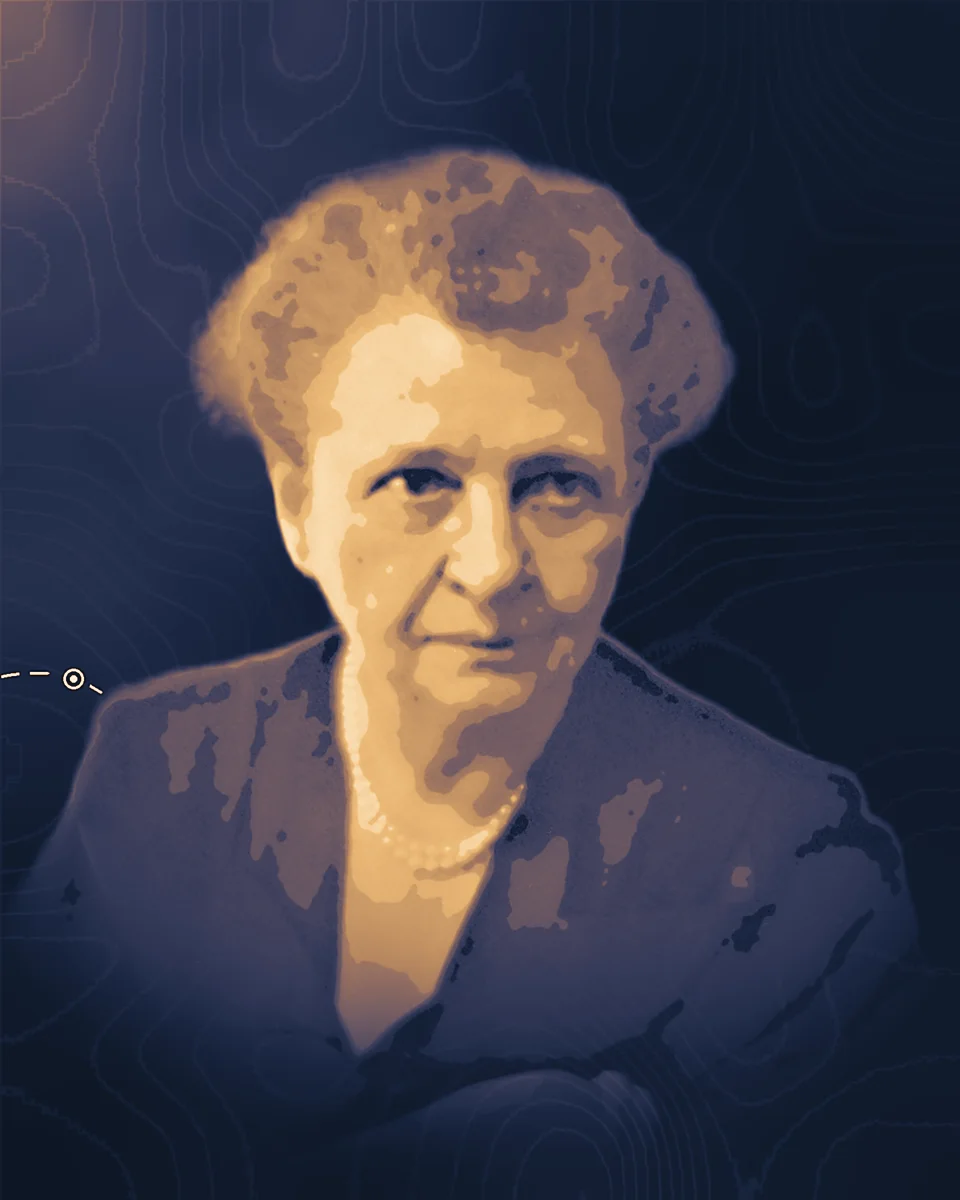
Frances Perkins
She investigated New York's factories after a garment-shop fire killed 146 workers, and later wrote the federal floor under wages and ceiling over hours that American garment work still runs on.
1880–1965
What they changed
1911
Witness to the Triangle fire
On 25 March 1911 a fire at the Triangle Waist Company, a blouse factory in New York, killed 146 workers. Perkins, then head of the New York Consumers' League, was nearby, ran to Washington Square and saw workers jump from the upper floors. She told the story at Cornell University in 1964.
1912
Investigator for the factory commission
New York's legislature set up the Factory Investigating Commission on 30 June 1911. Perkins testified before it, ran investigations for it and took its members on visits to factories, by the US Department of Labor's history. The commission's staff inspected 3,385 workplaces and it heard 472 witnesses. The same history counts 20 laws that followed, on fire safety, ventilation, sanitation and guards on machines.
1919
Rules set by a commission
In 1919 New York set up an industrial commission that could write safety and health rules itself, without a new law each time, and Governor Al Smith named Perkins to it. In 1929 Governor Franklin Roosevelt made her the state's Industrial Commissioner, the first woman in that post.
1933
First woman in the Cabinet
Roosevelt made her Secretary of Labor on 4 March 1933. She was the first woman to sit in a US Cabinet and held the post until 30 June 1945, longer than any other Secretary of Labor. The department calls her the principal architect of the Social Security Act of 1935.
1938
A federal floor under wages
Perkins took the post in 1933 on the condition that she could press for a minimum wage, a limit on hours and an end to child labor abuses, and she had department lawyers draft the bills. The Fair Labor Standards Act, signed on 25 June 1938, set a minimum wage of 25 cents an hour and a 44-hour week for the first year and banned "oppressive child labor" in the industries it covered.
Life
Frances Perkins was born Fannie Coralie Perkins in Boston on 10 April 1880 and grew up in Worcester, Massachusetts. She graduated from Mount Holyoke College in 1902 with a degree in physics. A talk at the college that year by the reformer Florence Kelley, she said later, "first opened my mind to the necessity for and the possibility of the work which became my vocation." She took a master's degree at Columbia University in 1910 and became executive secretary of the New York Consumers' League, where she pressed for a 54-hour limit on the working week of women and children in factories.
The fire of 1911 was not the start of the fight over New York's garment shops. In 1909 a walkout at the Triangle factory itself had grown into a general strike of garment workers after a young worker, Clara Lemlich, called for one at a meeting at Cooper Union. After the fire, on 2 April 1911, the union organizer Rose Schneiderman told a memorial meeting at the Metropolitan Opera House: "We have tried you good people of the public and we have found you wanting." That meeting set up a citizens' Committee on Safety. Perkins became its executive secretary in 1912.
trianglefire.ilr.cornell.edutrianglefire.ilr.cornell.edunps.gov
The commission's laws were not hers alone either. Robert F. Wagner, the majority leader of the state senate, chaired it, and Al Smith of the assembly was vice-chairman. Samuel Gompers, president of the American Federation of Labor, sat on it. Abram Elkus was its chief counsel and Dr. George Price ran its sanitary inspections. In her 1964 lecture Perkins said it was Smith who told the reformers to ask for a commission of legislators and not one named by the governor, because legislators could get its bills passed. The Department of Labor's history quotes her as saying the fire was "a torch that lighted up the industrial scene."
She married Paul C. Wilson in 1913 and kept her own name, and their daughter Susanna was born in December 1916. As Secretary of Labor she did not get the wage and hour law until 1938. To win votes from Southern members of Congress the minimum wage was cut from the 40 cents an hour first proposed to 25 cents. David Dubinsky's garment workers' union backed a strong bill.
After Roosevelt's death she served on the US Civil Service Commission, and in 1946 she published a memoir, The Roosevelt I Knew. From 1955 she taught at Cornell University's School of Industrial and Labor Relations. She died in New York City on 14 May 1965. The headquarters of the Department of Labor in Washington was named after her in 1980.
Read more
6 accounts
Lecture at Cornell University, Frances Perkins, 30 September 1964.
Her own account of the fire, the Committee on Safety and the commission, given to students a year before she died.
trianglefire.ilr.cornell.edu
The Roosevelt I Knew, Frances Perkins, Viking Press, 1946.
Her memoir of working with Roosevelt in Albany and Washington.
archive.org
Madam Secretary: Frances Perkins, George Martin, Houghton Mifflin, 1976.
A full biography.
archive.org
Triangle: The Fire That Changed America, David Von Drehle, Atlantic Monthly Press, 2003.
A history of the strike, the fire, the trial and the commission.
archive.org
Fair Labor Standards Act of 1938: Maximum Struggle for a Minimum Wage, Jonathan Grossman, Monthly Labor Review, June 1978.
The Department of Labor historian's account of how the wage and hour law was drafted and passed.
dol.gov
The New York Factory Investigating Commission, US Department of Labor, undated. The chapter of the department's history of job safety that covers the commission's hearings, inspections and laws.
dol.gov