Industries / Figureheads
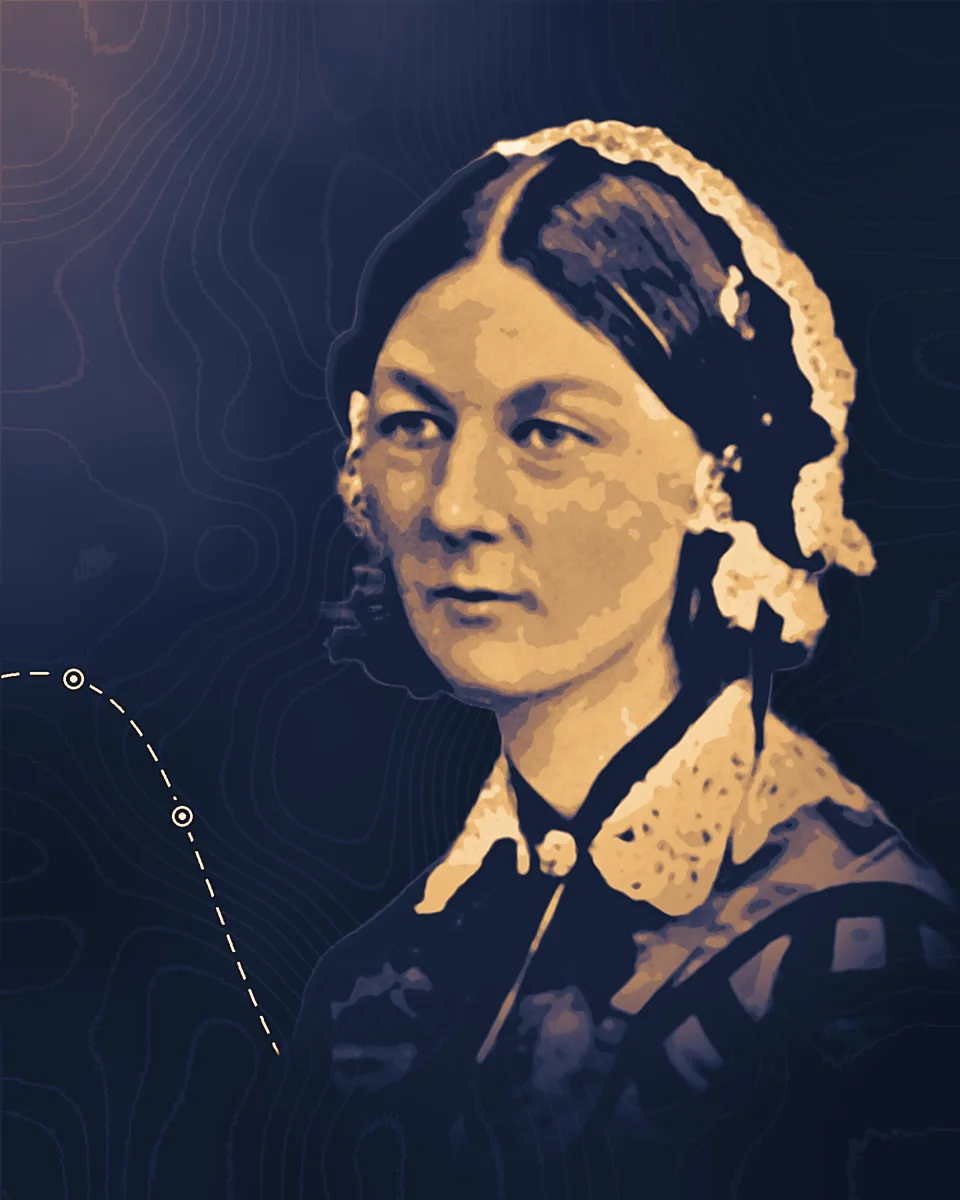
Florence Nightingale
She led the British army's nurses in the Crimean War, then used counts of the dead to push for cleaner barracks and hospitals and founded a school that made nursing a trained profession.
1820–1910
What they changed
1854
Women nurse in army hospitals
The government appointed Nightingale Superintendent of the Female Nurses in the Hospitals in the East, and she reached Constantinople on 3 November 1854 with a party of 38 nurses. At the barrack hospital in Scutari the army doctors at first did not want their help, then took it once casualties from the Battle of Inkerman filled the wards. The nurses set up kitchens, washed linen and clothes and wrote letters for the men. The National Army Museum says their work "set the standards for modern professional nursing".
1858
Deaths counted by cause
Back in London she helped prepare the evidence for a royal commission on the health of the army. Her report of January 1858 and its diagrams showed that more soldiers in the war died of preventable disease than of wounds. The Army Sanitary Committee then inspected 108 barracks and 58 army hospitals between 1858 and 1861 for repairs to ventilation, drains and water. The same year she became the first woman member of the Statistical Society of London, now the Royal Statistical Society.
1859
Notes on Nursing
Her short book was written for "women who have personal charge of the health of others", not as a manual for nurses. Its chapters run from ventilation and warming, noise, food, light and cleanliness to the observation of the sick, and she set nursing apart as knowledge that everyone ought to have, "distinct from medical knowledge, which only a profession can have."
1860
A school for nurses
By 1859 well-wishers had given more than £40,000 to the Nightingale Fund. With it she opened the Nightingale Training School at St Thomas' Hospital in London on 9 July 1860, and its trained nurses were sent to hospitals across Britain. The London Museum calls it the world's first non-religious school of nursing.
1863
Wards and records for hospitals
In Notes on Hospitals she wrote that "the first principle of hospital construction is to divide the sick among separate pavilions": long open wards with many windows that nurses could watch from end to end. When St Thomas' Hospital moved to Lambeth it was rebuilt on that plan, and wards of the kind are still called Nightingale wards. The same book asked hospitals to keep uniform figures, so that deaths could be compared by ward, age, sex and disease and between hospitals.
Life
Florence Nightingale was born on 12 May 1820 in Florence, Italy, and named after the city. She grew up in Derbyshire and Hampshire, and her father taught her languages. She was drawn to mathematics and read the Belgian statistician Adolphe Quetelet. Against her family's wishes she trained as a nurse in Germany in 1851, at the deaconess institution at Kaiserswerth run by Theodor and Friederike Fliedner, and in 1853 became superintendent of a London home for sick gentlewomen in Harley Street.
Her party left London on 21 October 1854. The Times reported that at night she walked the wards with a light in her hand, and as "the Lady with the Lamp" she became famous at home. Not everyone admired her. In March 1855 General Sir John Burgoyne wrote that she "likes to govern, and bestows all her tenderness upon those who depend upon her". She caught "Crimean fever" at Balaklava in May 1855, recovered slowly, and returned to England in August 1856.
Deaths at Scutari rose while she was there. By the National Army Museum's account the hospital's death rate reached 42% by February 1855, and she wrongly blamed poor food rather than poor sanitation. The building sat on a broken sewer. Deaths fell only after a sanitary commission under Dr John Sutherland arrived in March 1855, cleared the drains and opened the wards to air; Aravind and Chung give the fall as 52% to 20%. Like most doctors of her day she held that disease came from foul air and dirt, the miasma theory. In Notes on Nursing she called it "a continual mistake" to see diseases "as separate entities, which must exist, like cats and dogs", and wrote that she had seen smallpox begin in crowded wards where it could not have been caught. A 2020 review by Dumitrascu and colleagues says she was long unconvinced that germs cause disease, but took care against infection once Pasteur's work was known.
nam.ac.ukpmc.ncbi.nlm.nih.govarchive.orgpmc.ncbi.nlm.nih.gov
After the war she worked with Sidney Herbert, the former Secretary at War, with Sutherland, and with the statistician William Farr, who signed her nomination to the Statistical Society. She found that the army's hospital returns, which counted the men in hospital on one day a week, may have shown only a seventh of the true deaths in the Crimea, and called for standard measures. She went on to study the health of the army in India. For many years she was ill and mostly confined to bed, an illness the National Army Museum describes as what is now called chronic fatigue syndrome and Dumitrascu and colleagues suggest may have been brucellosis, and she worked by letter and report.
rss.org.ukpmc.ncbi.nlm.nih.govpmc.ncbi.nlm.nih.govnam.ac.ukpmc.ncbi.nlm.nih.gov
Her standing beside Mary Seacole has been argued over. Seacole, a Jamaican-born healer, travelled to London late in 1854 to volunteer as an army nurse and, by the National Army Museum's account, was rejected by the War Office and by Nightingale, so she paid her own way to the war and ran a hotel for soldiers near the front. When a statue of Seacole called "Pioneer Nurse" was planned at St Thomas' Hospital in 2016, the Nightingale Society, which exists to defend Nightingale's reputation, objected to the title and the site, saying Seacole "never claimed to be a nurse at all".
In 1907 she became the first woman to receive the Order of Merit. She died in London on 13 August 1910, aged 90. Her family declined burial in Westminster Abbey, and she was buried at East Wellow in Hampshire, near her parents' home. International Nurses Day has been held on her birthday since 1965, and the World Health Organization named 2020 the International Year of the Nurse and the Midwife for her bicentenary.
nam.ac.uklondonmuseum.org.ukpmc.ncbi.nlm.nih.govukhsa.blog.gov.uk
Read more
6 accounts
Notes on Nursing: What It Is, and What It Is Not, Florence Nightingale, 1859.
Her own book, in its first edition.
archive.org
Notes on Matters Affecting the Health, Efficiency, and Hospital Administration of the British Army, Florence Nightingale, 1858.
Her report on the war, with the diagrams of deaths by cause; the Wellcome Library's copy.
archive.org
Notes on Hospitals, Florence Nightingale, third edition, 1863.
Her case for pavilion wards and for uniform hospital statistics.
archive.org
The Life of Florence Nightingale, Edward Cook, Macmillan, 1913.
A two-volume life published three years after her death; this is volume 2, which covers 1862 to 1910.
archive.org
Florence Nightingale: The Lady with the Lamp, National Army Museum, undated. The museum's account of her war, her illness and her honours, with the criticism of her at the time.
nam.ac.uk
Evidence-based medicine and hospital reform: tracing origins back to Florence Nightingale, Mallika Aravind and Kevin C. Chung, Plastic and Reconstructive Surgery, 2010.
A review of her use of statistics in army and hospital reform.
pmc.ncbi.nlm.nih.gov