Industries / Figureheads
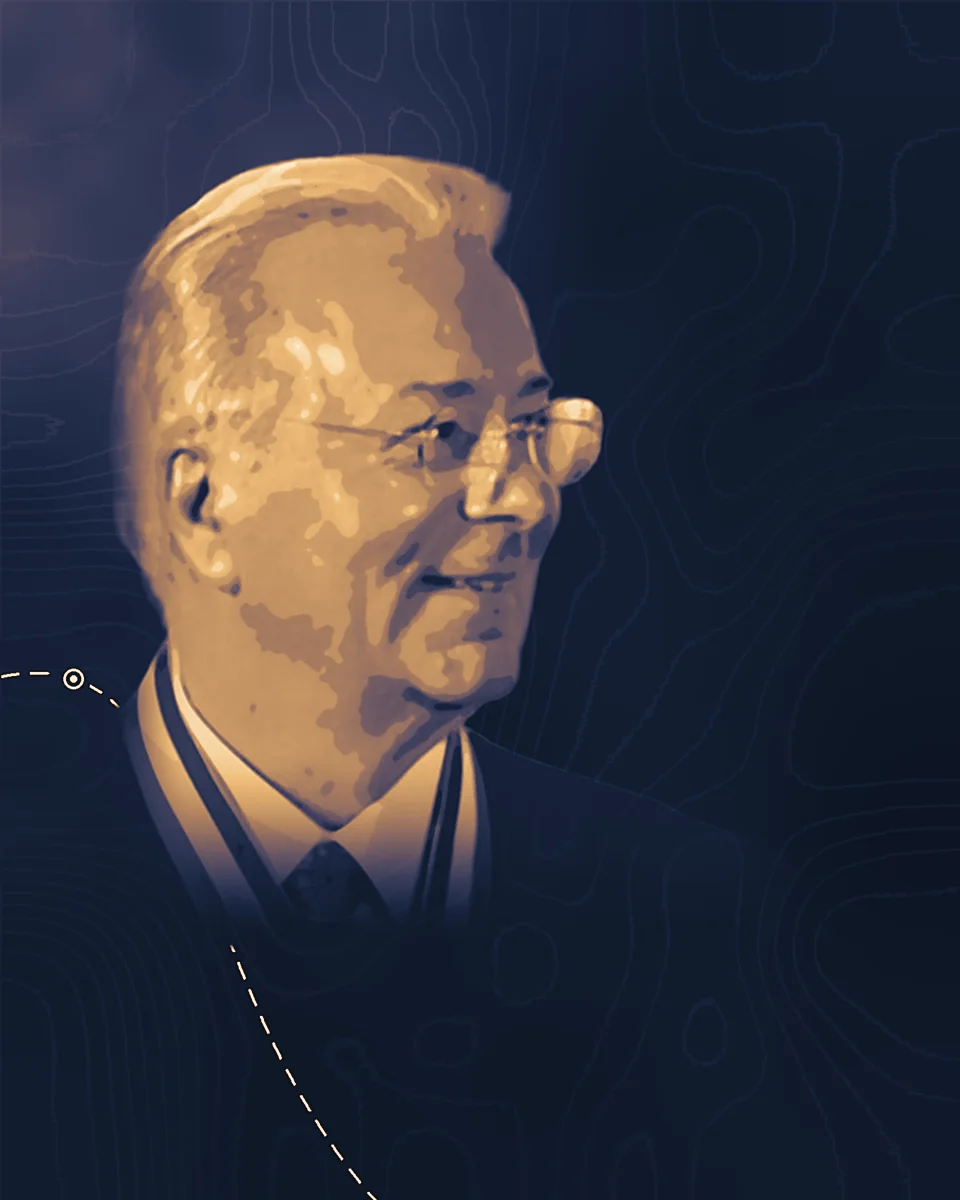
Federico Faggin
He made the silicon-gate transistor into a working chip process and used it to design the Intel 4004, the first microprocessor sold.
born 1941
What they changed
1968
Silicon-gate chips
In a MOS transistor, the kind nearly all chips now use, a gate electrode switches the current. Bell Labs had made such transistors with a gate of silicon in place of aluminum in 1967. At Fairchild's research laboratory Faggin, as project leader, worked with Tom Klein to turn that into a process for making chips, and designed the first one sold, the Fairchild 3708, in 1968. The Computer History Museum says silicon gate became the industry's standard process within five years.
1970
A process fit for logic
Intel used silicon gate for memory chips. When Faggin joined in 1970 he added a buried contact, a direct connection between two layers of the chip, and other changes suited to logic circuits. The museum says this is what let a whole processor fit on a chip small enough to manufacture.
1971
The Intel 4004
Ted Hoff and Stanley Mazor of Intel had drawn up a processor on one chip for the Japanese calculator maker Busicom. Faggin, helped by Busicom's Masatoshi Shima, designed it and its three companion chips, fitting 2,300 transistors into a 16-pin package. The US Patent and Trademark Office calls it "the first microprocessor". Intel put it on general sale in November 1971.
1972
The 8008
Faggin supervised Hal Feeney's design of Intel's 8-bit processor, the 8008, announced in 1972. It handled data eight bits at a time, twice the 4004's four.
1974
Zilog and the Z80
Faggin left Intel at the end of 1974 and founded Zilog with Ralph Ungermann. He conceived its Z80 processor and directed its development. The Computer History Museum calls the Z80 the most enduring of the 8-bit designs of the mid-1970s, and the Engineering and Technology History Wiki says more than a billion were sold.
Life
Federico Faggin was born in Vicenza, Italy, on 1 December 1941. After technical high school he went to work for Olivetti, where he designed his first computer at the age of 19. He took a doctorate in physics at the University of Padua in 1965. At SGS-Fairchild in Milan he developed the firm's first MOS process and its first MOS chips, and in 1968 he moved to Fairchild Semiconductor's laboratory in Palo Alto, California.
The silicon gate was not his idea alone, and the museum's account says so. Boyd Watkins at General Microelectronics described a similar structure in 1965. Robert Kerwin, Donald Klein and John Sarace at Bell Labs built transistors with silicon gates in 1967. What Faggin and Tom Klein did at Fairchild was make the idea into a dependable way to manufacture chips, which gave three to five times the speed of the older kind in half the area. Intel, founded in 1968 by people who had just left Fairchild, built its memory business on it. In an interview for the IEEE in 2004 Faggin said that Intel's founders had taken the process from Fairchild and given him no credit for it.
He joined Intel in April 1970 and was handed the Busicom project on his first day. Hoff and Mazor had set out what the four chips should do, but neither was a chip designer, and no detailed design existed. Faggin worked 70 to 80 hours a week through 1970, with Shima checking the logic. He put his initials, F.F., on the edge of the processor. Busicom had a working set of chips in March 1971.
Who invented the microprocessor has been argued over ever since. Other chips have a claim to be first, depending on the definition: the Four-Phase Systems AL1 of 1969, the chip set in the F-14 fighter's flight computer of 1970, and a Texas Instruments chip that was built as a prototype and never sold. Ken Shirriff, writing in IEEE Spectrum, concludes that the microprocessor was less an invention than something everyone knew was coming. The prizes have shared the credit in different ways. The Kyoto Prize of 1997 went to four engineers, Faggin, Hoff, Mazor and Shima. The US National Medal of Technology and Innovation for 2009 went to Faggin, Hoff and Mazor.
Faggin ran Zilog as president and chief executive until 1980. In 1986 he co-founded Synaptics, an early maker of touchpads and touchscreens, and from 2003 to 2008 he led Foveon, a maker of image sensors. He received the Marconi Fellowship in 1988 and the IEEE's W. Wallace McDowell Award in 1994, and entered the National Inventors Hall of Fame in 1996.
Read more
6 accounts
Oral history of Federico Faggin, Gardner Hendrie, Computer History Museum, 2004–2005.
Three long sessions on Olivetti, the silicon gate, the 4004 and Zilog, with his own corrections.
archive.computerhistory.org
Federico Faggin, an oral history, John Vardalas, IEEE History Center, 2004.
A second interview, franker about Fairchild, Intel and credit.
ethw.org
Chip Hall of Fame: Intel 4004 Microprocessor, Stephen Cass, IEEE Spectrum, 2018.
A short history that gives each of the four engineers his part.
spectrum.ieee.org
The Surprising Story of the First Microprocessors, Ken Shirriff, IEEE Spectrum, 2016.
The rival claims to the first microprocessor, from documents and the chips themselves.
spectrum.ieee.org
1968: Silicon gate technology developed for ICs, Computer History Museum, The Silicon Engine. The museum's account of who did what, with the Bell Labs and Fairchild papers.
computerhistory.org
The Intel 4004 microprocessor and the silicon gate technology, Federico Faggin, intel4004.com. His own site, with his account of the design and his papers.
intel4004.com