Industries / Figureheads
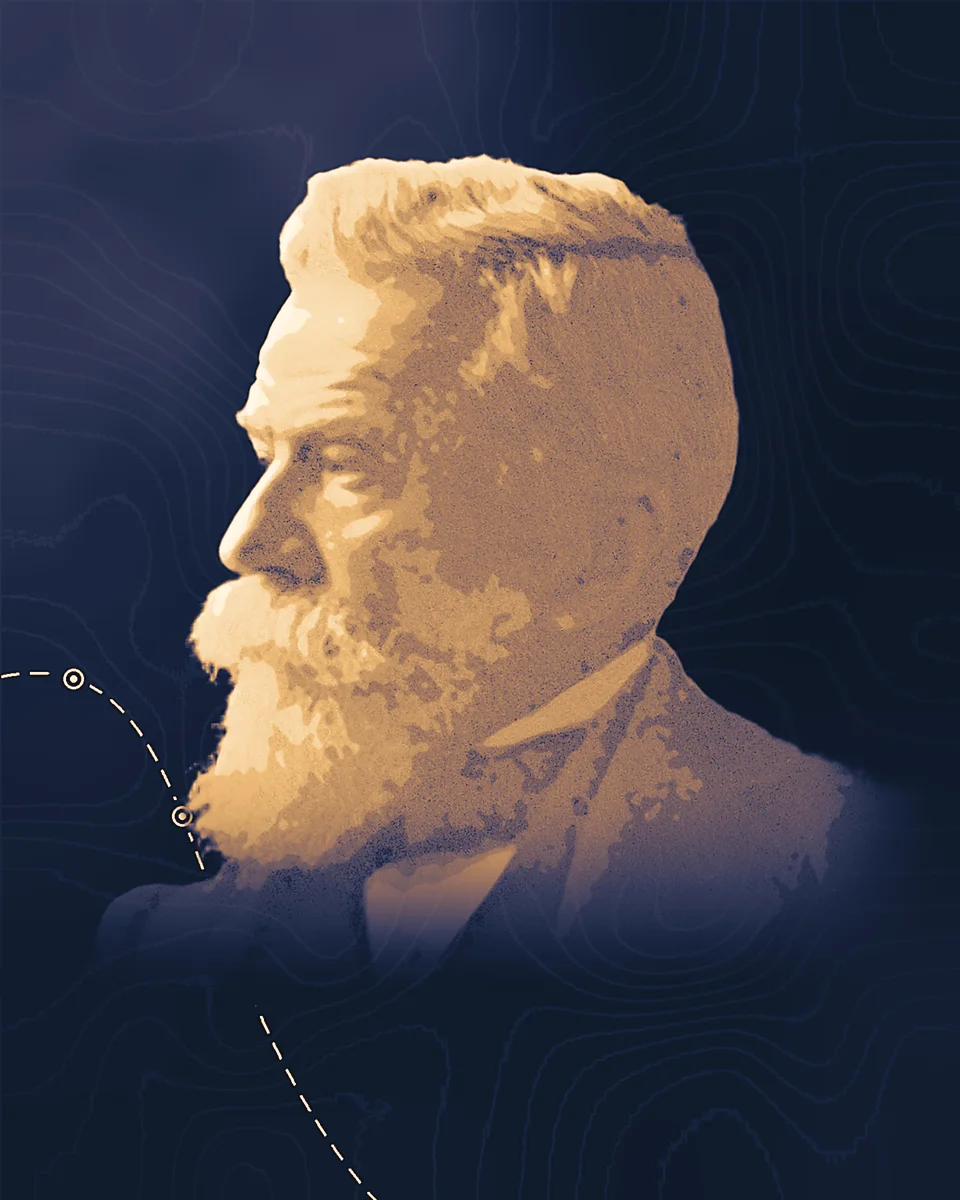
Ernest Solvay
He made the ammonia-soda process work at factory scale, and soda ash made from salt and limestone is still about two-thirds of world output.
1838–1922
What they changed
1861
Soda from brine and ammonia
Working at his uncle's gasworks in Brussels, Solvay saw that ammonia, salt water and carbon dioxide react to give sodium bicarbonate, which heat turns into soda ash (sodium carbonate). The reaction had been known for fifty years, and several chemists had failed to make it pay at scale. His company says his first patent was voided for that reason, and that a second in 1863 covered his equipment and the order of the steps.
1865
A works at Couillet
With his brother Alfred he founded Solvay & Cie in 1863 and built a works at Couillet, near Charleroi, which began making soda in 1865. After repeated setbacks he designed a tower in which carbon dioxide and ammonia-laden brine meet, and Belgium's Flemish chemical society dates the firm's prosperity from 1870. The ammonia is recovered and used again, so the process needs no sulfuric acid and gives off no acid gas.
1872
Plants in other countries
Ludwig Mond took a licence in 1872 and brought the process to England. Solvay's own firm built the first soda ash plant in the United States, at Syracuse, New York, in 1881, and a works at Berezniki in Russia in 1883. By 1890 there were plants in most European countries, Russia and the United States.
2024
Two-thirds of world soda
The US Geological Survey estimates that 49 million of the 73 million tons of soda ash made in the world in 2024 were synthetic, the kind made from salt and limestone as Solvay's works made it. The rest was refined from natural deposits.
Life
Ernest Solvay was born on 16 April 1838 at Rebecq-Rognon, near Brussels, the son of a salt refiner. An attack of pleurisy kept him from finishing school or going to university, and he taught himself by experiment. At 21 he went to work at the gasworks his uncle Florimond Semet managed in Brussels.
The idea was not his alone. The Flemish chemical society notes that the French physicist Augustin Fresnel had thought of an ammonia-soda method in 1811, and calls Solvay "the first to develop the entire process". W. A. Campbell, in the Dictionary of Scientific Biography, says Solvay did not know at the time that the reaction was fifty years old.
The early years were hard. The brothers raised a starting capital of 163,000 Belgian francs with difficulty, from relatives and local business owners. The Science History Institute records that an early plant exploded and that Solvay borrowed from his family to rebuild. By 1869, it says, he had solved his difficulties and the plant had tripled its output.
His process displaced that of Nicolas Leblanc, which was costly in labor and fuel and poured out acid gas and solid waste. Solvay's has a waste of its own, calcium chloride, and the US Geological Survey notes that synthetic soda ash still costs more to make than soda refined from natural deposits and "generates environmental wastes".
Wealth turned him to public life. By the Flemish chemical society's account he brought in a social security scheme and pensions for his workers in 1878 and an eight-hour day in 1897, before the law required them, and sat in the Belgian Senate for the Liberal party from 1893 to 1900. He founded institutes of physiology, sociology and commerce attached to the Free University of Brussels. In 1911 he paid for an invitation-only meeting of physicists in Brussels on radiation and quanta, the first of the Solvay conferences. Albert Einstein, Marie Curie and Max Planck were among those who came.
In 1914 he set up the national committee that fed the Belgian population during the First World War. He died in Brussels on 26 May 1922.
Read more
5 accounts
Une entreprise au cœur de l'histoire: Solvay, 1863–2013, Kenneth Bertrams, Nicolas Coupain and Ernst Homburg, 2013.
The French edition of the full scholarly history of the firm, published in English by Cambridge University Press as Solvay: History of a Multinational Family Firm.
archive.org
Making the Process, Christy Martin and Brigitte Van Tiggelen, Distillations, Science History Institute, 2011.
How the ammonia-soda process took over from Leblanc's, and what the Solvay family did with the money.
sciencehistory.org
Solvay, Ernest, W. A. Campbell, Complete Dictionary of Scientific Biography, 2008.
A short life with the patents and the spread of the process.
encyclopedia.com
Ernest Gaston Joseph Solvay, Koninklijke Vlaamse Chemische Vereniging, 2012.
The Flemish chemical society's four-page life, with the chemistry of both soda processes set out.
kvcv.be
Manufacture of Soda, Te-Pang Hou, American Chemical Society Monograph Series, second edition, 1942.
The working detail of the process, set down by a Chinese engineer as an exception, in his words, to the industry's "age-long secretiveness".
archive.org