Industries / Figureheads
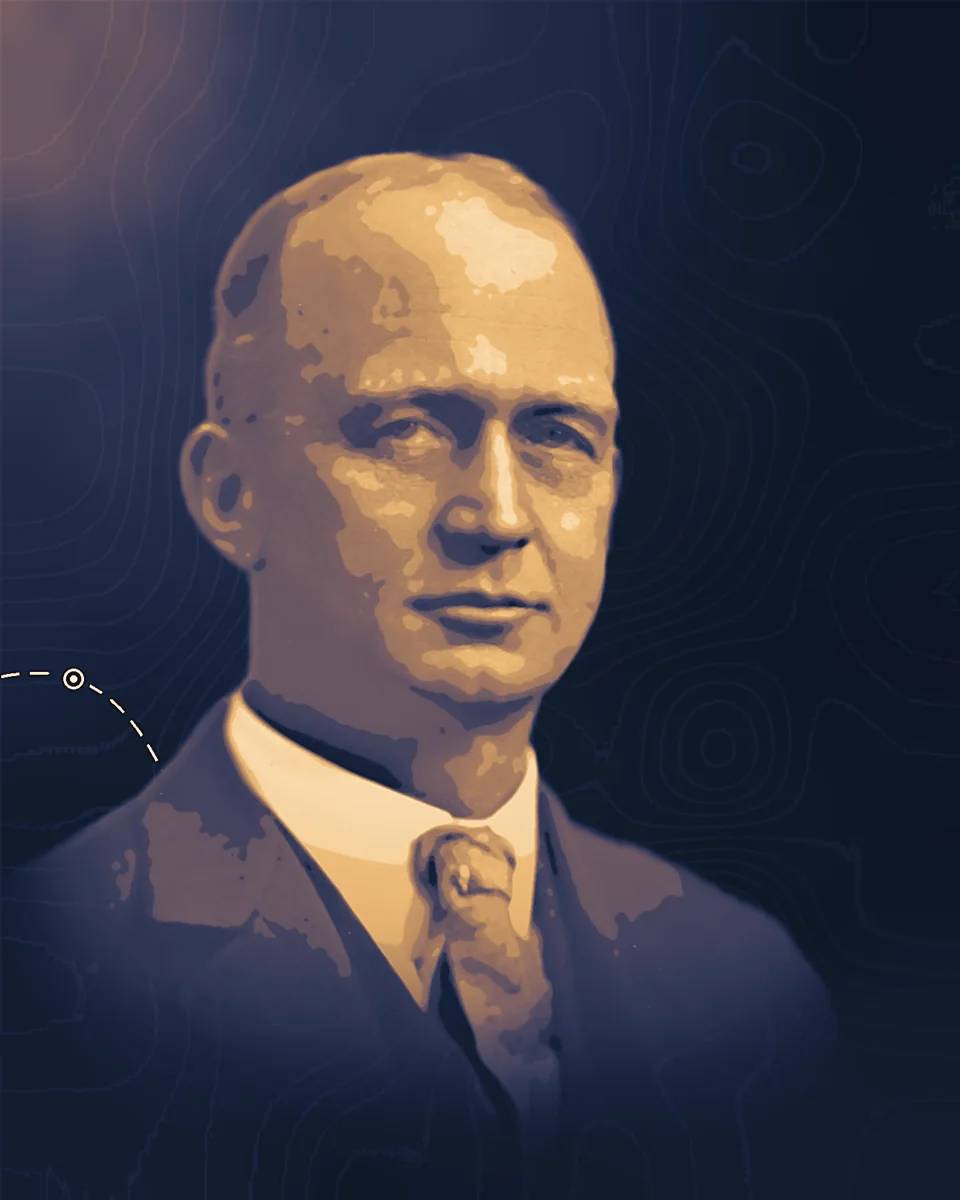
Ernest Amory Codman
A Boston surgeon who held that every hospital should follow every patient long enough to learn whether the treatment worked, published his own failures to show how, and helped start the standards by which American hospitals are accredited.
1869–1940
What they changed
1911
Every patient followed up
Codman opened his own small hospital in Boston in August 1911 to run it on what he called the End Result System. Each patient had an End Result Card recording the complaint, the diagnosis the treatment was based on, the treatment, complications before discharge, the final diagnosis, and "the result each year afterward". When a result fell short, the case was analyzed to fix the responsibility on the doctor, the hospital's organization, the disease or the patient's circumstances.
1916
Every failure in print
His report on the hospital's first five years, August 1911 to August 1916, set out all 337 cases with their results and marked each imperfect one by cause: lack of skill, of surgical judgment, of care or equipment or of diagnostic skill; the patient's disease or refusal of treatment; or the "calamities of surgery" no one could yet control. He wrote that the system meant "the introduction of the Comparative Principle into Clinical Science", and offered his standards to other hospitals "for comparison, not necessarily for emulation."
1917
Minimum standards for hospitals
After the American College of Surgeons was founded in 1913, its founder Franklin Martin put Codman on its Committee on Hospital Standardization. In 1917 the college set "minimum standards" for hospitals: an organized medical staff, only qualified and licensed doctors, regular review of the staff's clinical work, full medical records, and laboratories and X-ray departments. Its first survey found that only 89 of 692 hospitals of 100 beds or more met them. The program grew into the Joint Commission on Accreditation of Hospitals in the early 1950s.
1920
A registry of bone cancer
Codman set up the Registry of Bone Sarcoma to follow patients with bone cancer across the country, started with a gift of $1,000 from a patient's family and later more than $8,000 from the American College of Surgeons. Richard Brand calls it the first registry of its kind. Surgeons sent in few cases, but the registry produced a standard classification and Codman's 25 criteria for diagnosing osteogenic sarcoma.
Life
Ernest Amory Codman was born in Boston on 30 December 1869 into an old New England family. He graduated from Harvard College in 1891 and from Harvard Medical School in 1895, where he became best friends with the future neurosurgeon Harvey Cushing. He studied in Vienna and other European centres, joined Massachusetts General Hospital, and took up the X-rays that Wilhelm Röntgen had found in 1895. In 1899 he became the first radiologist, then called a skiagrapher, at Boston Children's Hospital.
The End Result idea grew in him between 1902, when he first tried to analyze results reported in the literature, and 1910. He wanted surgeons to be judged and promoted on their results, not on seniority, and Massachusetts General Hospital would not adopt the system. He gave up his full-time post there in 1911 and resigned entirely in 1914. His colleague Edward Martin wrote to him that year: "I suppose I should hate you if I lived in the same town."
At a meeting on hospital efficiency at the Boston Medical Library in 1915, Codman showed a cartoon of an ostrich burying its head in the sand, with derogatory remarks. The Boston newspapers reported it, the Suffolk District Medical Society asked for his resignation, and he resigned from its surgical section. His biographer William Mallon, as quoted by Brand, wrote that the evening may have ruined his career.
He wrote more than 100 papers and books. His best-known clinical work was on the shoulder, gathered in his book The Shoulder (1934), and several signs and findings still carry his name, among them "Codman's triangle" and "Codman's paradox". The registry he founded struggled: by 1926 it had drawn 17 cases from a college of more than 7,000 members. He died in 1940.
His ideas outlived the resistance. Russell and Ko write that he is "often referred to as the father of surgical quality improvement", and trace hospital accreditation in the United States to the ideas of Codman and Franklin Martin. Brand calls the End Result idea the forerunner of evidence-based medicine, and notes that national registries of the kind he began now run in a number of industrialized countries but have not succeeded in the United States.
pmc.ncbi.nlm.nih.govpmc.ncbi.nlm.nih.govpmc.ncbi.nlm.nih.gov
Read more
6 accounts
A Study in Hospital Efficiency, as Demonstrated by the Case Report of the First Five Years of a Private Hospital, E. A. Codman, privately printed, about 1918.
His own report, with the End Result Card, his classes of error and all 337 cases.
archive.org
The registry of bone sarcomas as an example of the end-result idea in hospital organization, E. A. Codman, Bulletin of the American College of Surgeons, 1924, reprinted in Clinical Orthopaedics and Related Research, 2009.
His case for national registries.
pmc.ncbi.nlm.nih.gov
The Shoulder, E. A. Codman, 1934.
His book on tears of the shoulder's supraspinatus tendon and other disorders around the joint; the Wellcome Library's copy.
archive.org
Ernest Amory Codman, MD, 1869–1940, Richard A.
Brand, Clinical Orthopaedics and Related Research, 2009. A short life drawn from William Mallon's biography of 2000.
pmc.ncbi.nlm.nih.gov
History and role of quality accreditation, Tamara A. Russell and Clifford Y. Ko, Clinics in Colon and Rectal Surgery, 2023.
How Codman's idea led to hospital accreditation in the United States.
pmc.ncbi.nlm.nih.gov
A brief history of quality improvement in health care and spinal surgery, Kevin Hines and colleagues, Global Spine Journal, 2020.
Codman, the college's 1917 standards and the Joint Commission, in sequence.
pmc.ncbi.nlm.nih.gov