Industries / Figureheads
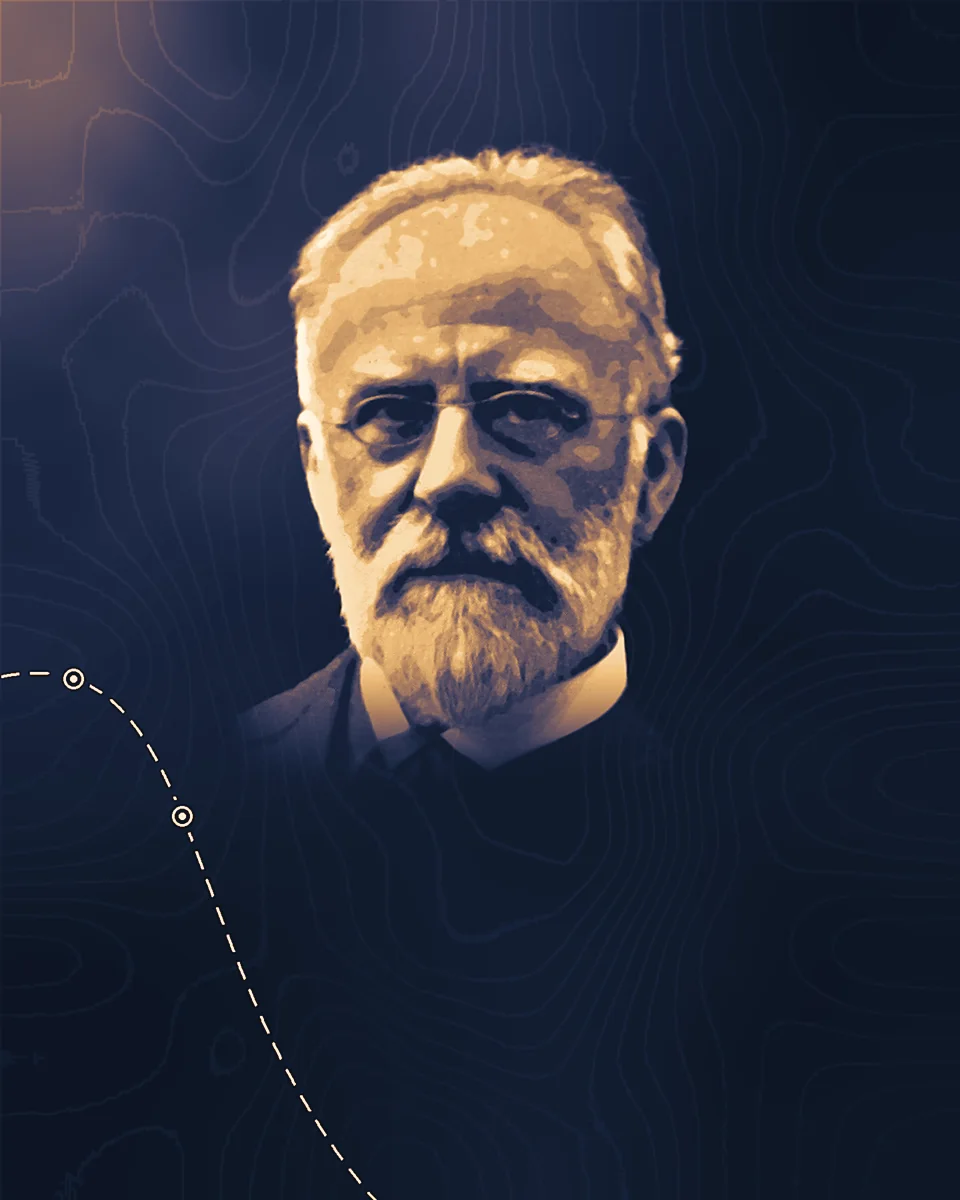
Emil Christian Hansen
He grew brewing yeast from a single cell, so that a brewery could start every batch from one known strain.
1842–1909
What they changed
1883
Wild yeast spoils beer
Louis Pasteur had shown that bacteria spoil beer. Hansen, studying a sickness in the Carlsberg brewery's beer, found that this was only part of the cause: yeast itself comes in distinct species, and stray "wild" yeasts mixed into the brewery's yeast ruined the flavour.
1883
Yeast from one cell
Hansen found a way to isolate a single yeast cell from a mass of yeast and grow a culture from it. The first brew with his pure yeast was made at Carlsberg on 12 November 1883. The Oxford Companion to Beer says this was the first time commercial beer was brewed from a pure culture.
1880s
Given away, not patented
The brewery's owner, J. C. Jacobsen, refused to patent the method and gave the strain to other breweries. With a colleague named Kühle, Hansen built an apparatus for growing pure yeast in quantity. An American obituary said every detail was "freely at the disposal of the brewing interests of the world".
1890s
Starter cultures beyond beer
From the middle of the 1880s students from many countries came to Copenhagen to learn the method. By 1909 pure cultures of wine yeasts were in use in Germany and France, and Danish and American workers had isolated the bacteria that give butter a constant flavour.
Life
Emil Christian Hansen was born on 8 May 1842 at Ribe, Denmark, and grew up poor. He became a journeyman house painter in 1860 and was turned down by the Academy of Fine Arts. He worked as a private tutor, trained as a teacher by 1869, and paid his way by writing novels.
He came to science late. In 1871 he became assistant to the zoologist Japetus Steenstrup, and in 1876 Copenhagen University gave him a gold medal for an essay on fungi that grow on dung. On 1 July 1878 he joined the Carlsberg Laboratory, which the brewer J. C. Jacobsen had founded in 1875, and in 1879 he became head of its physiology department and published a thesis on the organisms in beer and wort.
His method rested on the single cell. An obituary in the Scientific American Supplement, written by J. Christian Bay, said that pure yeast in Hansen's sense meant one species of yeast free from wild forms, and not only yeast free from bacteria. The strain chosen at Carlsberg, called Unterhefe No. 1 and later named Saccharomyces carlsbergensis, has been used there since 1883, and its genome was published in 2014.
Bay wrote that the value of the discoveries ran to hundreds of millions, and that Hansen lived and died on a modest professor's salary while the director of the brewery enjoyed a princely income. He worked beside the chemist Johan Kjeldahl, who led the laboratory's other department. He was elected to the Royal Danish Academy of Sciences in 1890 and received honorary doctorates from Uppsala, Vienna and Geneva.
He died on 27 August 1909.
Read more
4 accounts
Practical Studies in Fermentation, Emil Chr. Hansen, translated by Alexander K. Miller, 1896.
His own account in English of pure yeast and how to use it in a brewery.
archive.org
Emil Christian Hansen, 1842–1909, J.
Christian Bay, Scientific American Supplement, 23 October 1909. An obituary by a botanist who knew the work, on what the method was and where it spread.
archive.org
Hansen, Emil Christian, E. Snorrason, Dictionary of Scientific Biography, undated. The scholarly life, with the dates of his early years.
encyclopedia.com
Genome Sequence of Saccharomyces carlsbergensis, the World's First Pure Culture Lager Yeast, Andrea Walther, Ana Hesselbart and Jürgen Wendland, G3, 2014.
What Hansen's strain turned out to be, read from its DNA.
pmc.ncbi.nlm.nih.gov