Industries / Figureheads
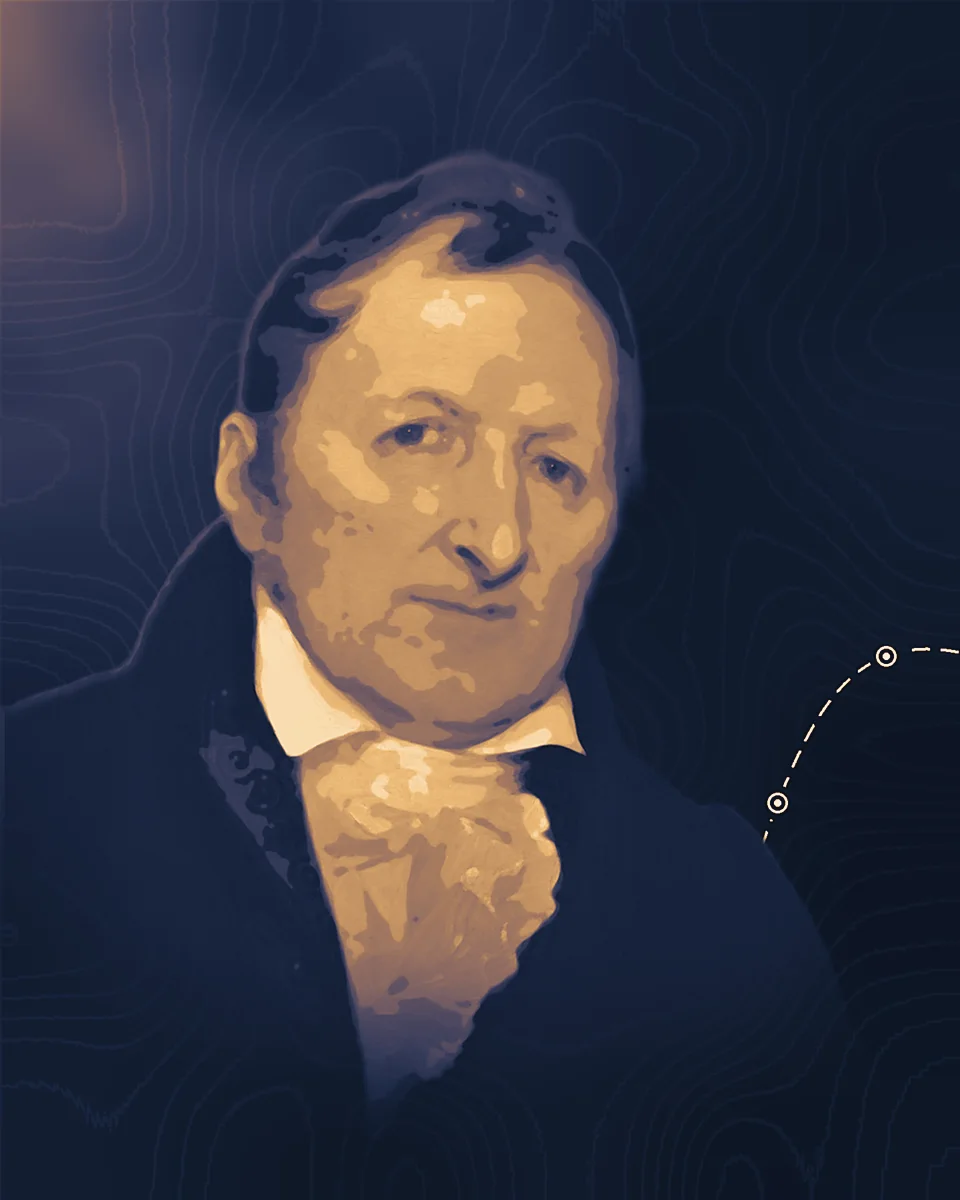
Eli Whitney
He patented a cotton gin that made short-fibered upland cotton pay, which fed the world's mills and spread slavery across the American South.
1765–1825
What they changed
1793
A gin for upland cotton
Roller gins had long cleaned long-fibered cotton, but the short upland kind that grew inland clung to its seeds. In a workshop on Catharine Greene's plantation near Savannah, Georgia, Whitney built a hand-cranked machine in about six months: a turning cylinder set with wire teeth pulled the fiber through slots too narrow for the seeds. The New Georgia Encyclopedia says it could clean up to fifty pounds of cotton a day.
1794
A patent widely copied
Whitney's US patent for the gin was signed on 14 March 1794. Planters and mechanics built copies and called them new inventions, and a loophole in the patent law of 1793 blocked his suits until the law was changed in 1800. The New Georgia Encyclopedia counts as many as sixty suits pending at once, few of them won.
1798
Muskets on contract
With the gin business failing, Whitney agreed to make 10,000 muskets for the federal government in a little over two years, though he had never made a gun. He delivered the last of them in January 1809, almost nine years late, by the US National Park Service's account. His factory near New Haven, Connecticut, made him rich.
1800s
Cotton and slavery grow together
The US National Archives says raw cotton output doubled each decade after 1800, and that by 1850 the United States grew three-quarters of the world's cotton. The gin removed the work of seeding. It did not reduce the work of planting and picking, which enslaved people did, and the number of slave states rose from six in 1790 to fifteen in 1860.
Life
Eli Whitney was born on 8 December 1765 in Westborough, Massachusetts, the son of a farmer. He entered Yale College in 1789 and graduated in 1792. A tutoring post in South Carolina fell through, and he accepted an invitation to Mulberry Grove, the plantation near Savannah of Catharine Greene, widow of Nathanael Greene, a general in the War of Independence. Her plantation manager, Phineas Miller, became his business partner and later married her.
Who invented the gin is disputed. The US National Archives says Whitney's idea "was based on earlier gins and also on ideas from other people, including Greene and enslaved laborers; some say that these were the rightful inventors of the cotton gin." The New Georgia Encyclopedia says the most widely repeated rival claim credits Greene, and that most evidence still points to Whitney as sole inventor. Greene and Miller paid for the work and for the lawsuits. The historian Angela Lakwete's 2003 book sets the gin in a longer history of roller gins from India and China, as summarized by John Lienhard of the University of Houston. Whitney's wire spikes worked loose and his gin had to be stopped to clear the seed. In 1796 Hodgen Holmes patented a gin with toothed saw blades that ran without stopping, and engineers of the US Department of Agriculture wrote in 2020 that the Holmes saw gin still dominates the ginning of upland cotton.
archives.govcotton.orggeorgiaencyclopedia.orgengines.egr.uh.edu
The gin's largest effect was on people who had no say in it. The National Archives calls the growth of slavery its "most significant effect." Cotton became the South's main cash crop. Planters imported about 80,000 Africans between 1790 and the federal ban on the slave trade in 1808, and by 1860 about one in three Southerners was enslaved. Whitney himself made little from the gin.
His second career was in guns. Late in life he claimed to have developed interchangeable parts, meaning parts made so alike that any one fits any gun, at his musket factory, and his first biographer, Denison Olmsted, repeated the claim. In 1960 the historian Robert Woodbury examined the evidence and found that the idea came from Europe and that Whitney's factory did not achieve it. The Linda Hall Library's account says John H. Hall at the Harpers Ferry armory has the better claim, and calls the Whitney story "a myth, unsubstantiated by any evidence whatsoever." The National Park Service puts it more mildly: Whitney tested the method and did not originate it.
Whitney died in New Haven on 8 January 1825 and is buried in the Grove Street Cemetery there.
Read more
5 accounts
Memoir of Eli Whitney, Esq., Denison Olmsted, 1846.
The first biography, by a Yale professor; the source of much of the legend.
archive.org
Inventing the Cotton Gin: Machine and Myth in Antebellum America, Angela Lakwete, Johns Hopkins University Press, 2003.
The history of gins before, around and after Whitney.
press.jhu.edu
The Legend of Eli Whitney and Interchangeable Parts, Robert S. Woodbury, Technology and Culture, 1960.
The paper that took the interchangeable-parts claim apart.
jstor.org
Eli Whitney's Patent for the Cotton Gin, US National Archives, read in 2026.
A teaching page with the patent drawing, the petition to renew it and the gin's effect on slavery.
archives.gov
Eli Whitney in Georgia, Edward A. Hatfield, New Georgia Encyclopedia, 2007.
The Mulberry Grove months and the lawsuits, from the state's own reference work.
georgiaencyclopedia.org