Industries / Figureheads
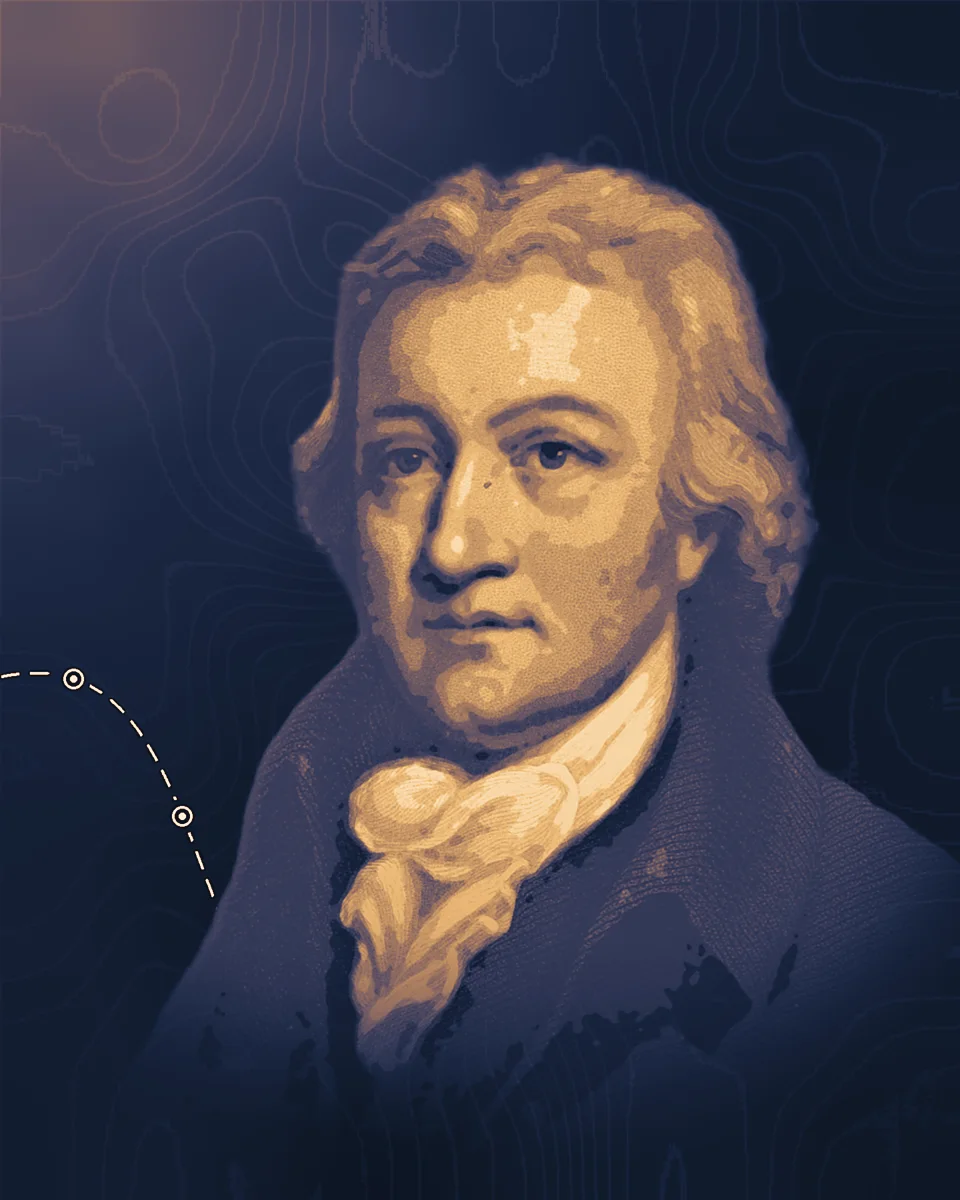
Edmund Cartwright
A country clergyman who had never seen a loom at work, he built the power loom from which the looms of the weaving mill descend, and a machine to comb wool, work done until then only by hand.
1743–1823
What they changed
1785
A loom driven by power
Cartwright patented a loom worked by machinery on 4 April 1785. He had built it before he had seen anyone weave, and it took two strong men to turn. He then studied the hand loom, had workmen in Manchester criticise a model, and patented improved looms in 1786 and 1787 in which mechanism did the work of the weaver's hands and feet.
1787
A weaving mill at Doncaster
No manufacturer would take the loom up, so he set up his own factory at Doncaster to weave and spin, and later put in a steam engine. The Dictionary of National Biography calls the loom worked there "the parent of that now in use" and says, after the weaving historian Alfred Barlow, that it was not the earliest power loom but the first to weave wide cloth such as calico for practical purposes.
1789
Wool combed by machine
Combing straightens wool fibers before they are spun, and it was done only by hand. Cartwright patented a combing machine in 1789 and improved it in three more patents by 1792. One machine did the work of twenty hand combers. Some fifty thousand combers petitioned Parliament against it, without result.
1791
Four hundred looms burned
A Manchester firm contracted to use four hundred of his looms and built a mill where some ran by steam, at a saving put at half the wages of hand weavers. The mill burned to the ground, probably set alight by workmen who feared for their jobs, and the Dictionary of National Biography says this kept other manufacturers from repeating the trial.
1809
Parliament votes him £10,000
By about 1806 the loom, improved by others, was making money for Lancashire manufacturers, and his patent had run out in 1804. Some fifty Manchester firms asked the government to reward him, and on 10 June 1809 the House of Commons voted him £10,000.
Life
Edmund Cartwright was born on 24 April 1743 at Marnham in Nottinghamshire, the fourth son of a family long settled there. He went to University College, Oxford, at fourteen, became a fellow of Magdalen College in 1764, and took holy orders. He was known first as a poet: his ballad Armine and Elvira of 1772 ran through several editions. In 1779 he became rector of Goadby Marwood in Leicestershire, where he tried out new methods of farming on the church land.
He told the story of the loom himself. In the summer of 1784 he was at Matlock, near Arkwright's mills, in company with some Manchester men. One said that once Arkwright's patent ran out, so much cotton would be spun that hands could never be found to weave it. Cartwright answered that Arkwright must then invent a weaving mill. The others said it could not be done. He replied that a machine had lately been shown in London that played chess, and that weaving could hardly be harder. He admitted he had "never at that time seen a person weave."
The machines cost him his fortune. By 1793 he had spent some £30,000, was deep in debt, and gave up the Doncaster works and his patent rights to his creditors and his brothers. Workers opposed both inventions: the Manchester mill was burned, and the wool combers petitioned against the combing machine. Parliament extended the combing patent for fourteen years in 1801, and he still ended a loser by it.
How much of the working power loom is his is a fair question. The Dictionary of National Biography heads its entry "the reputed inventor of the power-loom," says his was not the earliest, and says the loom came into favour only "with improvements effected in it" after he had left the trade. What the record gives him is the first power loom that wove broad cloth in a working mill, and the patents later builders started from.
He kept inventing: interlocking bricks, an engine meant to run on alcohol in place of water, a reaping machine. From 1800 to 1807 he managed an experimental farm at Woburn for the Dukes of Bedford. With Parliament's grant he bought a small farm in Kent. He died at Hastings on 30 October 1823 and was buried at Battle.
Read more
4 accounts
A Memoir of the Life, Writings, and Mechanical Inventions of Edmund Cartwright, 1843.
The family's life of him, published without the author's name and attributed to his daughter Mary Strickland; it has drawings of the loom and the combing machine.
archive.org
History of the Cotton Manufacture in Great Britain, Edward Baines, 1835.
Pages 229 and 230 print Cartwright's own account of how he came to build the loom.
archive.org
The History and Principles of Weaving by Hand and by Power, Alfred Barlow, 1878.
The technical history the Dictionary of National Biography relies on for where Cartwright's loom stands among early power looms.
archive.org
Cartwright, Edmund, Dictionary of National Biography, volume 9, 1887.
A careful short life by Francis Espinasse, with the patents and their dates.
en.wikisource.org