Industries / Figureheads
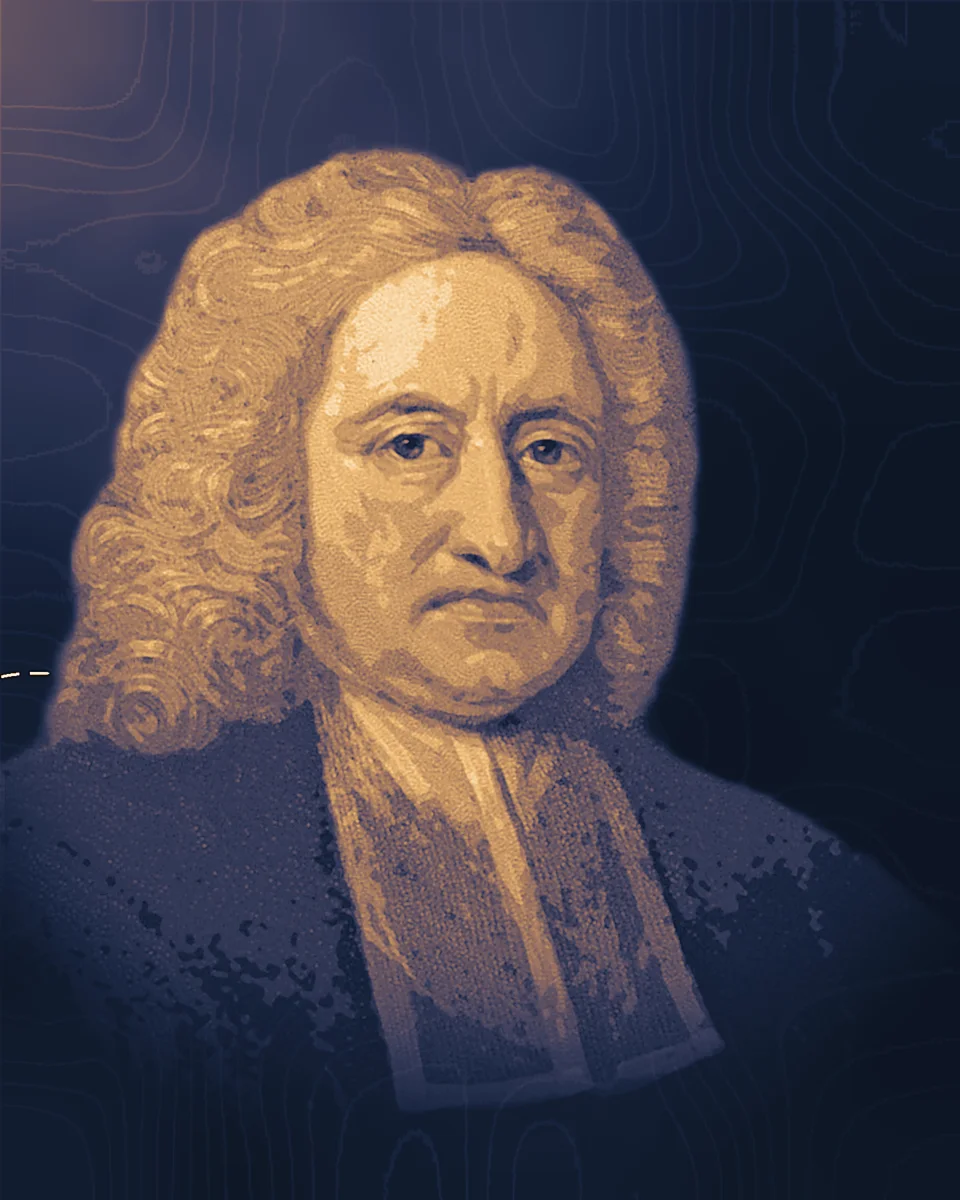
Edmond Halley
He turned five years of one city's birth and burial records into a table of survivors by age, and showed how life insurance and annuities could be priced from it.
1656–1742
What they changed
1693
Survivors counted by age
Halley took the records of Breslau, now Wrocław in Poland, for 1687 to 1691: 6,193 births and 5,869 burials, with the age of everyone who died. From them he built a table of how many people of each age were alive, starting from 1,000 at age one, and put the city at 34,000 people. He chose Breslau because few people moved in or out, while the bills of mortality of London and Dublin lacked ages and were swollen by incomers.
1693
Life cover priced by age
He wrote that by his table "the Price of Insurance upon Lives ought to be regulated", and gave the odds as an example: 100 to 1 that a man of 20 lives out the year, and 38 to 1 for a man of 50. The table also gave the chance that a person of any age would live to any later age.
1693
Annuities valued from deaths
An annuity is a payment made each year for as long as a person lives. Halley wrote that its value had "hitherto" been set "only by an imaginary Valuation", and computed values at 6% interest for every fifth age. They showed that the government fund then selling annuities at 7 years' purchase, about 14% a year, was charging too little for young lives, which were worth more than 13 years' purchase.
1693
Two and three lives
He gave rules for annuities and payments that depend on two or three lives at once, such as a sum paid to a younger person when an older one dies, "as in the case of providing for Clergy-mens Widows".
1756
The rule behind an office
When James Dodson set out to found the life office that became the Equitable Society, his associates later stated that he built on "the principle laid down by the late Dr. Halley" that "the price of insurance on lives ought to be regulated by the age". The St Andrews MacTutor archive calls Halley's tables "highly influential in the future production of actuarial tables in life insurance".
Life
Edmond Halley was born on 8 November 1656 at Haggerston, near London, the son of a wealthy soap-maker. He went to St Paul's School and in 1673 to Queen's College, Oxford. He left Oxford in 1676 without a degree to spend eighteen months on the island of St Helena, where he catalogued 341 stars of the southern sky. The Royal Society elected him a fellow in November 1678, at 22.
He saw Isaac Newton's Principia into print. He urged Newton to write it, corrected the proofs and paid for the printing himself, because the Royal Society had no money. From 1685 to 1693 he edited the Society's journal, the Philosophical Transactions, where his life table appeared.
The numbers were not his. Caspar Neumann, a deacon of a Breslau church, went through the city's records from 1687 and sent his observations to the philosopher Gottfried Leibniz, who told Henri Justel, the Royal Society's secretary. Neumann then sent the figures for 1687 to 1691, and the Society asked Halley to analyse them. The method had forerunners too: John Graunt had built a rough table from the London bills in 1662, which Halley's paper names, and the Dutch statesman Johan de Witt had valued life annuities in 1671. Halley's table has small inconsistencies: it starts at 1,000 at age one where his own figures give 890 survivors from 1,238 births.
His fame rests elsewhere. In 1705 he predicted that the comet seen in 1682 would return in 1758, and it did, sixteen years after his death. He became Savilian professor of geometry at Oxford in 1704 and Astronomer Royal in 1720. He feuded with the first Astronomer Royal, John Flamsteed. In 1712 he and Newton published Flamsteed's observations before they were complete, and Halley added a preface, without Flamsteed's knowledge, attacking him for secrecy. Halley died at Greenwich on 14 January 1742.
Read more
5 accounts
An Estimate of the Degrees of the Mortality of Mankind, Edmond Halley, Philosophical Transactions of the Royal Society, 1693.
The paper itself, with the table, the odds and the annuity values, in a text transcription.
jimclifford.ca
Edmond Halley: astronomer and actuary, Geoffrey Heywood, Journal of the Institute of Actuaries, 1985.
An actuary's account of Halley's work on mortality and annuities.
cambridge.org
Edmond Halley: Charting the Heavens and the Seas, Alan Cook, Clarendon Press, Oxford, 1998.
A full modern biography.
archive.org
Edmond Halley, J. J. O'Connor and E. F. Robertson, MacTutor History of Mathematics, University of St Andrews, 2000.
A biography that sets the life table beside his astronomy, with a full list of sources.
mathshistory.st-andrews.ac.uk
Edmund Halley and the Breslau table, Richard Pulskamp, Royal Holloway, University of London, undated. A historian of probability's notes on where the figures came from and where the table goes wrong.
gtfp.cs.rhul.ac.uk