Industries / Figureheads
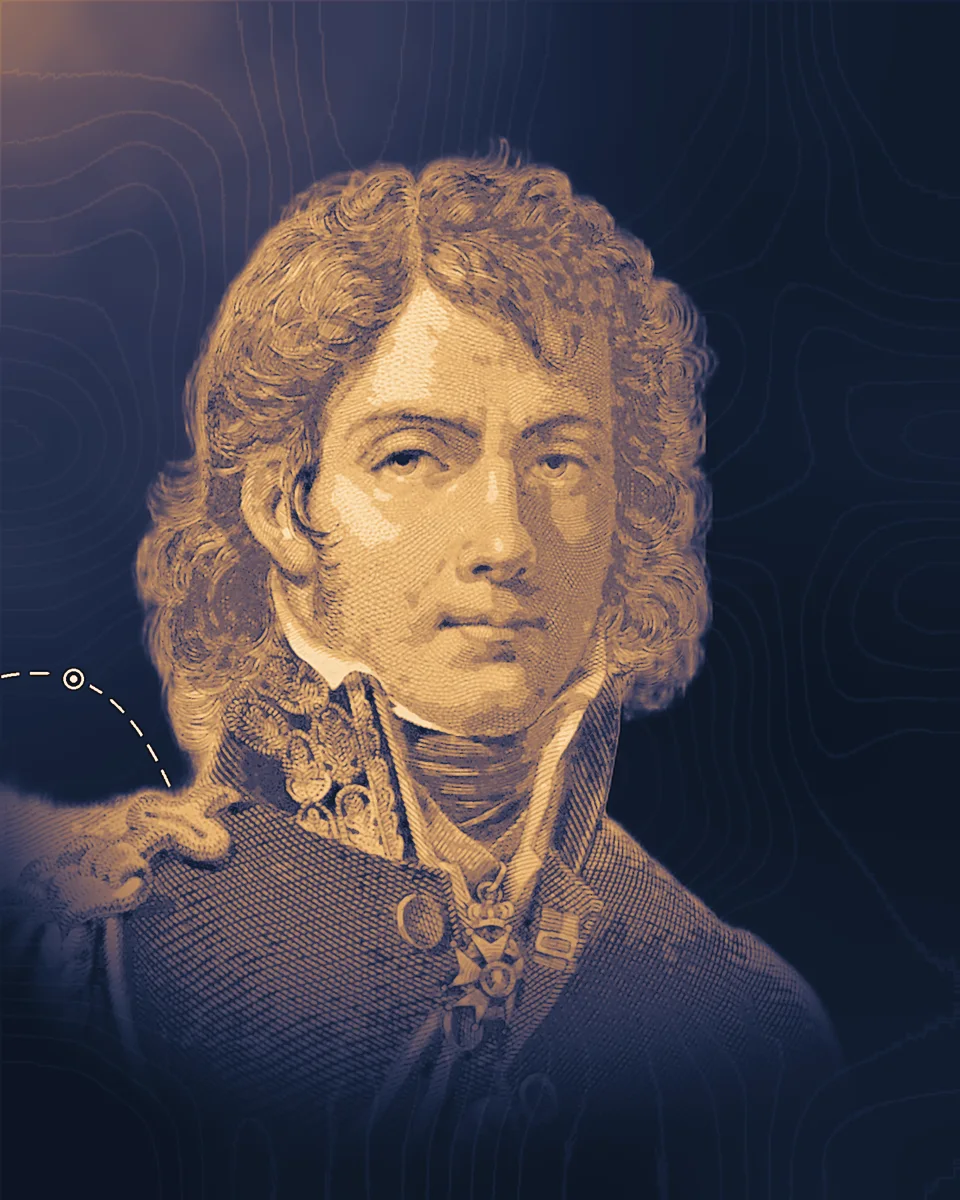
Dominique-Jean Larrey
A French army surgeon, he sent light sprung carriages onto the battlefield to bring the wounded in during the fighting and had them treated in order of how badly they were hurt, not by rank.
1766–1842
What they changed
1792
Flying ambulances
A royal ordinance of 1788 kept the army's medical service a league, about 4 km, from a battle until the fighting was over. In late 1792, on the Rhine, Larrey saw the French wounded at Limbourg fall into enemy hands because the ambulances were too far back. He proposed an ambulance that would follow the advance guard as the horse-drawn "flying artillery" did, and built a light sprung carriage to carry the wounded fast and smoothly. By his own account it was in action by January 1793. The war minister, Pache, had opened a contest for mobile ambulances in November 1792.
archive.orge-memoire.academie-chirurgie.fre-memoire.academie-chirurgie.fr
1797
Ambulances made permanent
In the Italian campaign of 1797, on Bonaparte's order, Larrey completed the organization of his ambulances as a standing part of the army. A 2024 review describes the system: two-wheeled carriages for flat ground and four-wheeled ones for rough, carrying dressings, food and water, in divisions of 113 men each, with a chief surgeon and 15 other surgeons. The casualties went to a field hospital behind the lines.
archive.orgpmc.ncbi.nlm.nih.gove-memoire.academie-chirurgie.fr
1790s
The worst hurt first
Larrey ordered treatment by how severe the wound was, not by the soldier's rank or standing, and treated enemy wounded as he treated French ones. The 2024 review dates this sorting, later called triage from the French trier, "to sort", to about 1792. In Egypt he had the wounded put aboard the ships home first, which P. Vayre, of the Académie nationale de médecine, calls a practice not followed at the time.
e-memoire.academie-chirurgie.frpmc.ncbi.nlm.nih.gove-memoire.academie-chirurgie.fr
1812
Amputation on the day
Without anaesthesia, Larrey held that a shattered limb should come off at once, within the day, rather than after the dead tissue had settled, as most authors then advised. Vayre and J.-J. Ferrandis, curator of the army medical museum at the Val-de-Grâce, count about 300 amputations at Eylau, 300 at Wagram and 200 at La Moskova (Borodino) in 1812. His critics spoke of "pyramids of limbs" beside his ambulances, and Vayre and Ferrandis write that no statistics can settle whether the sacrifice was worth it.
Life
Dominique-Jean Larrey was born on 8 July 1766 at Beaudéan, in the Pyrenees. His father, Jean, the village shoemaker, died in 1770, and the parish priest took charge of his schooling. In 1780, aged 14, he walked to Toulouse to join his uncle Alexis Larrey, chief surgeon of the Hôpital de la Grave, and trained there. He won a post as a navy surgeon at the end of 1787 and sailed to Newfoundland in 1788, but he suffered badly from seasickness and left the navy. In Paris he worked at the Hôtel-Dieu under the surgeons Desault and Sabatier.
He joined the Army of the Rhine as a surgeon in 1792, and in 1794 married Marie Elisabeth Leroult de Laville. In Egypt from 1798 to 1801 he was the army's chief surgeon, with Desgenettes as chief physician; there his ambulances used camels with a basket on each side. Bonaparte then made him chief surgeon of the Consular Guard. In 1803 he took his doctorate with a thesis on amputation.
Under the Empire he was chief surgeon of the Imperial Guard. At Eylau Napoleon made him a commander of the Legion of Honour on the field and gave him his own sword. After Wagram in 1809, where by Vayre's count he cared for 1,200 wounded, he was made a baron. In Russia in 1812 he was chief surgeon of the Grande Armée.
e-memoire.academie-chirurgie.fre-memoire.academie-chirurgie.fr
He was not the only organizer of battlefield care. His own memoirs print an ambulance designed by Baron Percy, a surgeon 13 years his senior, while Larrey was in Egypt. On 19 November 1808, at Percy's urging, Napoleon created a battalion of ambulance soldiers, which Larrey bitterly called a copy of his own flying ambulance. Napoleon is reported to have criticized him only once, over Moscow, saying that he "did not know how to administer his part", and in 1815 Percy was preferred to him as chief surgeon. At Waterloo he was taken prisoner by the Prussians and, by the 2024 review's account, saved from being shot when a Prussian surgeon recognized him.
archive.orge-memoire.academie-chirurgie.frpmc.ncbi.nlm.nih.gov
In his will of 15 April 1821 Napoleon wrote that Larrey had left in his mind "l'image du véritable homme de bien", the image of the true good man. Larrey had shown that young conscripts accused of wounding themselves to escape service were innocent, which earned him the lasting enmity of Marshal Soult. In 1831 he became chief surgeon of the Invalides in Paris. In 1842 he inspected the army hospitals of Algeria with his son Hippolyte, fell ill with pneumonia on the way home, and died at Lyon on 25 July 1842; his wife had died in Paris the day before. Soult, then minister of war, refused him burial at the Invalides. His remains were moved there from Père Lachaise on 15 December 1992.
e-memoire.academie-chirurgie.fre-memoire.academie-chirurgie.fr
Read more
4 accounts
Memoirs of Military Surgery, and Campaigns of the French Armies, D. J. Larrey, translated by Richard Willmott Hall, Joseph Cushing, Baltimore, 1814.
His own account of the campaigns and of how the flying ambulance began.
archive.org
Dominique Larrey (1766-1842), chirurgien militaire, baron d'Empire, P. Vayre and J.-J. Ferrandis, e-mémoires de l'Académie nationale de chirurgie, 2004.
A full life in French by a member of the Académie nationale de médecine and the curator of the army medical museum at the Val-de-Grâce.
e-memoire.academie-chirurgie.fr
Dominique Larrey (1766-1842), chirurgien en chef de la Grande Armée, Claude Savornin, Académie nationale de chirurgie, 2026.
A lecture to the academy's session on Napoleon and the surgeons.
e-memoire.academie-chirurgie.fr
Dominique-Jean Larrey (1766-1842): The Founder of the Modern Triage System, Matthew D. Turner and Muhammad Hamza Shah, Cureus, 2024.
A review of his ambulances and triage drawn from the older literature.
pmc.ncbi.nlm.nih.gov