Industries / Figureheads
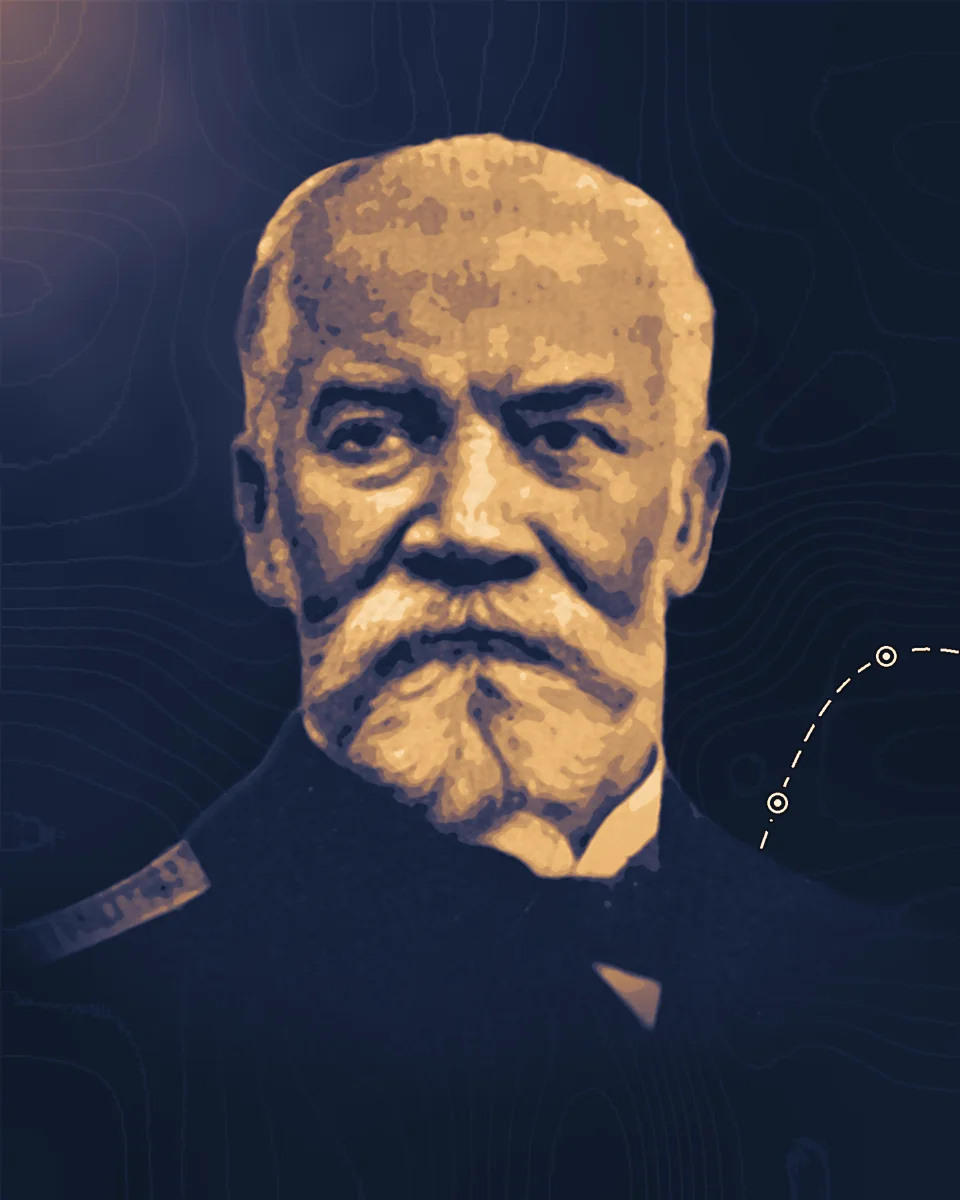
Dmitry Chernov
He showed in 1868 that steel changes its inner structure at set temperatures, so that forging and hardening could be done by rule and not by guess.
1839–1921
What they changed
1868
Critical points of steel
In April and May 1868 Chernov told the Russian Technical Society that steel has fixed temperatures at which it changes. Below the one he called point a, steel will not harden however fast it is cooled. At a higher one, point b, its grain structure changes. The two are known as the Chernov points. The Iron and Steel Institute's obituary of him says oil quenching, double heat treatment and heat refining either grew out of this work or are "the literal fulfilment of his precepts".
1872
Watching the Bessemer flame
He proposed warming iron that was low in silicon in a cupola furnace before blowing it in a Bessemer converter, and the Dictionary of Scientific Biography says he was the first to use a spectroscope, an instrument that splits light into its colours, to tell when to stop the blow. A later notice by a man who knew him says the observations damaged his eyesight.
1876
Read abroad
The 1868 paper appeared in English in the journal Engineering in July 1876 and in French in 1877. In 1886 the French metallurgist Floris Osmond measured the points exactly, using the thermoelectric pyrometer that Henry Le Chatelier had just invented, and introduced the letter a with index numbers to name them.
1878
How a steel ingot freezes
His paper "On the Structure of Cast Steel Ingots" set out how liquid steel crystallizes as it cools in the mould, and why castings come out with a hollow at the top (piping), gas holes and uneven composition (segregation). The Iron and Steel Institute's obituary says the paper "became a classic".
1889
A school of metallurgists
He took the chair of metallurgy at the Michael Artillery Academy in St Petersburg and held it until the revolution. The Dictionary of Scientific Biography calls him "the founder of an important school of metallurgists and metallurgical scientists".
Life
Dmitry Konstantinovich Chernov was born in St Petersburg on 1 November 1839, the son of a physician. He graduated from the city's Practical Technological Institute in 1858, stayed on to teach mathematics and help run its library, and attended lectures at the university. Older English and French sources spell his name Tschernoff or Tchernoff.
In 1866 he joined the Obukhov steel works, founded three years before to make guns. Steel guns were new in Russia and only Krupp in Germany made them elsewhere, in secret. Some of the Obukhov guns burst on test and others of the same chemistry held. Chernov's 1868 paper began as a review of work on gun steel by two Russians, A. S. Lavrov and N. V. Kalakutsky, to which he added his own findings on forging temperature. The Iron and Steel Institute's obituary says his audience "did not agree with many of the statements it contained".
What the points meant was settled later, by Osmond's measurements in 1886 and by X-ray study at the start of the 1920s. Osmond wrote, by the obituary's account, that the whole later development of the subject lay in Chernov's paper, and the American metallurgist Henry Marion Howe dedicated his book on iron and steel to him. Chernov worked from the forge and the foundry. Henry Clifton Sorby in Sheffield had begun looking at steel under the microscope five years before him, and the two lines of work met in the 1880s.
He left Obukhov in 1880 and spent four years in the Donets Basin in the south, where he found and opened rock-salt mines that made him rich. He came back to St Petersburg in 1884, held government posts, and from 1889 taught at the Artillery Academy. He lectured on the erosion of gun barrels and on the lines that appear on steel strained cold, which bear his name beside that of Lüders. The Iron and Steel Institute made him an honorary vice-president in 1915, and the American Institute of Mining Engineers an honorary member in 1902.
In September 1917 he was on holiday at Yalta in the Crimea with his wife and a daughter when the revolution cut them off from Petrograd. A. I. Krynitzky, who knew him, wrote that he went hungry and without warm clothes or books, and still lectured on steel and worked at mathematics. He died at Yalta on 2 January 1921. Krynitzky also records that he built violins to a theory of his own about the grain of the wood, and photographed frost on his conservatory windows to show his students how crystals grow.
Read more
3 accounts
Obituary of Professor D. K. Tschernoff, from notes by N. T. Belaiew, Journal of the Iron and Steel Institute, 1921.
The fullest account in English of the 1868 and 1878 papers and what followed from them.
gracesguide.co.uk
D. K. Tschernoff, A. I. Krynitzky, Transactions of the American Institute of Mining and Metallurgical Engineers, 1922.
A memoir of the man by someone who knew his house and habits, with the portrait used here.
archive.org
Chernov, Dmitri Konstantinovich, A. S. Fedorov, Dictionary of Scientific Biography. A historian's entry on the critical points, the ingot work and the Bessemer process, with a list of his papers and their translations.
encyclopedia.com