Industries / Figureheads
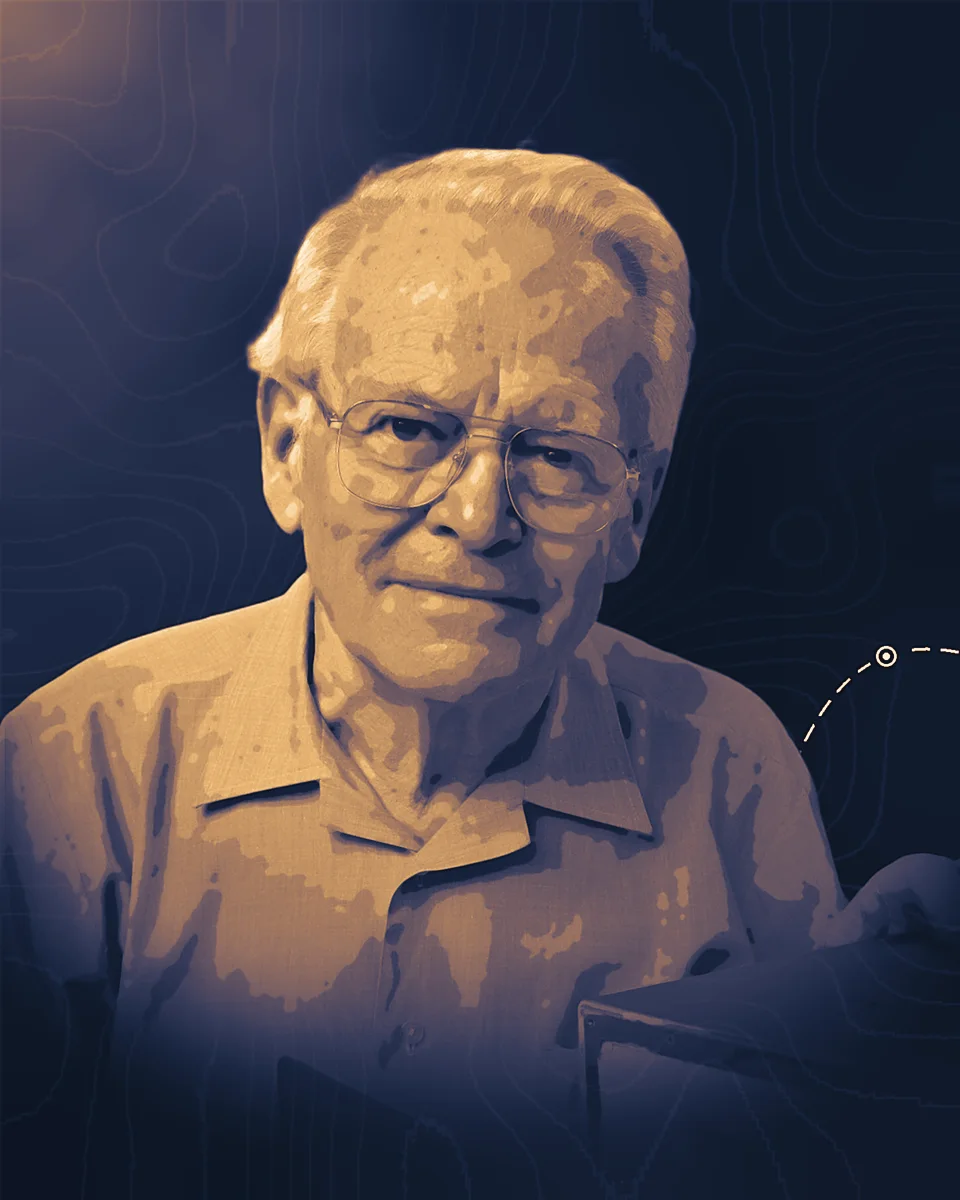
David Warren
He proposed and built a crash-proof recorder of cockpit voices and instrument readings, the forerunner of the black boxes every airliner now carries.
1925–2010
What they changed
1954
A recorder for crash investigators
While serving on a panel looking into the unexplained crashes of the de Havilland Comet, the first jet airliner, Warren saw the Minifon, a German pocket wire recorder, at a trade fair. In April 1954 he wrote a four-page note, "A Device for Assisting Investigation into Aircraft Accidents," proposing a recorder of the crew's voices that would survive a crash. By Warren's own later account, his boss showed no interest and told him to pass the idea to the instruments group and "get on with blowing up fuel tanks."
1958
A working prototype
The Aeronautical Research Laboratories (ARL) in Melbourne paid the instrument maker Tych Mirfield to build Warren's ARL Flight Memory Unit. It kept the last four hours of pilot voice and eight instrument readings on fine steel wire, erasing older recording as it went, so the wire never needed changing. Wire was chosen because it was small and stood much more heat than tape.
1958
Britain takes it up
Robert Hardingham, secretary of the UK Air Registration Board, saw the prototype on an informal visit to ARL and arranged for Warren to demonstrate it in England. The BBC showed it on the evening news, British makers and operators offered support, and the British authorities began moving toward making recorders compulsory.
1960
Australia makes recorders compulsory
After a Trans Australia Airlines Fokker Friendship crashed at Mackay, Queensland, in June 1960 for reasons no one could find, the judge inquiring into it was told about the ARL recorder and ordered recorders for pilot speech in Australian airliners from January 1963. Australia's Defence Science and Technology Group says this made Australia the first country to require cockpit voice recording, and IEEE Spectrum says the first to require both voice and flight data recording.
dst.defence.gov.auspectrum.ieee.orgkenblackbox.comcollections.museumsvictoria.com.au
1962
Voice and data together
A second version, designed with the electronics specialists Ken Fraser, Lane Sear and Walter Boswell, recorded voice and eight channels of flight data together in a fireproof case. It was flown in a Department of Civil Aviation Fokker Friendship from Essendon, Melbourne, in March 1962. The British firm S. Davall & Sons then made the "Red Egg" recorder, which Fraser says was based on the ARL system and was in production from 1968 to 1978.
Life
David Ronald de Mey Warren was born on 20 March 1925 at a Church of England mission on Groote Eylandt, in Australia's Northern Territory. His father, the missionary Hubert Warren, died in 1934 when the Holyman Airways airliner Miss Hobart disappeared over Bass Strait. Warren went to school in Launceston and Sydney, took an honours degree in science at the University of Sydney, and taught at Geelong Grammar School before taking a doctorate in fuels and energy at Imperial College London.
He joined the Commonwealth's Aeronautical Research Laboratories at Fishermans Bend, Melbourne, in 1952 and worked there as a principal research scientist until 1981, by Museums Victoria's account; an Australian Aviation obituary gives 1983. He was a combustion and fuels chemist, and his part in the Comet inquiry was to judge whether a fuel fire or explosion could explain the crashes.
collections.museumsvictoria.com.auaustralianaviation.com.aukenblackbox.com
The idea met resistance for years. Australia's civil aviation authorities wrote that "Dr Warren's instrument has little immediate direct use in civil aircraft." The Royal Australian Air Force said "the recorder would yield more expletives than explanations," and the Federation of Air Pilots called it "a spy flying alongside." Warren's new head of department from 1955, Tom Keeble, backed the work.
The black box was not one person's invention, and Warren was not the only one with the idea. The historian Allison Marsh, writing in IEEE Spectrum, lists earlier and parallel recorders: François Hussenot and Paul Beaudouin's photographic-film data recorder in France in 1939, Viejo Hietala's in Finland in 1942, and the University of Minnesota professor James Ryan's VGA Flight Recorder, patented in 1960. The US Air Force had also recorded crew conversations on magnetic wire aboard a B-17 bomber over occupied France. Marsh concludes that "first" is hard to prove, while agreeing that Warren invented the black box. The second version was built with Fraser, Sear and Boswell, whom the Royal Aeronautical Society's award of 2001 also named. The ARL system was never patented, and Warren received no money for it.
spectrum.ieee.orgdst.defence.gov.aukenblackbox.comimperial.ac.uk
After ARL he advised the Victorian government on energy resources in 1982 and 1983. He was made an Officer of the Order of Australia in 2002 for service to the aviation industry, and Qantas named an Airbus A380 after him in 2008. He died in Melbourne on 19 July 2010, survived by his wife Ruth and their four children.
Read more
5 accounts
A Device for Assisting Investigation into Aircraft Accidents, David Warren, Aeronautical Research Laboratories, 1954.
His own four-page memorandum, Mechanical Engineering Technical Memorandum 142, that first set out the idea.
kenblackbox.com
The inventor of the black box was told to drop the idea and get on with blowing up fuel tanks, Allison Marsh, IEEE Spectrum, 2021.
A historian's account of the work, the resistance to it and the other people with a claim to the invention.
spectrum.ieee.org
Australian Black Box invention, Ken Fraser, revised 2023.
The account of the engineer who designed the 1962 version's electronics, with the laboratory's reports and photographs.
kenblackbox.com
Dr David Warren, AO, Research Scientist and Inventor, David Crotty and Matthew Churchward, Museums Victoria, 2010.
A short life by the museum that holds his 1958 prototype.
collections.museumsvictoria.com.au
Obituary: Dr David Ronald De Mey Warren, Imperial College London, 2010.
His doctoral college's obituary, with his own words on how the idea came to him.
imperial.ac.uk