Industries / Figureheads
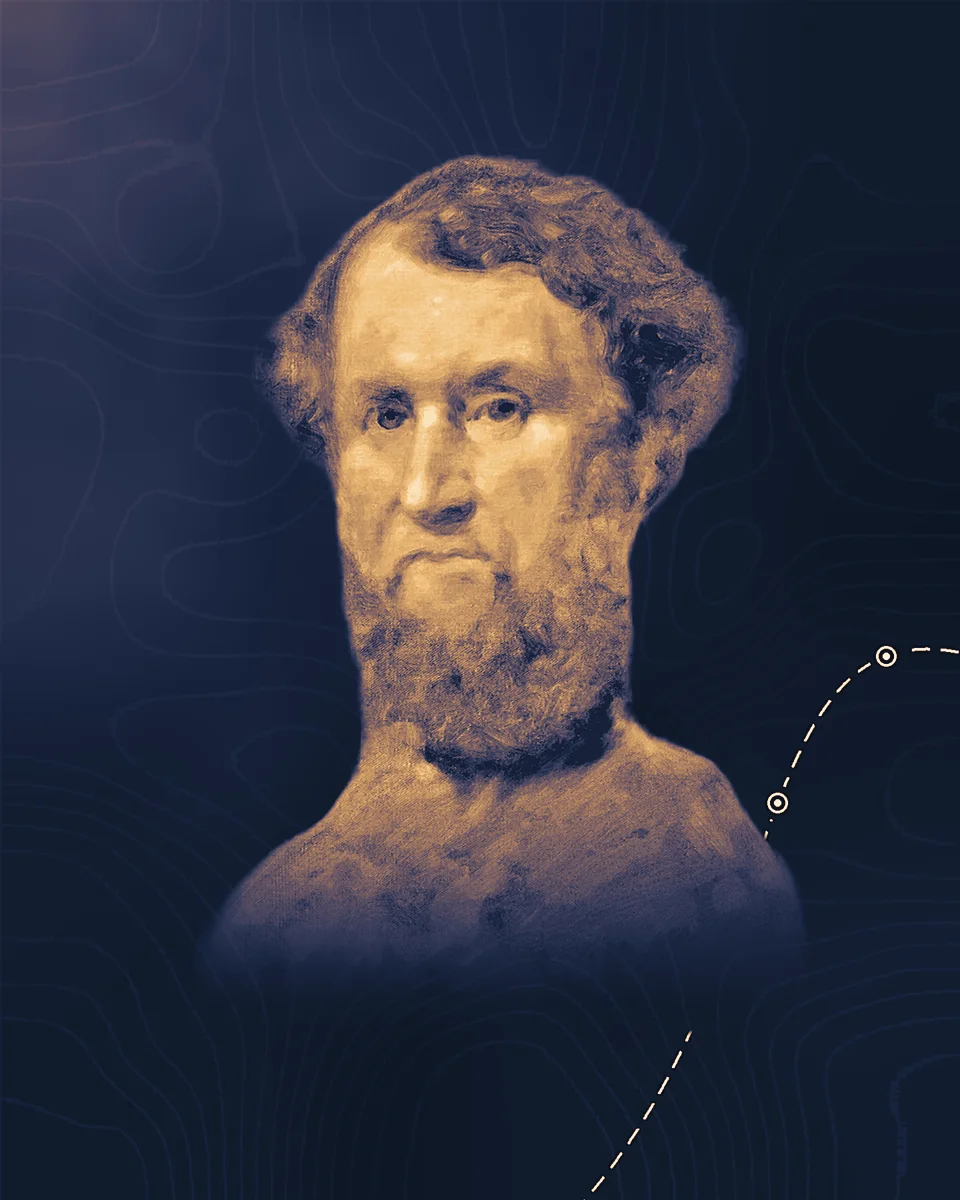
Cyrus McCormick
He built a horse-drawn reaper and the factory and sales system that put it on farms.
1809–1884
What they changed
1831
A machine cuts standing grain
In July 1831 McCormick, aged 22, showed a horse-drawn reaper in a field near Steele's Tavern, Virginia. The National Inventors Hall of Fame says it had "all the essential components of later commercial machines".
1834
The reaper is patented
He was issued a 14-year US patent on 21 June 1834. Obed Hussey had patented a different reaper on 31 December 1833, and the two men competed for the next two decades.
1847
A factory in Chicago
He moved production from licensed shops to his own factory on the north bank of the Chicago River, at the transport center of the farming West. The next year 700 reapers were built and sold there.
1851
Top award in London
The reaper won a Council Medal, the highest award at the Great Exhibition in London, and McCormick used the result to sell machines in other countries.
Life
Cyrus Hall McCormick was born on 15 February 1809 at Walnut Grove, the family farm in Rockbridge County, Virginia. His father, Robert, patented several farm implements and worked for years on a reaper without getting one to work. The farm ran on slave labor: by the historian William T. Hutchinson's count, Robert McCormick held about 1,200 acres and nine enslaved people in 1830.
The 1831 reaper was built on that farm, and Cyrus did not build it alone. Jo Anderson, a man the McCormicks held in slavery, worked on it with him and raked the cut grain off the platform at the first public trial. McCormick's grandson wrote in 1931 that Anderson "deserves honor as the man who worked beside him in the building of the reaper". The 1834 patent was issued to McCormick alone. After emancipation McCormick gave Anderson $800 to buy a cabin and a lot at Greenville, Virginia.
The credit was disputed in his lifetime and after it. Hussey's patent came six months before McCormick's, and in 1848 Hussey and a group of rival makers opposed the renewal of McCormick's 1834 patent. On 29 March 1848 the Patent Office's extension board refused the renewal by two votes to one, although the Commissioner of Patents had reported in McCormick's favor. The 14-year patent ran out that June. In 1885, the year after McCormick died, his brother Leander published a memorial claiming that their father was the true inventor. Hutchinson went through those statements and judged them "valueless" against the records that date from 1831.
The machine sold slowly at first: seven in 1842, 29 in 1843 and 50 in 1844. After the 1844 harvest McCormick rode west to look at the prairies, and in 1847 he moved to Chicago. The National Inventors Hall of Fame credits his sales to door-to-door canvassing and written guarantees.
The Chicago fire of 1871 destroyed the factory, and he rebuilt it on a new site. He died in 1884. In 1902 his son merged the firm with four competitors to form the International Harvester Company.
Read more
4 accounts
Cyrus Hall McCormick: Seed-Time, 1809–1856, William T.
Hutchinson, 1930. The first volume of the standard biography, with a full chapter on who invented the reaper and another on the 1848 patent fight.
archive.org
Cyrus Hall McCormick: Harvest, 1856–1884, William T.
Hutchinson, 1935. The second volume: the Chicago factory, his politics, his giving and his last years.
archive.org
Obed Hussey, Who, of All Inventors, Made Bread Cheap, edited by Follett L. Greeno, 1912.
The case for Hussey, in letters and testimony collected by his supporters.
archive.org
The Century of the Reaper, Cyrus McCormick III, 1931.
The family's own account, by his grandson, with its acknowledgment of Jo Anderson.
archive.org