Industries / Figureheads
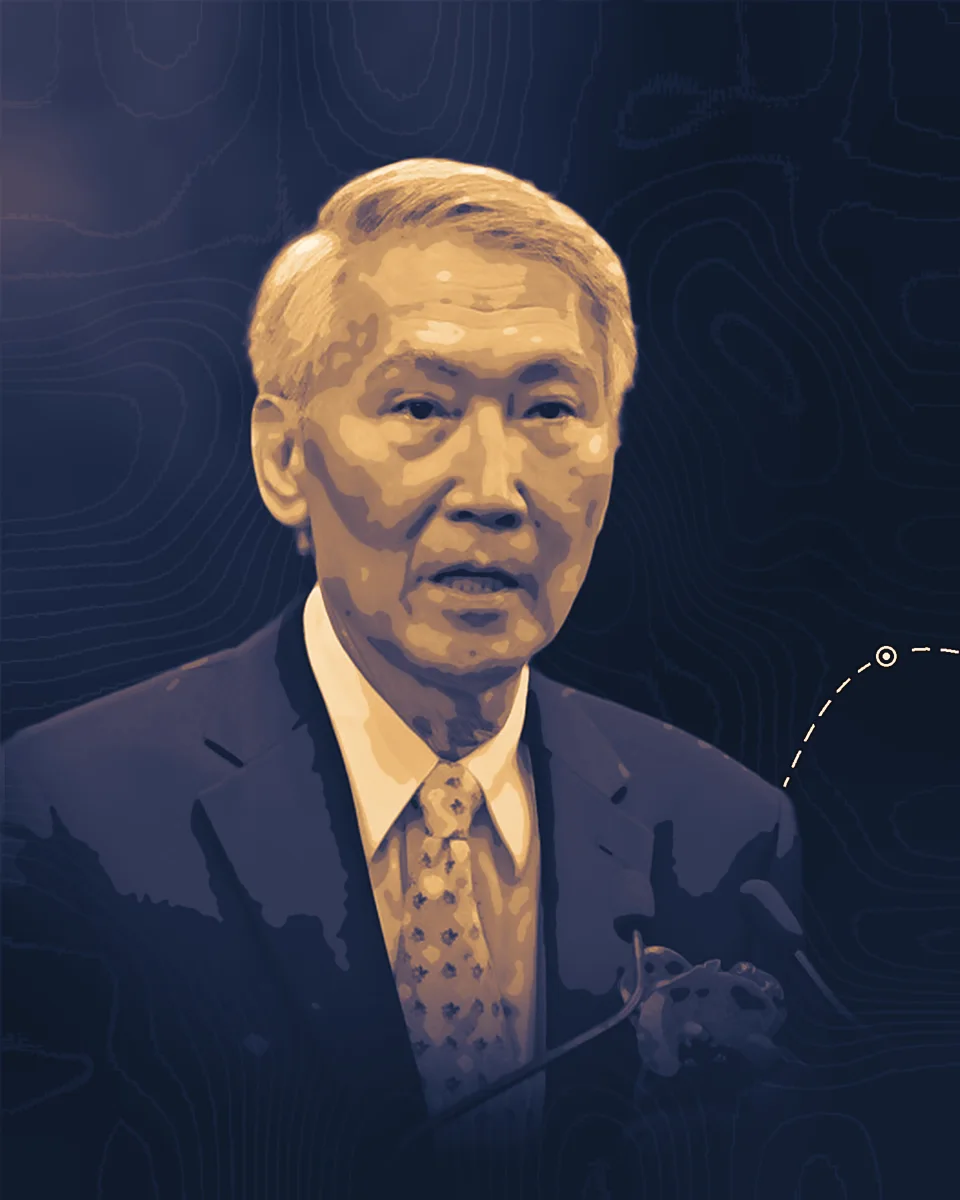
Chenming Hu
He led the Berkeley team that built the FinFET, the fin-shaped transistor in today's advanced chips, and the transistor models that chip designers simulate with.
born 1947
What they changed
1980s
Chips that wear out predictably
Small transistors were found to drift with long use in ways that short tests missed. With his students Hu worked out a theory that predicts the damage done by fast-moving electrons, called hot carriers, and then models of how the thin oxide layer in a transistor breaks down. The IEEE says these models made highly reliable chips possible.
1995
A standard transistor model
A circuit simulator needs equations that say how each transistor behaves. Hu's group at Berkeley wrote such a set, called BSIM, and gave it away. It became the industry's standard, and a coalition of chip companies and simulator vendors still steers its updates. The US National Medal of Technology and Innovation citation calls it "the first industry-standard model for circuit design".
1999
The FinFET built
Engineers expected flat transistors to leak too much current to be useful below about 100 nanometres. With money from DARPA, the US defense research agency, Hu and his Berkeley colleagues Tsu-Jae King Liu and Jeffrey Bokor proposed raising the channel, the path the current takes, into a thin upright fin with the gate wrapped over it. A graduate student, Xuejue Huang, made the working device, and the team published it in December 1999.
2011
Fins reach the factory
Intel was the first to put FinFETs into production, in 2011, and TSMC and Samsung followed. IEEE Spectrum wrote in 2020 that FinFETs "currently dominate the processor industry". The second design in the same 1990s proposal, a thin layer of silicon on an insulator, is also in production.
2020
IEEE Medal of Honor
The Institute of Electrical and Electronics Engineers gave Hu its highest award "for a distinguished career of developing and putting into practice semiconductor models, particularly 3-D device structures, that have helped keep Moore's Law going over many decades".
Life
Chenming Hu was born in Beijing in 1947, and his family moved to Taiwan when he was a child. He graduated in electrical engineering from National Taiwan University in 1968 and went to the University of California, Berkeley, where he took a master's degree in 1970 and a doctorate in 1973. His thesis was on optical circuits, and he went on with that work at the Massachusetts Institute of Technology.
He returned to Berkeley as a professor in 1976, meaning to work on energy, and his early research there included a petrol-electric hybrid car. The high-voltage devices such cars need took him back to semiconductors. In 1982 he spent a sabbatical at National Semiconductor in Santa Clara. He said that once he saw industry at work, "I found that's where the interesting problems are." The reliability work of the 1980s and the BSIM models followed from that.
The fin was not a new idea when Hu's team built it. In 1989 Digh Hisamoto and three colleagues at Hitachi in Japan had published a transistor with an upright channel, which they called DELTA. The Semiconductor History Museum of Japan credits the FinFET to "Hisamoto (Hitachi) and others" and says Hu gave it the name that stuck. IEEE Spectrum says ideas like it had been described before, and that Hu's team "actually built manufacturable devices" and showed that the design would work at 25 nanometres and below. Hu counted three professors and eleven students and visiting researchers on the 1999 paper.
The industry took the paper up at once and then waited. Hu was invited to Intel within months, and told people the design would take about ten years to reach production. It took eleven. Asked why, he said of the flat transistor: "It was not broken yet." From 2001 to 2004 he left Berkeley to be chief technology officer of TSMC in Taiwan.
He stopped teaching regular classes in 2009 and, as a professor emeritus, was still leading the work on BSIM in 2020. President Barack Obama gave him the US National Medal of Technology and Innovation at the White House on 19 May 2016, and in October 2023 he received Taiwan's Presidential Science Prize.
Read more
4 accounts
How the Father of FinFETs Helped Save Moore's Law, Tekla S. Perry, IEEE Spectrum, 2020.
A profile written for his Medal of Honor, from his childhood in Taiwan to the FinFET.
spectrum.ieee.org
The Origins of Intel's New Transistor, and Its Future, Rachel Courtland, IEEE Spectrum, 2011.
An interview in which Hu tells how the proposal was written and who built the device, as a copy on his own site.
chu.berkeley.edu
Early 2010s: Full-scale use of FinFETs has started, Semiconductor History Museum of Japan, 2024.
A short history that begins with Hitachi's DELTA transistor and lists the papers.
shmj.or.jp
Modern Semiconductor Devices for Integrated Circuits, Chenming Calvin Hu, 2010.
His textbook, which he offers as a free download.
chu.berkeley.edu