Industries / Figureheads
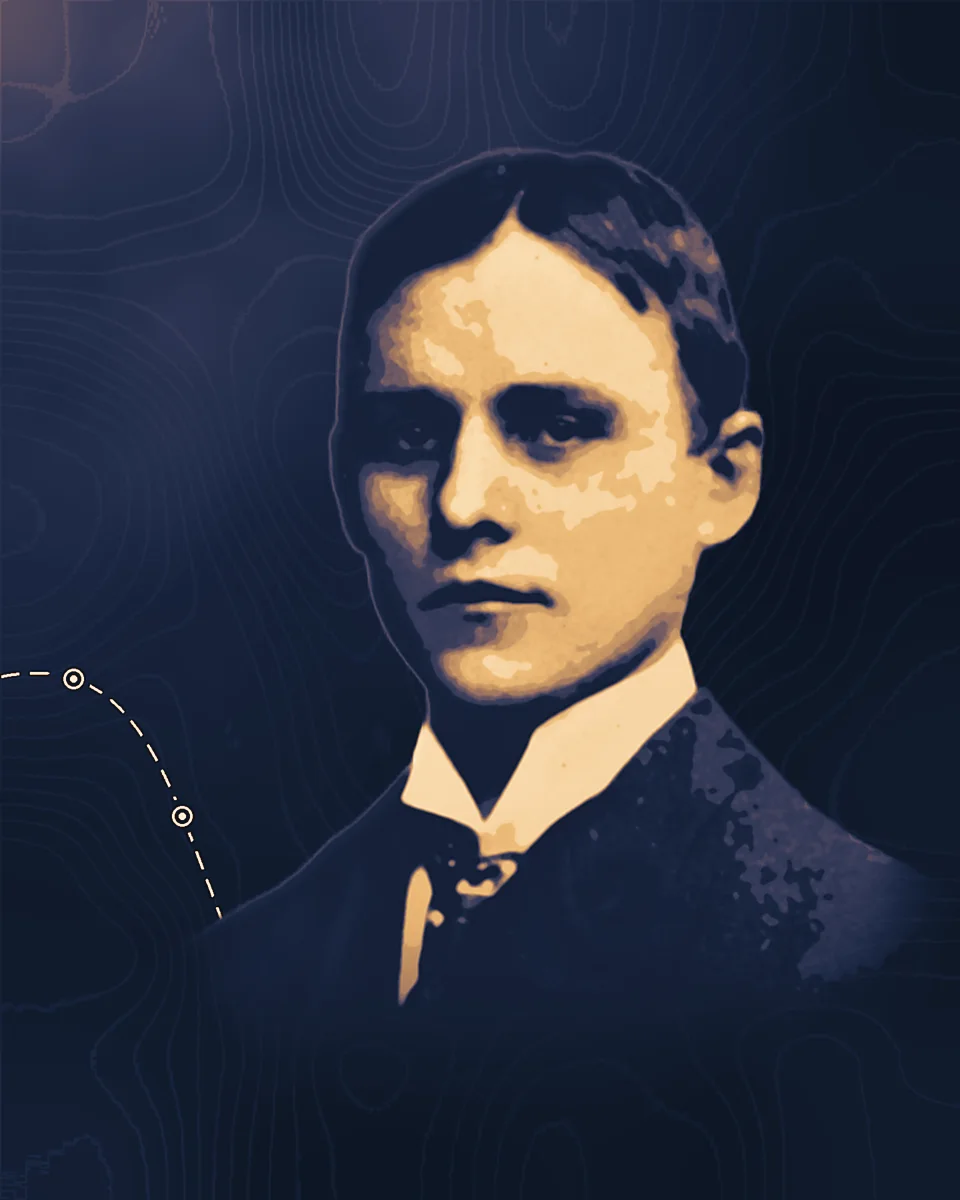
Charles Martin Hall
He found, at 22, how to make aluminum by passing electric current through alumina dissolved in molten cryolite, and built the first company to do it at scale.
1863–1914
What they changed
1886
Aluminum by electrolysis
On 23 February 1886, in a woodshed behind his family's house in Oberlin, Ohio, Hall dissolved alumina (aluminum oxide) in molten cryolite, a fluoride mineral, in a carbon crucible and passed a battery current through it for about two hours. He poured out "a number of small globules of aluminum". Until then the metal was made with sodium and cost several dollars a pound.
1888
The first commercial pots
Alfred Hunt raised $20,000 and the Pittsburgh Reduction Company was started on 18 September 1888. Hall and its first employee, Arthur Vining Davis, built steel cells lined with baked carbon, which they called pots. Theodore Beck, writing for The Electrochemical Society in 2014, says the basic design of today's cells with prebaked anodes is the same apart from size, hooding and fume recovery.
1889
The American patent
Hall applied on 9 July 1886 and learned that Paul Héroult of France had applied for a French patent on the same process on 23 April. The US Patent Office set the two against each other in 1888. Hall proved his February date and was granted his basic patent, No. 400,766, on 2 April 1889.
1893
A metal people could afford
Ruling for Hall's company against the Cowles company in 1893, Judge William Howard Taft found that the process had cut the price of aluminum from $6 or $8 a pound to 65 cents. The Science History Institute puts it at 30 cents after the company moved its smelting to Niagara Falls.
Life
Charles Martin Hall was born on 6 December 1863 in Thompson, Ohio, the son of a minister. The family moved to Oberlin in 1873. He entered Oberlin College in 1880 and graduated in 1885. His chemistry professor there was Frank Fanning Jewett, who lent him apparatus and batteries and gave him room in his own laboratory. Jewett later said that he had told his class a fortune awaited whoever made aluminum cheaply, and that Hall had turned to a classmate and said he was going for that metal. The Oberlin College Archives say the story of the classroom challenge "appears to contain more myth than fact." Hall said he had been thinking about aluminum since he was a schoolboy.
After graduating he worked in the woodshed at home. His older sister Julia Brainerd Hall, who had studied chemistry at Oberlin too, followed the experiments closely. How much she did is disputed. In 1979 the historian Martha Moore Trescott argued that Julia was a collaborator who kept the records that later proved his date. In 1997 the Oberlin chemist Norman Craig answered that her technical part was negligible and that her main contribution was running the household. Both agree that she was his closest confidante and that her testimony helped in the patent case.
Héroult made the same discovery in France within about two months, at the same age. Each held the patent in his own country. Hall never claimed otherwise: accepting the Perkin Medal in 1911, with Héroult in the room, he said his friend had "invented the process independently in France".
Selling the process took two years. Backers in Boston dropped it in October 1886. The Cowles Electric Smelting and Aluminum Company of Lockport, New York, took an option and had Hall work there from July 1887 to July 1888, then let the option go. Hall then reached Hunt's group in Pittsburgh. In his own account the troubles that had dogged his small cells for three years "disappeared as if by magic" at full size. The Cowles company later fought the patent in court. Taft ruled for Hall in 1893, but in 1903 an appeals court awarded Cowles damages under patents of Charles Bradley that it had bought, by Harry Holmes's account.
The Mellon banking family of Pittsburgh financed the company from 1890 and paid for the Niagara Falls plant. It was renamed the Aluminum Company of America in 1907, later Alcoa. Hall was its vice president until his death and held about a quarter of its stock. He kept inventing and was granted 22 US patents.
He never married. He died in Daytona, Florida, on 27 December 1914, the same year as Héroult, and was buried in Oberlin. He left most of his estate to education: Oberlin College received more than $10 million, and Berea College in Kentucky and schools in Asia were the other main heirs.
Read more
5 accounts
The Story of Aluminum, Harry N. Holmes, Journal of Chemical Education, February 1930.
An Oberlin chemist's account, which quotes at length Hall's own Perkin Medal address of 1911 and the recollections of Jewett and of Hall's sister.
archive.org
Charles Martin Hall Collection, Oberlin College Archives, 1989.
The finding aid for his papers, with a careful biographical note and dates for the patents and the lawsuits.
oberlin.libraryhost.com
Hall and Héroult and the Discovery of Aluminum Electrolysis, Theodore R. Beck, The Electrochemical Society Interface, 2014.
Two pages on both men by an aluminum electrochemist.
electrochem.org
Julia Hall, Woman Inventor?, Frederic D. Schwarz, Invention & Technology, 1998.
Sets Trescott's case for Julia Hall beside Craig's reply.
inventionandtech.com
Paul Héroult and Charles Hall: Turning a Rarity into a Commodity, Claudia Flavell-While, The Chemical Engineer, 2013.
The Institution of Chemical Engineers' profile of the two inventors.
thechemicalengineer.com