Industries / Figureheads
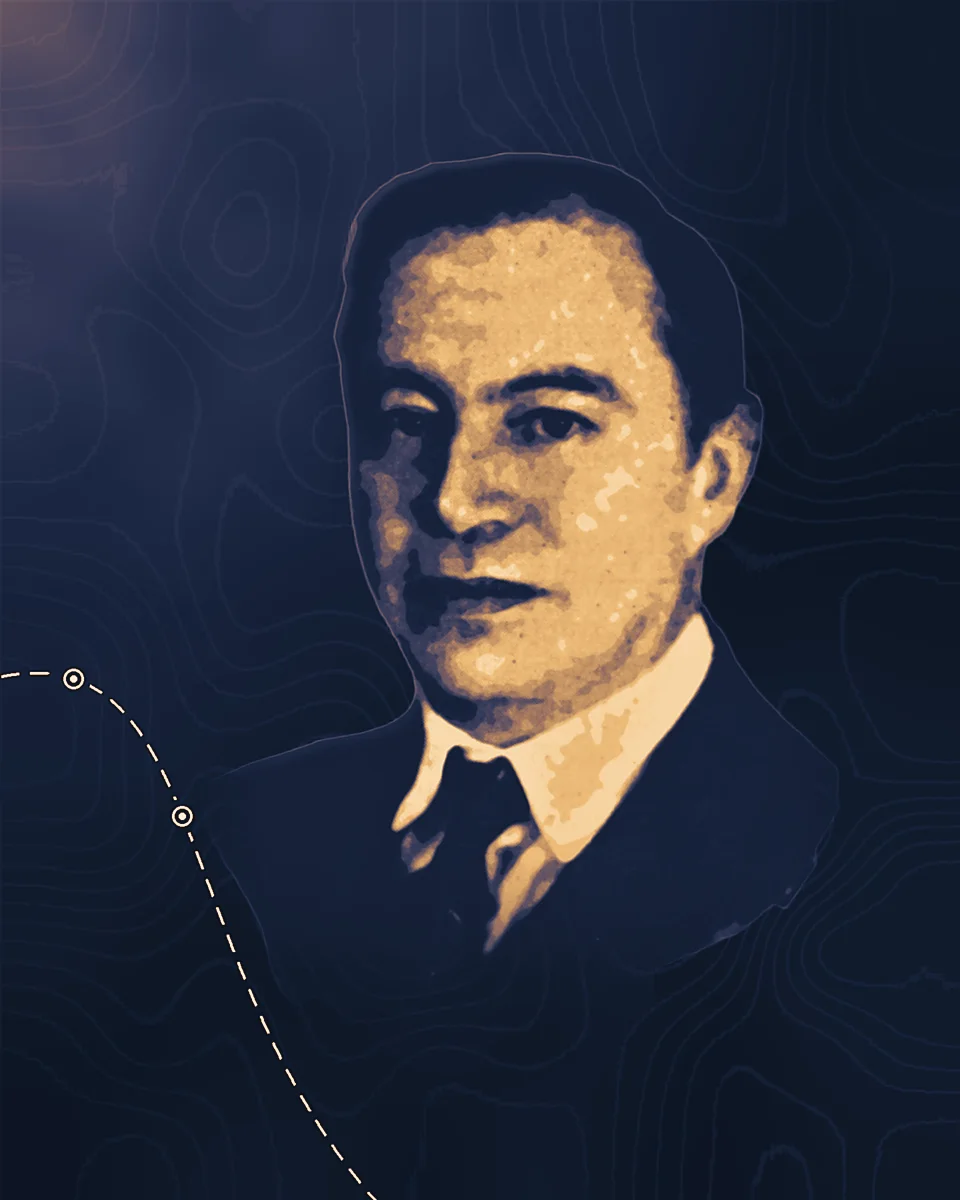
Charles LeGeyt Fortescue
He showed in 1918 that any unbalanced set of three-phase currents or voltages can be split into balanced parts, the method grid engineers still use to work out faults and to build protective relays.
1876–1936
What they changed
1918
Unbalanced circuits split apart
A three-phase line carries three alternating currents that normally rise and fall in an even rhythm, a third of a cycle apart. A fault, such as a wire touching the ground, upsets that balance and makes the circuit hard to calculate. At the American Institute of Electrical Engineers (AIEE) convention in Atlantic City on 28 June 1918, Fortescue showed that any unbalanced set can be written as the sum of balanced sets, each of which can be solved like a simple circuit. Engineers at Schweitzer Engineering Laboratories, a relay maker, wrote in 2019 that these "sequence components" soon became one of the foundations of protective relaying, and that short-circuit software still often uses them.
1929
Lightning recorded on a line
In the 1928 lightning season Fortescue, A. L. Atherton and J. H. Cox put two cathode-ray oscillographs, instruments that draw a voltage with a beam of electrons, on a heavily insulated line where it crosses the Chilhowee ridge in Tennessee. The instruments were built to the design of Harald Norinder of the Swedish Royal Board of Waterfalls. They caught one lightning surge whole, from its start to its end, while strokes to earth near the line left nothing that could be recorded. The AIEE's obituary says Fortescue advanced the theory that direct strokes to the lines were the cause of the trouble.
1932
The Franklin Institute's medal
The Franklin Institute in Philadelphia gave him its Elliott Cresson Medal in engineering for "Symmetrical Coordinates in Polyphase Networks".
2000
First among a century's papers
For a power engineering conference in 2000, G. T. Heydt, S. S. Venkata and N. Balijepalli collected 39 papers and books nominated as the most important in the field from 1900 to 1999 and asked engineers to pick three. Of 73 people who answered, 47 picked Fortescue's 1918 paper, more than any other. The authors called the vote unscientific and wrote that his paper was "perhaps" the most fundamental of the 39.
Life
Charles LeGeyt Fortescue was born at York Factory, Manitoba, on 7 November 1876, and went to a private school in England. He took a bachelor of science degree at Queen's University in Kingston, Ontario, in 1898 and joined the Westinghouse Electric & Manufacturing Company in East Pittsburgh as an apprentice the same year. He stayed with Westinghouse for the rest of his life. Queen's gave him a doctorate in 1931.
He worked in transformer engineering from 1901 to 1918, managed the porcelain, insulator and transmission engineering department from 1918 to 1926, and was the company's consulting transmission engineer from 1926. The AIEE credited him with better transformer designs, with ways of measuring very high voltages by the spark between two metal spheres, and with rules for the shape of insulators, and said he was "said to have developed" the first commercial 100,000-volt transformer. Both of his obituaries count nearly 200 patents. In a 1930 article he worked through how higher voltages, and circuit breakers that clear a fault in eight cycles or less, let long lines carry more power without losing step, and wrote that he had suggested capacitors in series with long lines before 1915 but had not pressed the idea because of its drawbacks.
The 1918 paper grew out of work he began late in 1913 on induction motors running on unbalanced supplies, and its own applications were to motors, generators and phase converters. He thanked Professor Karapetoff, who suggested the mathematical paper, and his Westinghouse colleague J. Slepian, for "the idea of sequence operators". He did not claim to be first: he wrote that the method had been used "to a limited extent" before, though never set out as a system. Edith Clarke's 1943 textbook traces the splitting of unbalanced currents into two balanced sets to papers by L. G. Stokvis from 1912, one of them presented with André Blondel's sponsorship in Paris in 1914, and credits Fortescue with the third, "zero-sequence" set and a general method. She dates the use of the method for short circuits to papers by R. D. Evans and S. Bekku in 1925 and A. P. Mackerras in 1926.
He also worked on the stability of long lines and on lightning. Electrical World's obituary said he was internationally known for curbing the effects of lightning on transmission lines and distribution systems. The Westinghouse engineer Edwin Harder told an IEEE History Center interviewer in 1991 that Fortescue's tests in Tennessee showed that only strokes that actually hit a line did the damage, and that another Westinghouse engineer, Monteith, built a method of line design on that finding.
He died at his home in Pittsburgh on 4 December 1936 after a long illness. He was a Fellow of the AIEE. A scholarship for graduate students of electrical engineering was set up in his memory in 1939; ETHW, the IEEE's history wiki, lists its holders up to 2015–2016.
Read more
5 accounts
Method of Symmetrical Co-ordinates Applied to the Solution of Polyphase Networks, C. L. Fortescue, Transactions of the AIEE, vol. 37, 1918, pp.
1027–1140. The paper itself, in the scanned volume.
archive.org
Theoretical and Field Investigations of Lightning, C. L. Fortescue, A. L. Atherton and J. H. Cox, Transactions of the AIEE, vol. 48, 1929.
The Tennessee lightning records and the theory of surges on lines.
archive.org
High Impact Papers in Power Engineering, 1900–1999, G.
T. Heydt, S. S. Venkata and N. Balijepalli, North American Power Symposium, 2000. The vote on the century's papers, with a short account of what Fortescue's paper did.
uwaterloo.ca
Sequence Component Applications in Protective Relays, Bogdan Kasztenny, Mangapathirao V. Mynam and Normann Fischer, Schweitzer Engineering Laboratories, 2019.
A relay maker's tutorial on how his method is used to protect the grid today.
selinc.com
Obituary of Charles LeGeyt Fortescue, Electrical Engineering (journal of the AIEE), January 1937.
His career as his professional institute recorded it.
archive.org