Industries / Figureheads
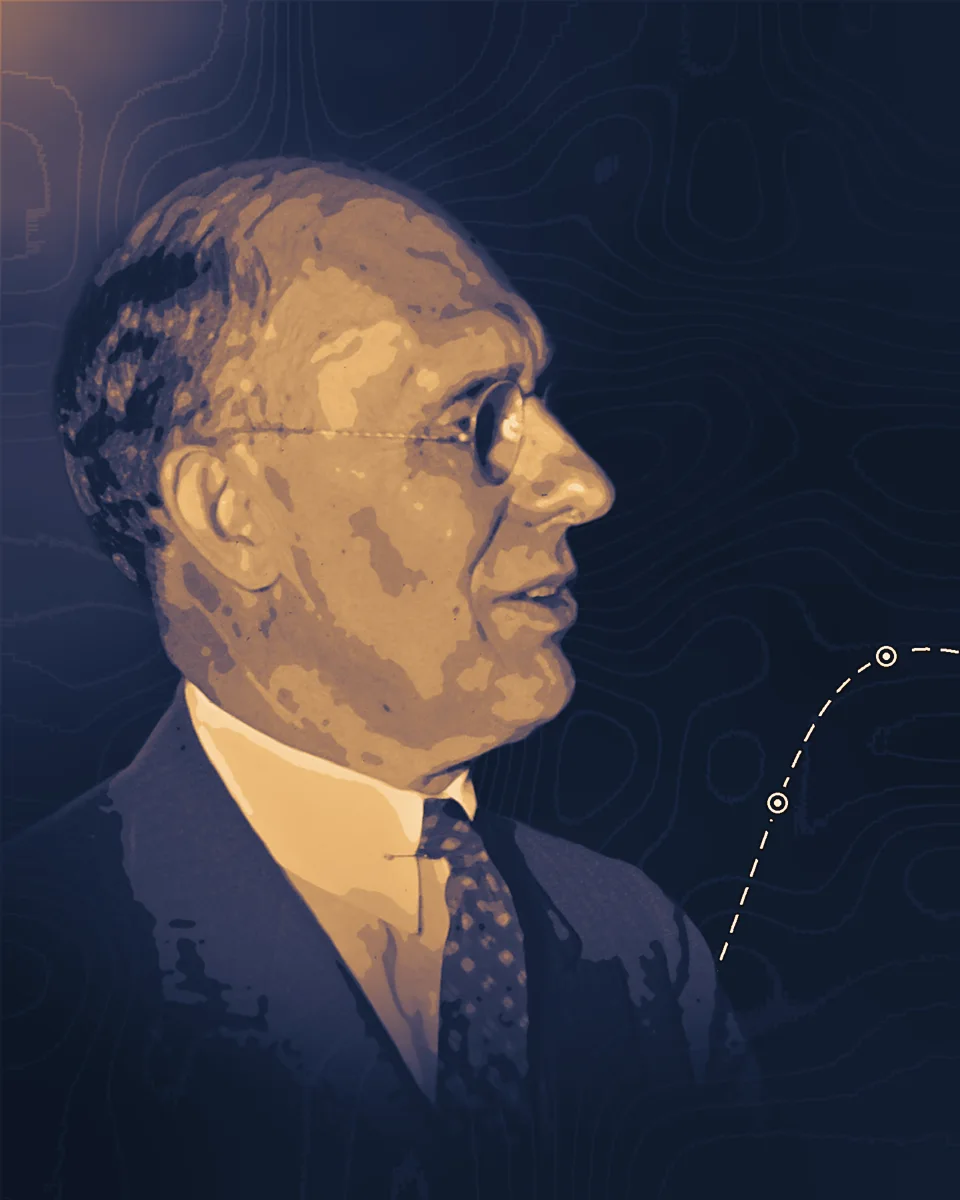
Charles F. Kettering
He gave the car its electric starter, built General Motors' research laboratory, and put lead in gasoline.
1876–1958
What they changed
1909
A better ignition
Working in a barn in Dayton, Ohio, Kettering and Edward Deeds finished an improved ignition system for car engines in the summer of 1909. Cadillac's president, Henry Leland, ordered 8,000 sets within weeks, and the two men formed the Dayton Engineering Laboratories Company, Delco, to make them.
1912
The electric starter
Engines were started by swinging a hand crank, which could kick back and break an arm. Kettering's small electric motor turned the engine over instead, and Cadillac fitted it to its 1912 models. Drivers no longer needed the strength to crank.
1920
A research laboratory for cars
Kettering sold Delco to General Motors and from 1920 headed its new research division, a post he held for more than a quarter of a century. A light, fast diesel engine for locomotives and the refrigerant Freon came out of it.
1921
Lead in gasoline
Engines "knocked" when their fuel burned too early, which limited their power. After a search Kettering had led since 1916, his laboratory found on 9 December 1921 that a little tetraethyl lead stopped the knock. It went on sale in 1923 as "Ethyl" and was sold for decades. The historian William Kovarik has shown that Kettering's team knew from the start that alcohol also stopped knock.
Life
Charles Franklin Kettering was born on 29 August 1876 on a farm near Loudonville, Ohio. Weak eyes forced him to leave Ohio State University more than once, and room-mates read his lessons to him. He took his degree in electrical engineering in 1904, aged 27, and joined the National Cash Register Company in Dayton, where his first job was to put an electric motor on the cash register.
He worked on car ignition in the evenings with Edward Deeds, an NCR manager, and left NCR in 1909. The starter followed a death. In early 1910 a man named Byron Carter was hurt when a crank kicked back as he restarted a stalled car on a Detroit bridge, and he died. Leland asked for a safer way. Kettering had his answer in 1911, and within two years of the 1912 Cadillac Delco grew from a handful of people to 1,500.
Alfred Sloan recruited him to lead General Motors' research. Not all of it worked. His air-cooled engine was dropped in 1923 as a $31 million write-off, by the Dayton history's count. The Franklin Institute, a science museum in Philadelphia, gave him its Franklin Medal in 1936.
Leaded gasoline is the part of his record that did lasting harm. Carroll Hochwalt made the compound and Thomas Midgley ran the tests; Kettering directed the work and chose the name "Ethyl", which Kovarik says confused it with ethyl alcohol. In October 1924 two dozen men at a Standard Oil refinery at Bayway, New Jersey, were poisoned making it, and six died; eleven more died at General Motors and DuPont plants about the same time. At a Public Health Service conference on 20 May 1925 Kettering argued that there was no practical substitute. The physician Alice Hamilton disputed that, and by Kovarik's account told him to his face, "You are nothing but a murderer." The Service found "no good reason" to ban the fuel in 1926. The United States officially banned the sale of leaded gasoline in 1996, and Algeria, the last country selling it, stopped in 2021. Researchers cited by Kovarik put the cost at millions of early deaths.
environmentalhistory.orgtheconversation.comdaytoninnovationlegacy.org
Freon, the refrigerant Midgley developed from 1928 at Kettering's urging, came from the same laboratory. Kettering retired from General Motors in 1947, aged 71. With Sloan he founded the Sloan-Kettering Institute for cancer research in New York in 1945. He died at his home in Dayton on 25 November 1958.
Read more
4 accounts
Case Files: Charles F. Kettering, The Franklin Institute, undated. The institute's account of the work for which it gave him the Franklin Medal in 1936, drawn from its own award files.
fi.edu
Charles F. Kettering, Dayton Innovation Legacy, undated. A long illustrated life from his home city, with the barn, the starter and the failures.
daytoninnovationlegacy.org
Ethyl: How a Classic Occupational Disease Became an International Public Health Disaster, William Kovarik, International Journal of Occupational and Environmental Health, 2005.
The history of leaded gasoline from the company's and the health service's own papers.
environmentalhistory.org
A century of tragedy: how the car and gas industry knew about the health risks of leaded fuel but sold it for 100 years anyway, William Kovarik, The Conversation, 2021.
A shorter account for general readers, written when the last country stopped selling it.
theconversation.com