Industries / Figureheads
Charles E. L. Brown
At Maschinenfabrik Oerlikon he designed the generators and oil-insulated transformers of the 1891 Lauffen–Frankfurt line, then co-founded Brown, Boveri & Cie, where he devised multiple-break oil switches and the cylindrical rotor of turbo-generators.
1863–1924
What they changed
1886
Direct current over 8 km
With his first Oerlikon dynamos, Brown carried 37 kW over 8 km from Kriegstetten to Solothurn in Switzerland, by his obituary in the Elektrotechnische Zeitschrift. The American Institute of Electrical Engineers, electing him an honorary member in 1912, dated his first high-voltage direct-current transmission to 1886.
1891
Machines for the Lauffen line
For the 175 km three-phase line from Lauffen to Frankfurt, Oerlikon built two generators to Brown's design, each taking 300 horsepower at 150 revolutions a minute and having a revolving field magnet with a single exciting coil, by Silvanus Thompson's 1895 account. The transformers that raised their output for the line, some built in Berlin and some at Oerlikon, were immersed in oil for insulation. Lecturing in Frankfurt that February, Brown said his transformers stood entirely under oil, which he called the best insulating material, and that bare copper wire on oil insulators, on tall poles, would carry the current.
1891
Brown, Boveri & Cie
On 1 October 1891 he gave up the electrical department at Oerlikon and set up on his own in Baden, Switzerland, with his colleague there Walter Boveri, to make direct- and alternating-current dynamos and build plants for lighting, power transmission and railways, as the Elektrotechnische Zeitschrift reported that month. Switzerland's historical dictionary says he took out more than 30 Swiss patents for the firm in its first ten years. Brown, Boveri & Cie merged with ASEA in 1988 to form ABB, by ABB's own history.
1898
Breaking high voltage in oil
His obituary says Brown first proposed and used multiple breaks in high-voltage oil switches, at the Paderno power station on the Adda, so that the current is interrupted at several points in series at once, and that the tube fuses used as disconnectors were also his. Switzerland's historical dictionary dates his oil switch to 1898, and Germany's national biography also credits him with both devices.
1901
A rotor for turbo-generators
After the firm took up Charles Parsons's steam turbine patents around 1900, Brown saw that a rotor with projecting poles could not hold together at the size and speed of large three-phase turbo-generators. He made the rotor a cylindrical drum with slots, radial or parallel, to hold the field winding. His obituary says every maker of turbo-generators had to adopt the principle and that Germany's supreme court upheld his patents; Switzerland's historical dictionary dates the cylindrical rotor to 1901.
Life
Charles Eugene Lancelot Brown was born in Winterthur, Switzerland, on 17 June 1863, a British citizen and the son of the English engineer Charles Brown, whom his obituary calls the inventor of the bayonet frame and of the Sulzer valve steam engine. He took a diploma in mechanical engineering at the Technikum in Winterthur and trained at Bürgin & Alioth in Basel. He joined Maschinenfabrik Oerlikon near Zurich in 1884, by Switzerland's historical dictionary and Germany's national biography, or in the spring of 1885, by his obituary, and headed its electrical department from 1887 to 1891; the national biography says from 1886.
His first years at Oerlikon went to direct-current machines. His dynamos of 1888 for the Aluminium-Industrie AG at Neuhausen, for 6,000 and 12,000 amperes, were for a long time the largest in the world, and a four-pole machine of his won the grand prize for dynamos at the Paris exhibition of 1889. His obituary says he saw the limits of direct current for transmission by 1889 and turned to alternating current. Oerlikon also built a power plant at Kassel with Oskar von Miller, sending alternating current at high voltage to substations where synchronous motors drove direct-current generators, by Michael Dolivo-Dobrowolsky's account.
Three-phase came to Oerlikon from AEG in Berlin. Dolivo-Dobrowolsky showed his first motors to Oerlikon's heads, Colonel Huber and Brown, and the firms signed a licence: they would work on the system together, and Oerlikon would pay AEG a fee for each horsepower of three-phase plant. Germany's national biography and Brown's obituary credit Brown and Dolivo-Dobrowolsky jointly with the distributed multi-phase winding. The credit for oil-insulated transformers is disputed. His obituary calls the Lauffen transformers "the first oil transformers", and the AIEE's 1912 citation says that in 1889 he "designed some of the first oil-insulated transformers"; Dolivo-Dobrowolsky wrote in 1917 that James Swinburne, who had filled the stoneware pots of his transformers with oil, "must be called the inventor of oil transformers".
archive.orgdeutsche-biographie.dearchive.orgethw.orgarchive.org
Brown, Boveri & Cie began as a limited partnership in Baden. His obituary describes the next decade: single-phase generators for Frankfurt's municipal power station in 1894, chosen against German firms' direct-current bids at the urging of the city engineer W. H. Lindley; Swiss hydro plants in whose planning Brown had a large hand, among them Baden, Schwyz, Aarau, Rathausen, Hagneck, Spiez and Beznau; generators of 8,000 V for Schwyz in 1896 and of 14,500 V, made directly without a transformer, for Paderno in 1898; and three-phase railways, from the Lugano tramway of 1894 to the Gornergrat, Jungfrau, Burgdorf–Thun and Simplon lines. Dolivo-Dobrowolsky wrote that AEG later lost a patent suit in Zurich against the firm over the three-phase transformer.
When the firm became a company limited by shares in 1900, Brown chaired its board until 1911. Switzerland's historical dictionary says the work at the top grew more commercial as the firm grew, which did not suit "the impulsive and eccentric tinkerer", and that in 1911 the two founders broke with each other. Brown withdrew into private life and spent his last years at Montagnola in Ticino. The Technische Hochschule in Karlsruhe made him an honorary doctor, in 1911 by the dictionary and in 1912 by his obituary, and on 12 January 1912 the American Institute of Electrical Engineers elected him an honorary member. Baden made him an honorary citizen in 1916. He died of a heart attack at Montagnola, near Lugano, on 2 May 1924.
Read more
6 accounts
C. E. L. Brown † (Ein Stück Geschichte der Elektrotechnik), Elektrotechnische Zeitschrift, 1924.
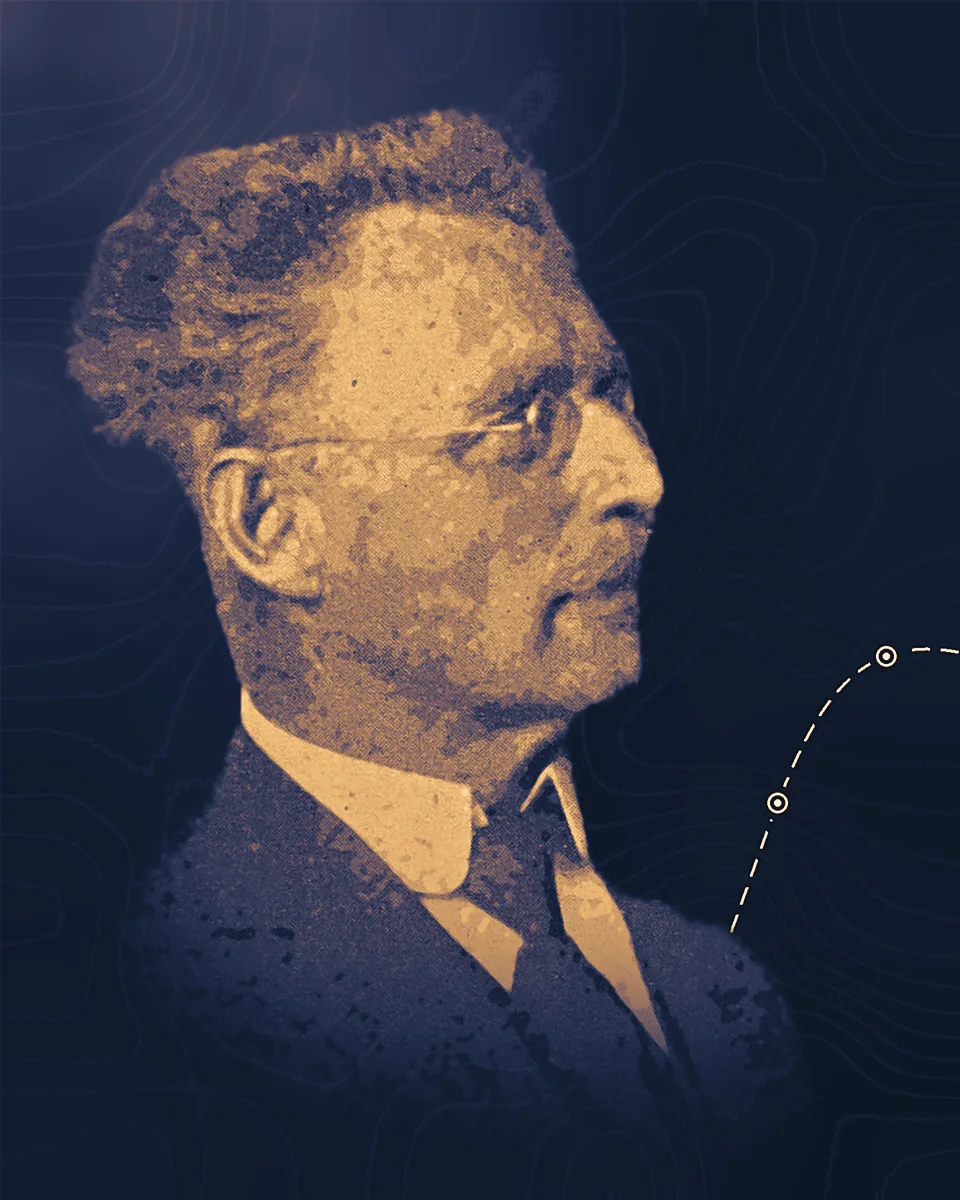
The German electrical engineers' journal's obituary, two pages on his machines from 1885 to 1911, with the photograph this portrait is based on.
archive.org
Brown, Charles Eugen Lancelot, Andreas Steigmeier, Historisches Lexikon der Schweiz, 2004.
Switzerland's historical dictionary: his family, his Oerlikon years, Brown Boveri and the break with Boveri.
hls-dhs-dss.ch
Brown, Charles Eugene Lancelot, Carl Graf von Klinckowstroem, Neue Deutsche Biographie vol. 2, 1955.
Germany's national biography, short, with a list of the older obituaries.
deutsche-biographie.de
Polyphase Electric Currents and Alternate-Current Motors, Silvanus P. Thompson, 1895.
A contemporary description, with drawings, of the Lauffen generators and of the line they fed.
archive.org
Aus der Geschichte des Drehstromes, M. Dolivo-Dobrowolsky, Elektrotechnische Zeitschrift, 1917.
The AEG engineer's own history, including how AEG and Oerlikon came to work together and how their patents later set the firms against each other.
archive.org
Long Distance Electric Power Transmission Using Three-Phase Alternating Current, 1891, IEEE Milestone, 2025.
The IEEE citation naming him with Oskar von Miller and Dolivo-Dobrowolsky.
ethw.org