Industries / Figureheads
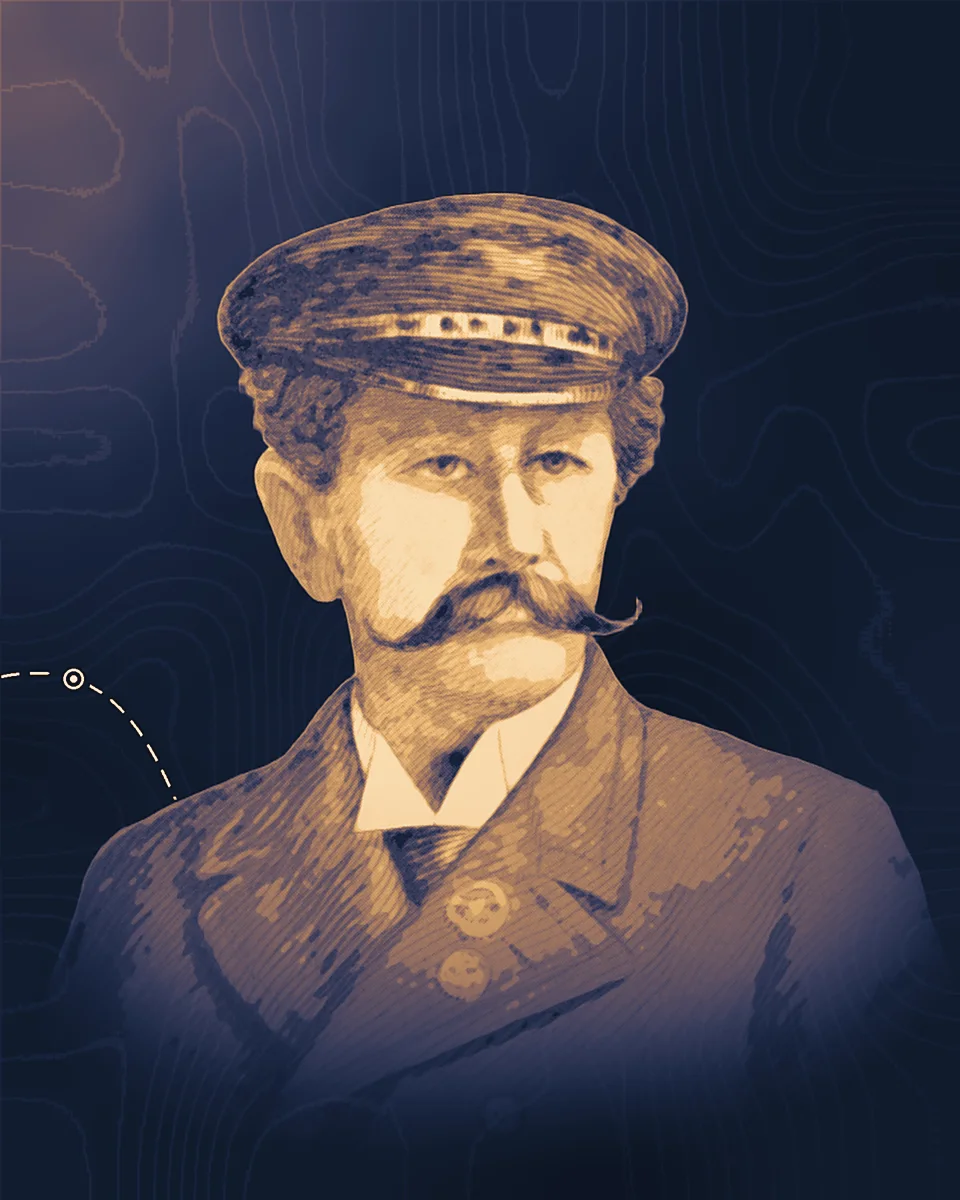
Carl Benz
He designed a motor car as one machine, engine and chassis together, patented it in 1886 and built it for sale.
1844–1929
What they changed
1880
A two-stroke engine that ran
Benz began designing a one-horsepower gas engine on the two-stroke principle in 1877, because Otto's patents still covered the four-stroke design. The first engine ran in 1880, and stationary engines of one and then four horsepower gave him a business.
1886
The motor car patent
Benz drew his first car in 1884, drove a three-wheeled one in his workshop yard in the autumn of 1885 and patented it as German patent 37435, a "vehicle with gas engine operation". The UN's register of documentary heritage dates the filing to 29 January 1886, the date the industry file takes as the start of the trade. The national biography of Gottlieb Daimler credits Benz as the first to create the motor vehicle "developed as a unit".
1888
Shown and not sold
At the Munich engine exhibition of 1888 Benz drove the car for two hours a day and won the Great Gold Medal. The press was enthusiastic and nobody bought one. The Paris world exhibition of 1889 did no better, and he blamed the three-wheeled layout on bad roads.
1893
Steering for four wheels
In the winter of 1892 to 1893 Benz applied for a patent on a steering gear that turns each front wheel on its own pivot, so the wheels follow circles about one centre. It let him build the four-wheeled car he had first planned, and sales followed.
1900
Cars in series
By about 1900 the Benz range ran from a low-priced "people's car" to racing cars, trucks and luxury models. Germany's national history museum counts 603 vehicles built by the firm in 1900.
Life
Carl Benz was born in Karlsruhe on 25 November 1844. His father, a locomotive driver, died in 1846. From 1853 he attended the science-minded Lyzeum in Karlsruhe, and from 1860 he studied mechanical engineering for four years at the Karlsruhe polytechnic under Ferdinand Redtenbacher and then Franz Grashof. He worked as a fitter at a locomotive builder in Karlsruhe, then as a designer in Mannheim and at a bridge builder in Pforzheim.
In 1871 he went back to Mannheim and set up a small iron foundry and machine shop with a partner. The partnership soon broke up. Germany's national history museum says the business survived only because his fiancée, Berta Ringer, put her dowry into it. They married in 1872 and had two sons and three daughters.
His engine business went through two companies. In 1883, after his backers tried to dictate his designs, he left the first and founded Benz & Cie. in Mannheim with new partners. His own two-stroke engine was too heavy for a vehicle, so for the car he turned to the four-stroke engine of Nicolaus Otto once it was free of patent. He chose three wheels to avoid the steering problem that he solved only in 1893.
He was not alone in the field. Gottlieb Daimler and Wilhelm Maybach, working at Cannstatt near Stuttgart, fitted their own engine to a carriage in 1885 to 1886, and the two firms stayed separate until 1926. A New York book of 1904 on the makers of the automobile already printed his portrait and a short life among those of the car's inventors.
Benz & Cie. became a joint-stock company in 1899, with Benz holding a third. In 1903, after disputes inside the firm, he left its management, moved to Ladenburg near Mannheim and founded a small company with his sons Eugen and Richard. He lived to see Benz & Cie. merge with the Daimler company in 1926 to form Daimler-Benz. He died in Ladenburg on 4 April 1929.
Read more
4 accounts
Benz, Carl, Marie-Louise Broecker, Neue Deutsche Biographie, volume 2, 1955.
The German national biography's entry, with his schooling, his firms and the engineering in order.
deutsche-biographie.de
Carl Friedrich Benz 1844–1929, Deutsches Historisches Museum, LeMO, undated. A year-by-year life from Germany's national history museum.
dhm.de
Automobile Biographies, Lyman Horace Weeks, The Monograph Press, 1904.
An early American account of the people who made the motor car, written while Benz was still at work.
archive.org
UN News report on new entries in the Memory of the World Register, United Nations, 25 May 2011.
The report of the Benz patent's entry in UNESCO's register of documentary heritage.
news.un.org