Industries / Figureheads
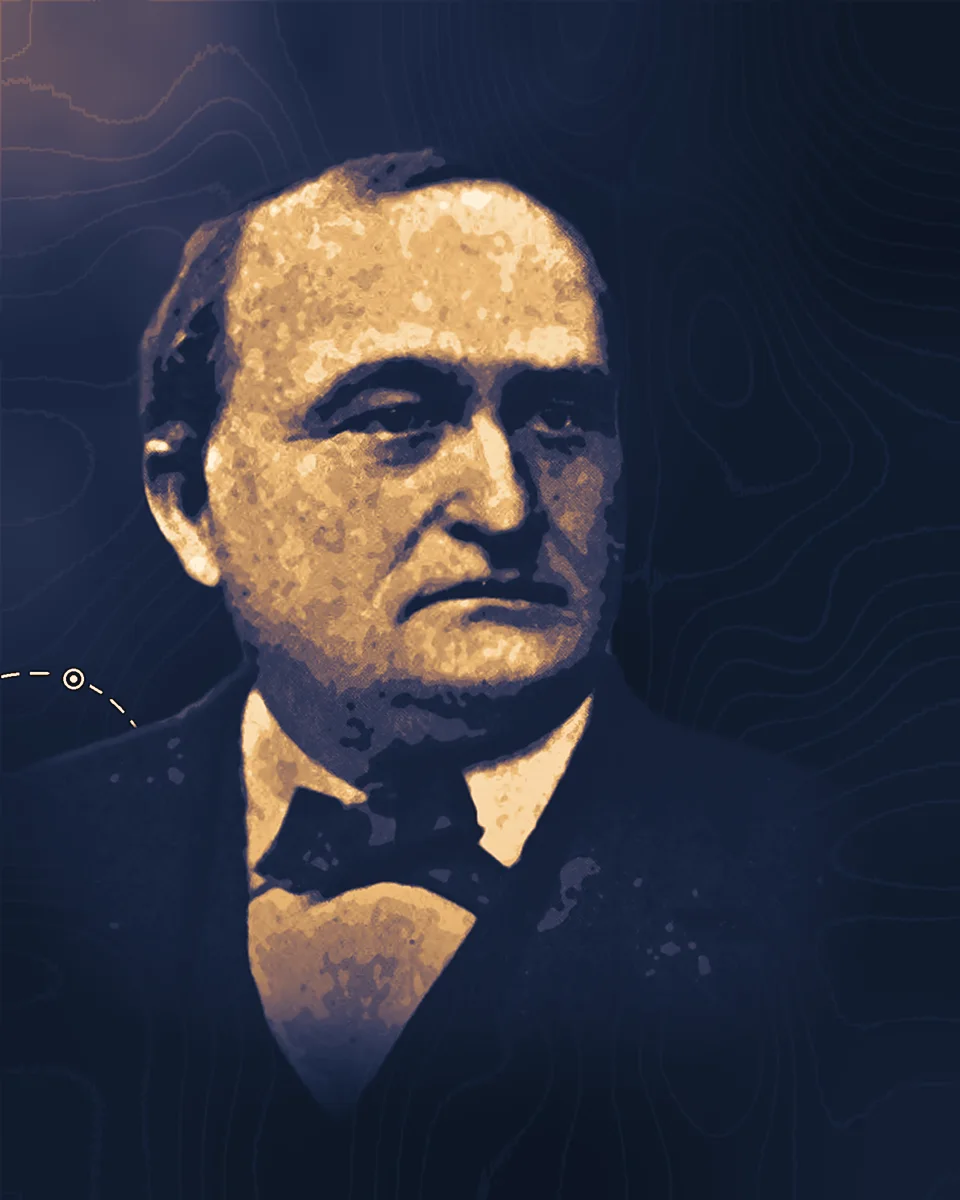
Byron D. Benson
He led the Tidewater Pipe Company, whose six-inch line of 1879 was the first to pump oil over the Allegheny Mountains, and so showed that pipelines rather than railroads would carry crude oil long distances.
1832–1888
What they changed
1874
A blocked line pays
Benson, David McKelvy and Robert E. Hopkins leased the Columbia Conduit line to Pittsburgh from its builder, David Hostetter, after the Pennsylvania Railroad had stopped it from crossing under its tracks. They ran the oil into tank wagons, carted it across the tracks on the public road, and pumped it on to Pittsburgh, and were soon doing good business, by Ida Tarbell's account.
1878
The Tidewater Pipe Company
With Hopkins and McKelvy, Benson first planned a seaboard line from the Butler field to Baltimore, surveyed by the engineer Herman Haupt. In the autumn of 1878 they switched to the larger Bradford field and a six-inch line of 109 miles from Rixford to Williamsport, on the Reading Railroad. The Tidewater Pipe Company was formed in November 1878 with $625,000 of capital, and Benson was its first president.
1879
Oil over the mountains
On 28 May 1879 Benson opened the valve at Station One at Coryville. A pump of a new pattern built for the job by the Holly Company, driven by a 70-horsepower engine, forced the oil 28 miles to a second station about 700 feet higher, which pushed it over the summit of the Alleghenies, nearly 2,600 feet up; from there it ran down by gravity. The oil reached the tank beyond Williamsport on 4 June. Until then, Tarbell writes, oil had never been pumped more than thirty miles.
1879
Railroads lose the long haul
Tarbell set the costs side by side: 35 to 45 cents a barrel to the seaboard by rail by the Reading Railroad president's estimate, against Haupt's 1876 estimate of 16 2/3 cents by pipe. She concluded that "the day of the railroads as long-distance transporters of crude oil was over." Standard Oil answered by laying its own seaboard lines and forming the National Transit Company in 1881 to run them.
Life
Byron David Benson was born on 29 February 1832 in Pompey, Onondaga County, New York, by the record of his grave; the Pennsylvania Historical and Museum Commission's marker at his Titusville house gives his years as 1832 to 1888 and says he lived there from 1872.
The Tidewater was a team's work. Tarbell names Benson, McKelvy and Hopkins together throughout, and says they took up an older idea of Henry Harley's and hired the same engineer, Herman Haupt. The chief engineer who drove the line through to Williamsport was B. F. Warren, and the largest stockholders were Alanson A. Sumner and Benson. Standard Oil tried to stop the line by buying a "dead line", a strip of rights of way across the whole state, but never completed it, and the Tidewater found a gap.
Standard then cut off the Tidewater's buyers, so it built refineries of its own at Bayonne, New Jersey, and near Philadelphia, and extended its line toward the coast, reaching Bayonne in 1882 by ExplorePAHistory's account. In January 1882 a minority group of stockholders seized the board at the annual meeting and elected Franklin Gowen of the Reading Railroad and the speculator James R. Keene; the "Benson party", as Tarbell calls the majority, won an injunction, and Judge Church ruled the election illegal. John D. Rockefeller then bought the minority's shares. In the suit, Standard's John D. Archbold swore that Benson and McKelvy had repeatedly proposed to him that the two companies divide the trade and fix rates and prices, which Benson called "grossly inaccurate."
In October 1883 the Tidewater and Standard signed contracts that gave the Tidewater 11.5 percent of the business and Standard 88.5 percent. Tarbell, who admired the Tidewater's founders as "business men of the first order", wrote that the agreement "limited and kept up prices" and ended any competition between them.
Benson stayed president of the Tidewater until his death. He died on 6 February 1888 in Manhattan and was buried at Woodlawn Cemetery in Titusville. In 1949 the Commission put up a marker at Coryville, opposite the site of Station One of "the first pipe line to carry oil across the Alleghenies."
titusvillepaheritageconnection.omeka.netfindagrave.comexplorepahistory.com
Read more
3 accounts
The History of the Standard Oil Company, volume 2, Ida M. Tarbell, 1904.
Chapter 9, "The Fight for the Seaboard Pipe-Line", is the fullest account of the Tidewater, with the incorporation papers and the 1883 agreements in the appendix.
archive.org
The History of the Standard Oil Company, volume 1, Ida M. Tarbell, 1904.
The Columbia Conduit lease and the producers' first seaboard plans.
archive.org
Sketches in Crude Oil, John J. McLaurin, 1896.
The oil region's pipelines and the men who ran them, Benson among them, from a local writer of the time.
archive.org