Industries / Figureheads
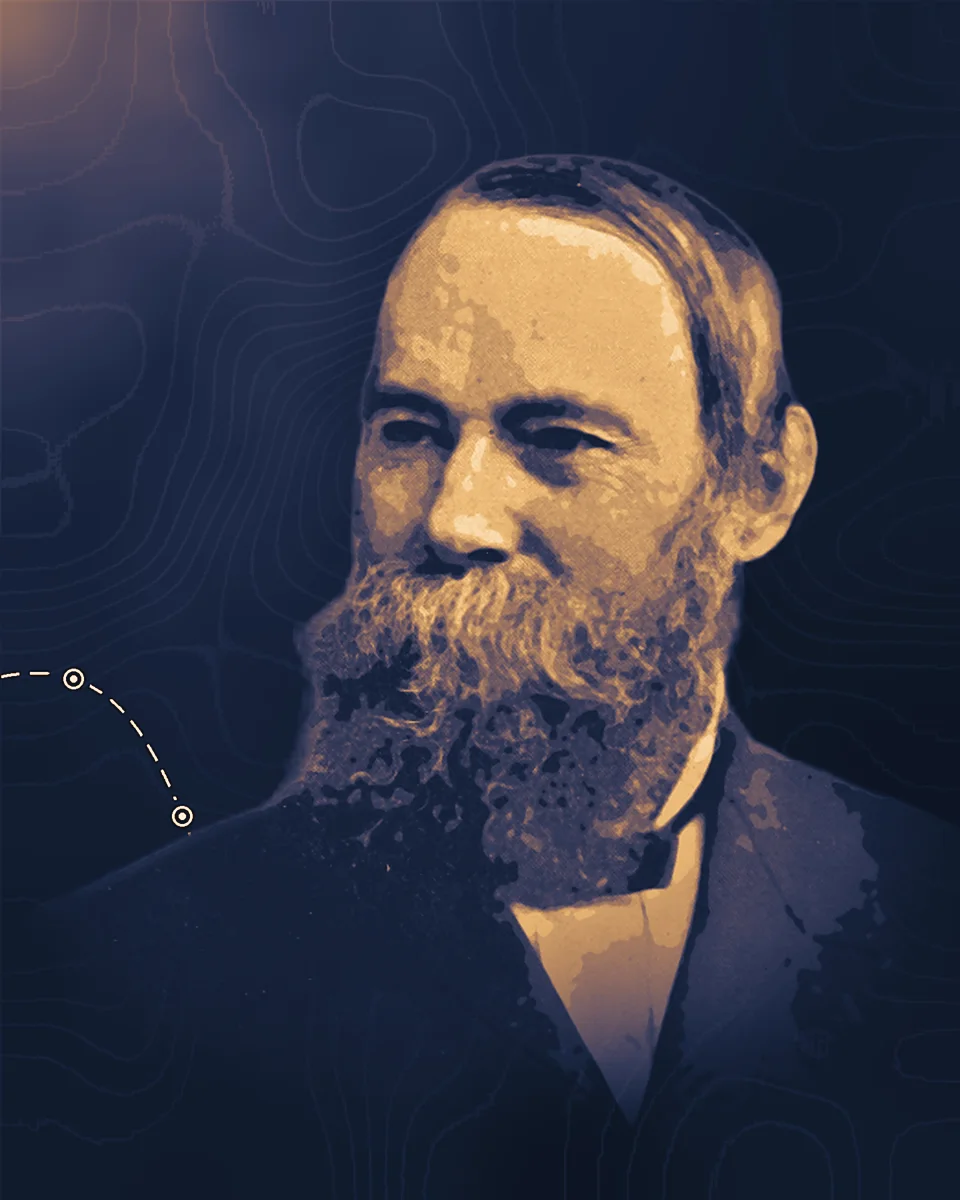
Benjamin Chew Tilghman
A Philadelphia inventor who found that sulfurous acid turns wood into paper pulp and patented the sulfite process, which others later made pay.
1821–1901
What they changed
1866
Wood softened by acid
Tilghman dropped a burnt match stick into a weak solution of sulfurous acid, and the next day the wood had gone soft and looked like paper pulp. With his brother Richard he then ran a series of trials on cooking wood in the acid. Printing paper was scarce and dear after the Civil War, and makers were looking for something other than rags.
1867
The sulfite patent
He patented cooking sliced wood under pressure in sulfurous acid with lime sulfite dissolved in it, as US patent 70,485, "Improved mode of treating vegetable substances for making paper-pulp". This is the chemistry of the sulfite process, which works on softwoods that soda cooking could not handle.
c. 1867
A mill that ate itself
The brothers built a mill at Manayunk, near Philadelphia. Its digesters, the vessels the wood was cooked in, were lined with lead, and the acid corroded the lead so fast that repairs cost them about $40,000, by the figure of his biographer George Iles. They gave the business up.
1884
A German court cites him
Germany's supreme court upheld the voiding of parts of Alexander Mitscherlich's sulfite patent because Tilghman had patented pulping with calcium bisulfite in 1866 and 1867. Mitscherlich's licensees then refused to pay him.
Life
Benjamin Chew Tilghman was born in Philadelphia on 26 October 1821, the third son of a lawyer. He graduated from the University of Pennsylvania, studied law to please his father and was admitted to the bar, but never practised. He preferred a workshop. He worked all his life with his brother Richard Albert Tilghman, two years younger, and as young men the two toured chemical works, laboratories and mills across Europe. Before the war he made hardened steel shot for sawing and polishing stone.
When the Civil War began he joined a Union volunteer regiment as a captain and rose to colonel. He was badly wounded in the thigh at Chancellorsville, and when he could walk on crutches he took command of a regiment of Black soldiers. He ended the war a general by brevet, an honorary rank, commanding a brigade in Florida.
The sulfite work followed straight after the war and was a commercial failure for him. Iles, writing in 1912, says the first digesters that resisted the acid were built of concrete in 1883, seventeen years after the patent. The process that became an industry was built by others: Carl Daniel Ekman in Sweden, whose mill at Bergvik ran from 1874, and Alexander Mitscherlich in Germany. A 2018 review from the US Forest Products Laboratory says Tilghman abandoned his experiments over corrosion and control, "but other engineers, inspired by his work, went on to develop the sulfite process". Iles also notes that the brothers were not first to cook wood with chemicals: soda cooking had been patented in the 1850s.
He turned from chemistry to mechanics and invented the sand blast, a jet of sand driven by steam or air that cuts, cleans and etches glass, stone and metal. Iles calls it one of the few inventions with no forerunner and says nobody disputed his title to it. It is the work he is best known for outside paper. He never married. He was struck by paralysis in February 1901 and died at his house in Philadelphia on 3 July 1901.
Read more
4 accounts
Benjamin Chew Tilghman, George Iles, in Leading American Inventors, 1912.
A chapter-length life written eleven years after his death, with his own description of the sulfite method.
archive.org
Improved mode of treating vegetable substances for making paper-pulp, Benjamin C. Tilghman, US patent 70,485, 1867.
The patent itself.
patents.google.com
Pulping, Carl Houtman, US Forest Products Laboratory, 2018.
A review chapter that places his discovery in the line from soda to sulfite to kraft cooking.
research.fs.usda.gov
Mitscherlich, Alexander, Frieder Schmidt, Neue Deutsche Biographie, 1994.
The German side of the patent case that turned on his priority. In German.
deutsche-biographie.de