Industries / Figureheads
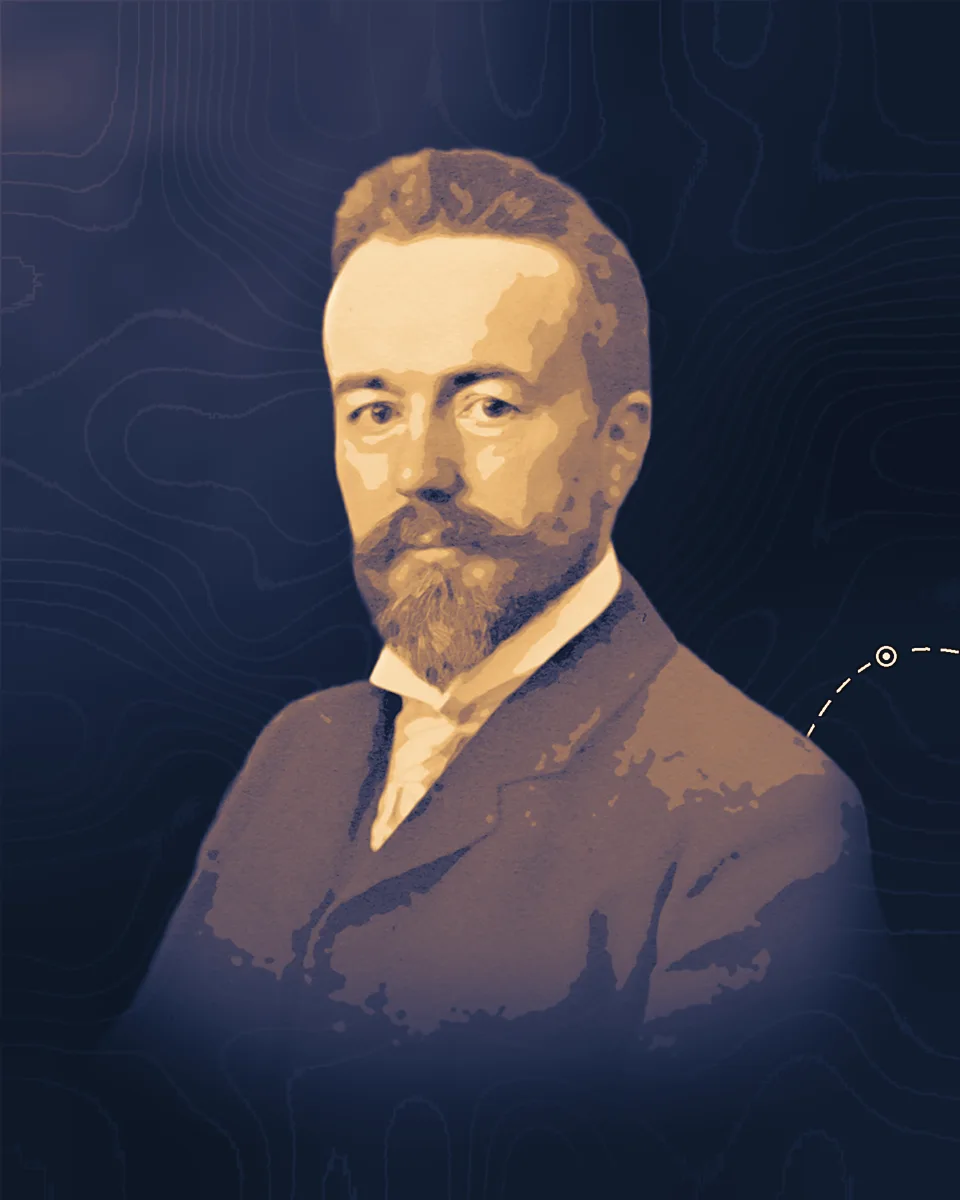
Aurel Stodola
He wrote the book engineers designed steam and gas turbines from, and showed how to work out a turbine's steam flow from charts of measured values.
1859–1942
What they changed
1895
Governors that hold steady
Stodola wrote down the equations for the speed-governing systems of hydroelectric plants and tested them at a plant. He asked his colleague Adolf Hurwitz for help with the mathematics, which led Hurwitz to the stability test that carries his name and is still taught in control engineering.
1903
The turbine book
A lecture of 1902 to the Society of German Engineers became Die Dampfturbinen in 1903. Later editions, titled Dampf- und Gasturbinen, took in gas turbines, and it was translated into English and French. The Dictionary of Scientific Biography says it "holds a unique place in the literature of engineering" and that, in the decades when the steam turbine grew, Stodola was "the leading authority on that machine."
1904
Design from charts
The properties of steam change with temperature and pressure in ways no simple formula captures. Stodola was the first to base the analysis of heat engines on entropy charts, graphs of measured values on which a real machine can be compared with an ideal one, and he soon took up the chart Richard Mollier proposed in 1904. The same source says the approach was adopted universally shortly afterwards.
1939
The first power gas turbine
At the age of 80 he supervised the acceptance tests of the 4 MW gas turbine that Brown Boveri built for the municipal power station at Neuchâtel, Switzerland. It turned 17.4% of its fuel's energy into electricity. The American Society of Mechanical Engineers calls it the first successful electricity-generating gas turbine to go into commercial operation; it stayed in service until 2002.
Life
Aurel Boleslav Stodola was born on 10 May 1859 at Liptovský Mikuláš, then in the Kingdom of Hungary and now in Slovakia, the second son of a leather manufacturer. He studied at the technical university in Budapest, at the University of Zurich and at the Swiss Federal Polytechnic in Zurich, now ETH Zurich, where he graduated as a mechanical engineer in 1880.
He spent two years as a volunteer in the machine works of the Hungarian State Railways, studied further in Berlin and Paris, and worked in his father's factory. From 1886 to 1892 he was chief engineer at Ruston and Company in Prague, where he designed steam engines of many kinds. In 1892 the Zurich polytechnic, which remembered him as a student, appointed him to its new chair of thermal machinery. He held it until he retired in 1929.
He did not invent the steam turbine. It dates from the 1880s, and his subject from about 1900 was how to design it well. He studied how steam flows through the flared nozzles of Gustaf de Laval, where it was disputed whether the flow could go faster than sound, and his careful experiments produced the first results that agreed with theory. He also worked on vibration and on the critical speeds at which a turbine shaft shakes. Most of what he found went straight into the next edition of the book.
His teaching, his consulting for industry and his research ran together, and he worked closely with Swiss turbine builders. During the First World War he worked on better artificial limbs. His friends included Albert Einstein. He stayed in Zurich after retiring and died there on 25 December 1942.
Read more
3 accounts
Steam Turbines: With an Appendix on Gas Turbines and the Future of Heat Engines, Aurel Stodola, translated by Louis C. Loewenstein, 1905.
The first English edition of the book, from the second German edition.
archive.org
Stodola, Aurel Boleslav, Otto Mayr, Dictionary of Scientific Biography, 1976.
The standard short scholarly life, by a historian of control engineering.
encyclopedia.com
Neuchâtel Gas Turbine, American Society of Mechanical Engineers, landmark 135, 1988.
The record of the machine he tested in 1939.
asme.org