Industries / Figureheads
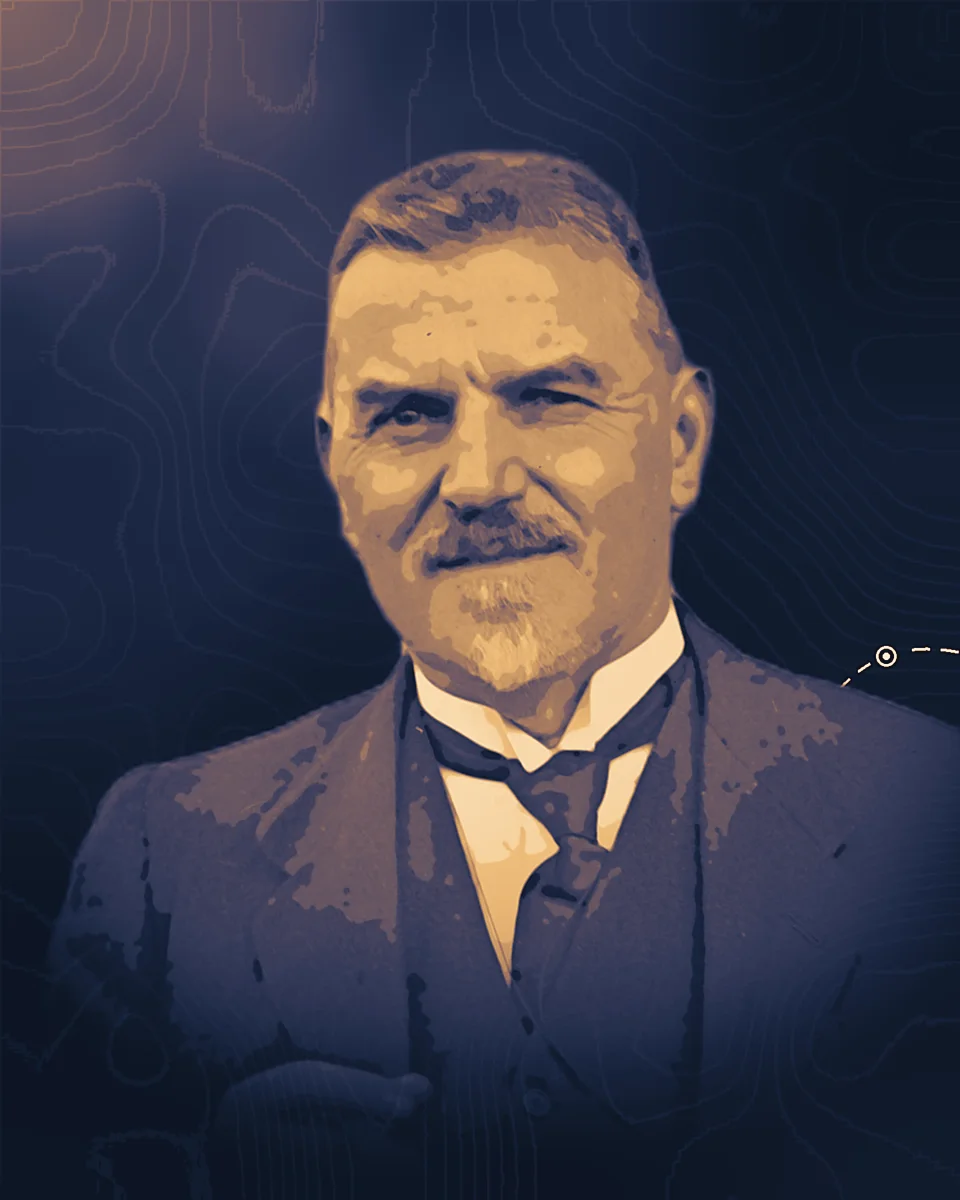
Arnold Theiler
A Swiss veterinarian in South Africa, he made the vaccine that helped drive out rinderpest, showed that a tick carries East Coast fever, and built the Onderstepoort laboratory that made vaccines for the region's herds.
1867–1936
What they changed
1896
Rinderpest vaccine for southern Africa
When rinderpest, a viral cattle plague, swept south in 1896, the Transvaal government made Theiler its veterinary surgeon. With H. Watkins-Pitchford of Natal he developed a serum-virus vaccination, giving immune serum with the live virus, later refined with the scientists J. Bordet and J. Danysz, whom the Transvaal had asked the Pasteur Institute in France to send. Robert Koch published his bile vaccine first, but by the S2A3 biographical database's account Theiler's method proved safer and more effective, and it was widely applied. The disease was driven out of South Africa, after about half the country's cattle had died.
1900s
Ticks spread East Coast fever
After the Anglo-Boer War, cattle brought in to restock the herds carried a new disease, East Coast fever. After two years of work Theiler showed it was caused by an unknown organism carried by ticks, later named Theileria parva after him. Dipping cattle to kill the ticks eventually rid South Africa of it.
1908
A laboratory at Onderstepoort
Theiler persuaded the colonial government of the Transvaal to build a modern research laboratory on the farm De Onderstepoort, north of Pretoria, opened in 1908 and called a "Palace of Extravagance" by some politicians. Its staff studied redwater, gallsickness, heartwater, horse sickness, bluetongue and plant poisonings, and by 1926 it was issuing 2 million doses of anthrax vaccine a year free of charge, and up to 2.5 million doses of bluetongue vaccine.
1912
Lamsiekte studied on the veld
From 1912 the institute ran a station at Armoedsvlakte, near Vryburg, to study lamsiekte, a form of botulism in cattle. Its staff analysed veld plants for phosphate and dosed cattle with phosphorus.
1920
A veterinary school in Africa
Theiler was largely responsible for setting up the Faculty of Veterinary Science at the University of Pretoria and became its first dean in 1920, as well as director of veterinary research, until he retired in 1927.
Life
Franz Arnold Theiler was born on 26 March 1867 at Frick, in the Swiss canton of Aargau, the son of a teacher. He studied veterinary science at Bern and Zurich, finishing in August 1889, and after a short time in practice emigrated in 1891 to the South African Republic, the Transvaal. There were no veterinary services in the two Boer republics, and he started as a farm hand, losing his left hand in a chaff cutter.
His first public work was for people. Expecting smallpox to spread from Swaziland, he ordered the virus strain and equipment from Switzerland, and when the disease reached mineworkers in Johannesburg in 1893 he made enough vaccine within months to bring the outbreak under control. In 1896 President Paul Kruger sent him to Rhodesia, now Zimbabwe, to report on a cattle disease moving south, and he confirmed it was rinderpest.
In 1898 he became director of a new bacteriological institute at Daspoort near Pretoria, which made rinderpest serum, smallpox vaccine for people and vaccines for blackquarter and lungsickness in cattle. He served the Transvaal's artillery as its veterinarian early in the Anglo-Boer War, and after the British took Pretoria they kept him on to continue his research.
The rinderpest campaign came at a great cost. The S2A3 database records that it was won only after half the cattle of the country, and more of its wild hoofed animals, had died, and that the losses convinced the authorities that animal disease research was worth paying for. The vaccine work was shared: Watkins-Pitchford developed the serum-virus method with him, and Bordet and Danysz helped refine it.
He retired from Onderstepoort at the end of 1917, was recalled in 1920 and retired again in 1927. He continued research in Switzerland, returned to Onderstepoort in 1934, and died in London on 24 July 1936; his ashes lie beneath his statue at Onderstepoort. He published about 240 papers, and the universities of Cape Town and the Witwatersrand gave him honorary doctorates in 1935. He married Emma Sophie Jegge, and they had two sons and two daughters.
Read more
4 accounts
Theiler, Dr Sir Franz Arnold, compiled by D. W. Verwoerd, S2A3 Biographical Database of Southern African Science. A full account of his career, with its sources.
s2a3.org.za
Concise History of ARC-Onderstepoort Veterinary Institute, Agricultural Research Council, South Africa. The institute's own history, from the rinderpest station to the vaccine output of the 1920s, with photographs.
arc.agric.za
Onderstepoort 100 Years, Part 1, Veterinary History Society of South Africa, undated. A centenary history of the laboratory he built.
vethistorysa.co.za
They Came to South Africa, Fay Jaff, undated. A book of lives of immigrants to South Africa, with a section on Theiler.
archive.org