Industries / Figureheads
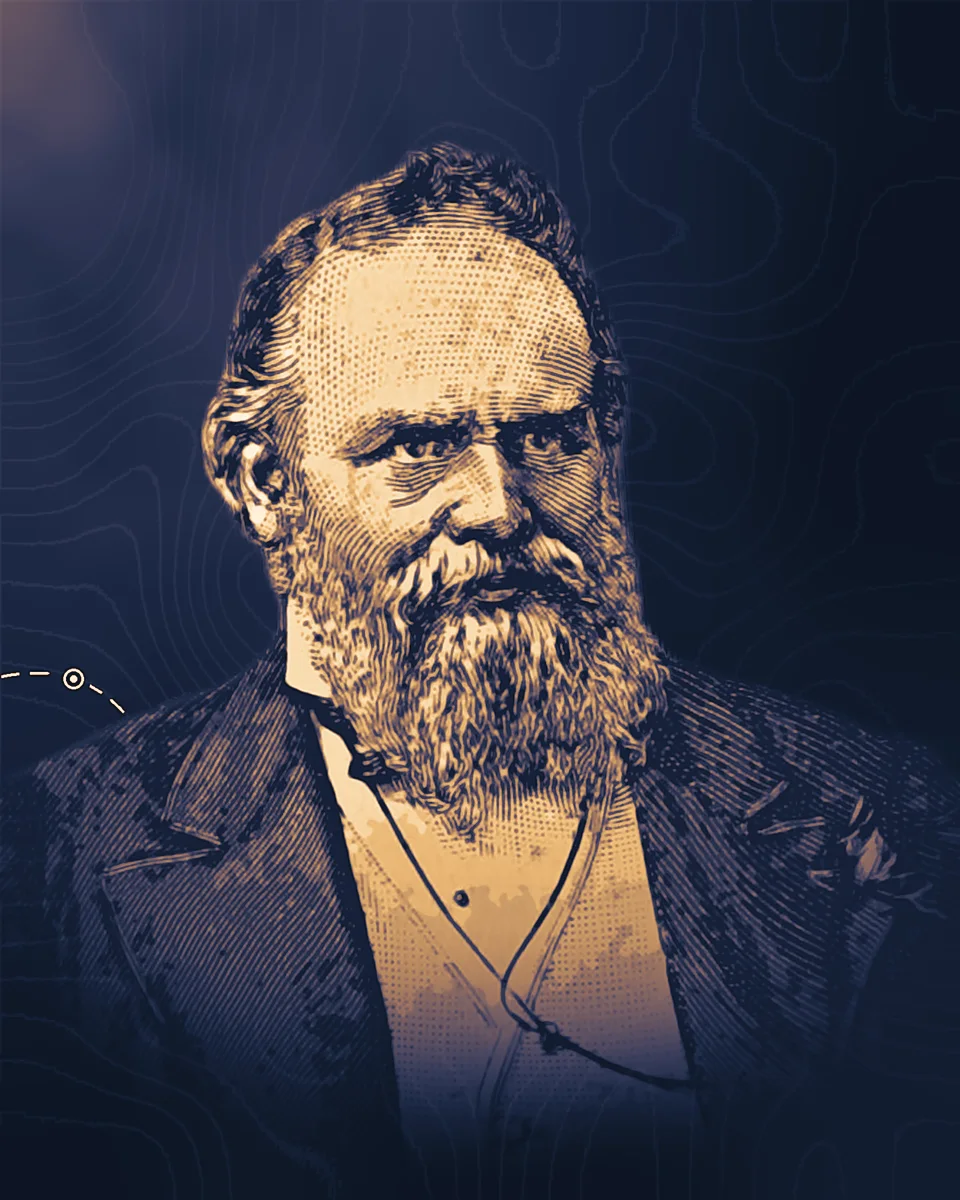
Aristide Boucicaut
With his wife Marguerite he turned a small Paris draper's shop, Le Bon Marché, into a store with marked prices, free entry, returns, small margins and a building of its own, the model later department stores copied.
1810–1877
What they changed
1852
Marked prices, open doors
Boucicaut became a partner of the Videau brothers in their shop Au Bon Marché, at the corner of the rue de Sèvres and the rue du Bac. A 2016 history in the bulletin of France's Académie nationale de médecine lists the practices the Boucicauts worked out there: entry was free, exchanges were accepted, prices were on show, goods were delivered to the home and sold by mail. The Fondation Napoléon's history adds that goods were sold at a fixed price "et non à la tête du client" (not by sizing up the customer), could be touched and tried on, and were sold off at the end of a line.
1850s
Small margins, fast sales
The Académie's history says the Boucicauts cut their margins hard "pour vendre beaucoup, et vite" (to sell a lot, and quickly). The store's own 1894 booklet gives his rule as "the system of selling everything at a small profit and entirely on trust", and says he began the practice of taking back and refunding anything that did not suit the buyer on reflection. By the Fondation Napoléon's count, sales grew 44 times over in twelve years.
1869
A building made for selling
In 1869 Boucicaut laid the first stone of a new building for the store. The Académie's history says it formed, with the older shop, "le premier Grand Magasin en Europe" (the first department store in Europe), and EBSCO's Research Starters says it "is considered the first department store." The store's booklet reprints a Larousse dictionary entry that puts its sales in the year of his death at more than 82 million francs.
1876
A stake for the staff
By the Larousse entry, Boucicaut paid his staff a share of their own sales, promoted them by length of service and merit, kept a doctor for free consultations, and from June 1872 ran free classes for them in foreign languages, fencing and music. On 31 July 1876 he set up a provident fund (caisse de prévoyance) that built up a small capital for each employee, or a dowry for young women, without any deduction from their pay, and he added to it at every stocktaking.
Life
Jacques-Aristide Boucicaut was born in Bellême, in the Orne department of Normandy, on 14 July 1810, the son of a hatter. He went into the drapery trade young and worked as a shop assistant in the provinces and then in Paris, where he was a clerk at the Petit Saint-Thomas, a shop on the rue du Bac selling cloth, buttons and trimmings.
He met Marguerite Guérin, a dairy-shop worker, in Paris. His family opposed the match because of her poor birth, and the couple married on 5 October 1848, by the account of Jacques Trotoux and Michel Germain in the Académie's bulletin. The Bon Marché was their joint work. The Banque de France's economics museum, Citéco, says the store "was set up in Paris by Aristide and Marguerite Boucicaut", and LVMH, which owns it now, says the two became its owners in 1863, when they bought out the Videau brothers.
The credit for the department store is shared and argued over. EBSCO's history says Xavier Ruel of the Bazar de l'Hôtel de Ville brought in fixed prices in 1856, and that Alexander Turney Stewart's Marble Palace in New York dates from 1846. Citéco lists the Bazar de l'Hôtel de Ville (1856), Printemps (1865) and La Samaritaine (1869) as followers of the Bon Marché, and EBSCO says Printemps was selling by mail from seven catalogs by 1872. The Académie's history says Émile Zola took the Bon Marché, with the Grands Magasins du Louvre, as the model for his 1883 novel Au Bonheur des Dames.
The store ran on its staff. The Fondation Napoléon's history says salespeople were trained to advise customers, and that unmarried women employees were lodged in dormitories on the top floor. The Académie's history lists Sunday rest, a canteen, free medical care and paid leave. The store's own booklet describes the young women employees as the object of "une sollicitude toute paternelle" (a wholly paternal concern), lodged in its buildings on the rue de Babylone.
Boucicaut died in Paris, almost without warning, on 26 December 1877. He left the store to his only son, Antony-Aristide, who died in 1879, and Marguerite then ran it alone until her own death in 1887.
Read more
4 accounts
The Bon Marché: Bourgeois Culture and the Department Store, 1869–1920, Michael B.
Miller, Princeton University Press, 1981. The standard history of the store, its staff and its customers, written from the store's archives.
archive.org
Souvenir offert par les magasins du Bon Marché fondés par Aristide Boucicaut, Au Bon Marché, 1894.
The store's own booklet, with portraits of both founders, the Larousse dictionary's entries on their lives and the store's account of its rules.
archive.org
L'Hôpital Boucicaut : 100 ans de médecine, Jacques Trotoux and Michel Germain, Bulletin de l'Académie nationale de médecine, 2016.
A history of the hospital Marguerite's will paid for, which opens with the couple's lives and their trade.
academie-medecine.fr
Les grands magasins sous le Second Empire, Marie de Bruchard, Fondation Napoléon, 2016.
A short history of the Paris department stores of the 1850s and 1860s and their methods.
napoleon.org