Industries / Figureheads
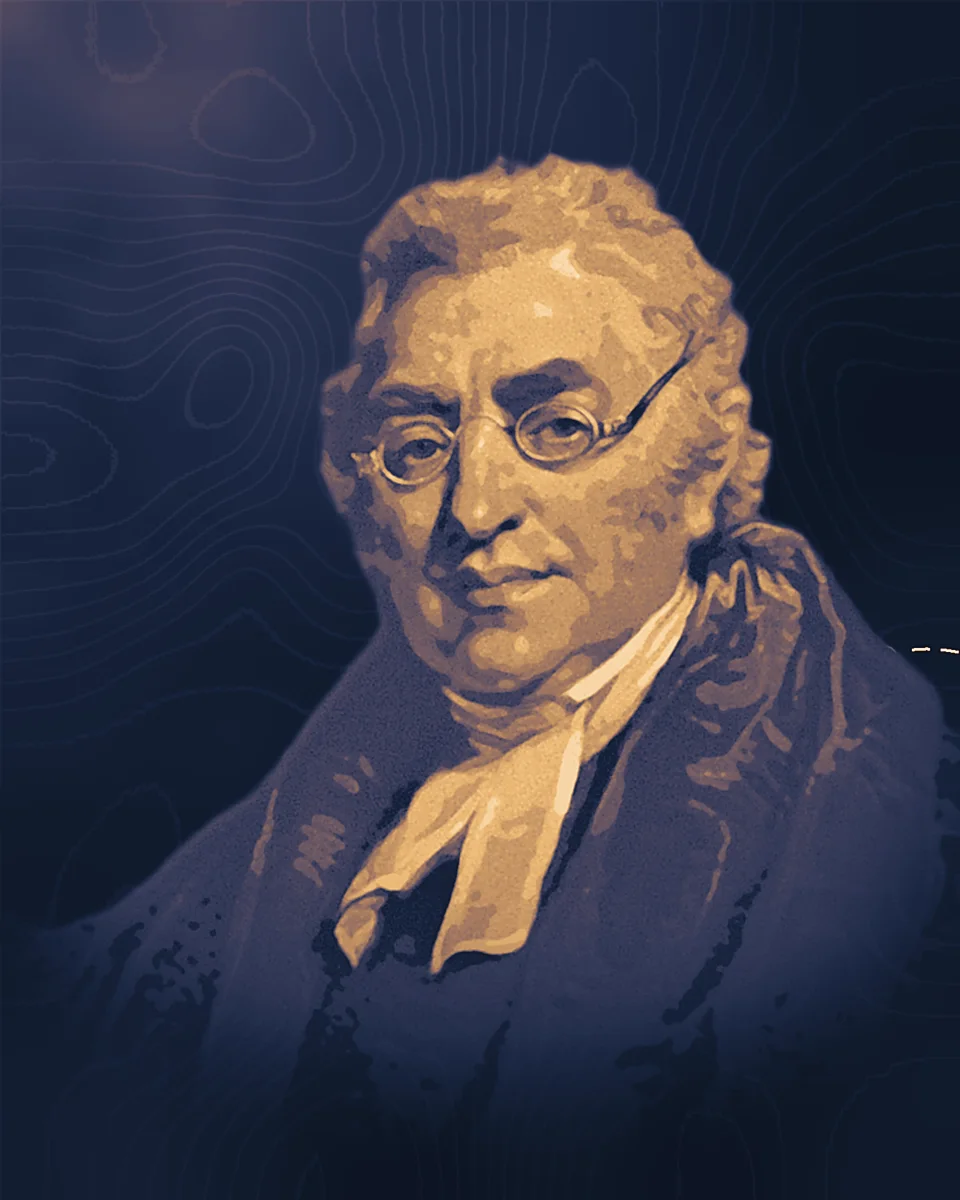
Andrew Bell
At an orphan school in Madras he had older pupils teach the younger ones, and his "Madras system" became the plan of the Church of England's schools for the poor.
1753–1832
What they changed
1790s
Pupils teaching pupils
At the Male Orphan Asylum at Egmore, near Madras, which he ran without pay, Bell could not get the hired masters to teach his way. Riding past an Indian school held in the open air, he saw small children writing letters with their fingers in sand. He had a boy, John Frisken, the son of a private soldier, teach the alphabet that way, then made other boys teachers of the classes below them, until the boys did nearly all the teaching. This is the account of his biographer J. M. D. Meiklejohn.
1797
The method in print
Bell left India on 20 August 1796, and in 1797 he published An Experiment in Education, made at the Male Asylum at Madras in 1797, a system "by which a school or a family may teach itself under the superintendence of the master". The historian Ellwood Cubberley records that the plan was soon taken up by a number of charity schools.
1811
A national network of schools
In 1811 churchmen formed the National Society for Promoting the Education of the Poor to spread Bell's plan, with the Archbishop of Canterbury as president. Within a month £15,000 had been given, and by 1831 its monitorial schools taught 900,412 children, by Cubberley's figures. One master with monitors could teach from 200 to 1,000 pupils.
1810s
Teachers trained by the society
The National Society set up a training school for teachers, and Cubberley counts the model schools of Bell's and Lancaster's societies as the beginning of teacher training in England.
Life
Andrew Bell was born in St Andrews, Scotland, on 27 March 1753, and studied at the university there. He went to Virginia as tutor to a tobacco planter's sons, and on his way back in 1781 his ship was wrecked and a whaler picked him up. He was ordained and sailed for India in 1787 as chaplain to several regiments, and in 1789 he became minister of St Mary's Church, Madras.
The Madras asylum's boys were mostly sons of European fathers and Indian mothers. Meiklejohn records that they were kept from their mothers' families, and that Bell hoped "to alter the character of a race of men". The writing in sand that started the system was copied from an Indian school. Cubberley adds that the monitorial idea was older than either Bell or Joseph Lancaster: a monitorial school ran in Paris in 1790, and the English schoolmaster John Brinsley described the principle in 1612.
Bell and Lancaster spent years quarrelling over who had invented the system. The church took Bell's side and the Dissenters Lancaster's, and the two rival societies, Bell's National Society and Lancaster's British and Foreign School Society, divided England's schools for the poor between them. Bell became rector of Swanage in 1801, Master of Sherburn Hospital in 1809 and a prebendary of Westminster. He married Agnes Barclay; they later separated.
In his last years he lived at Cheltenham. On 11 May 1831 he ordered £120,000 transferred to four trustees in St Andrews for education there. He died on 27 January 1832 and was buried in the nave of Westminster Abbey, where a monument by William Behnes shows him seated among schoolboys.
Read more
5 accounts
An Old Educational Reformer, Dr Andrew Bell, J. M. D. Meiklejohn, William Blackwood, 1881.
A life by the professor of education at St Andrews.
archive.org
An Analysis of the Experiment in Education, made at Egmore, near Madras, Andrew Bell, 1807.
His own account of the system, expanded from the tract of 1797.
archive.org
Joseph Lancaster, David Salmon, 1904.
A life of his rival that sets out the quarrel over the system and compares the two men.
archive.org
The History of Education, Ellwood P. Cubberley, Houghton Mifflin, 1920.
Its chapter on England gives the spread, the numbers and the costs of monitorial schools.
archive.org
Andrew Bell, Westminster Abbey, undated. The abbey's page on his life, grave and monument.
westminster-abbey.org