Industries / Figureheads
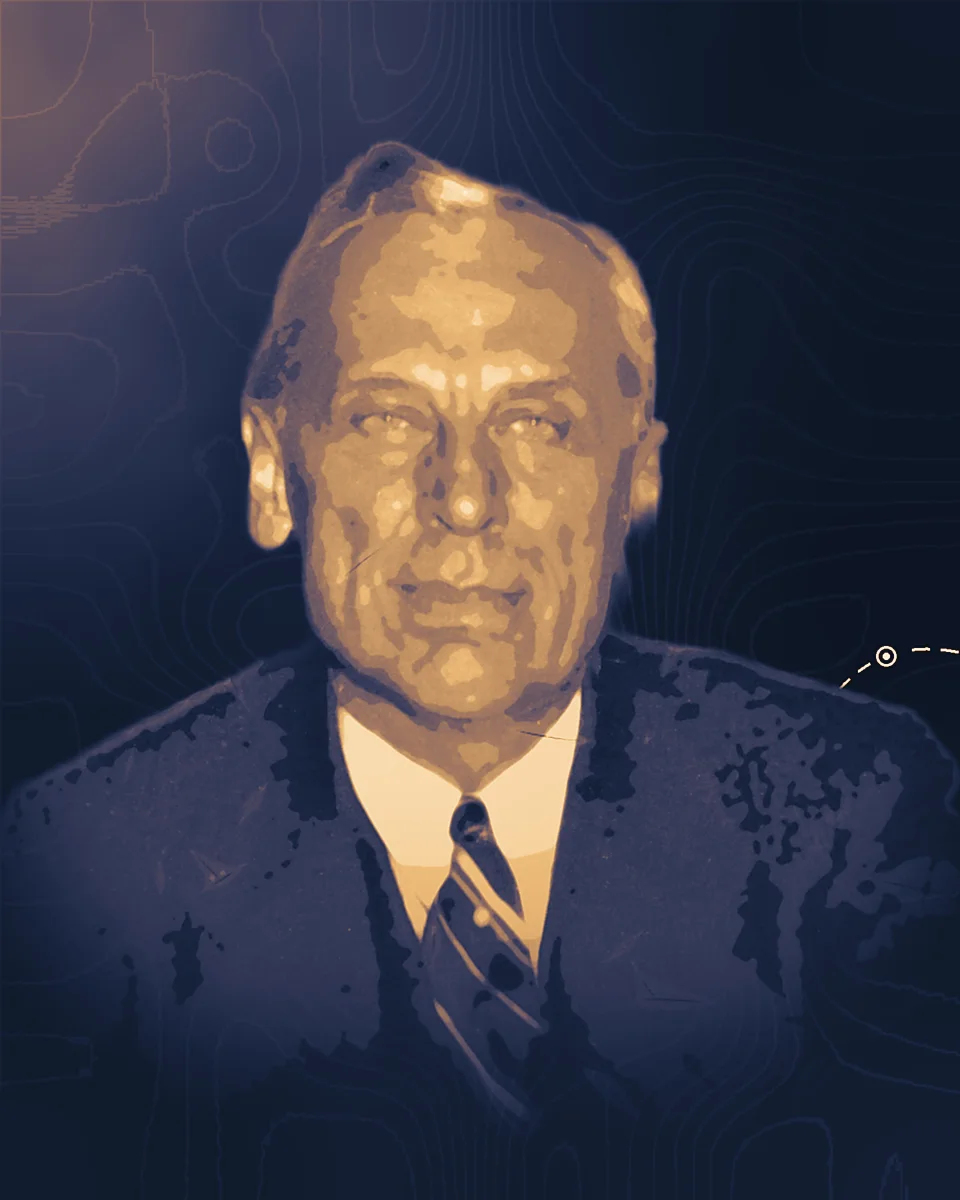
Alfred P. Sloan
He organized General Motors as separate divisions under one central office, each with its own price class of car, a pattern large car makers still follow.
1875–1966
What they changed
1920
Divisions under a central office
General Motors had been stitched together from separate car and parts firms by William Durant. As vice president of operations from 1920 and president from 1923, Sloan gave each firm its own division and manager and set one central staff over them. The New York Times wrote that he "centralized administration and decentralized operations".
1920s
A car for each price
He lined up the brands so that, in the Times's words, "one brand of automobiles did not conflict with another". Chevrolet was the cheapest, and a buyer whose income rose could trade up to Oldsmobile, Buick or Cadillac.
1920s
A new model every year
Where Ford sold one unchanged car, Sloan brought out a new model of each brand each year, with changes in engineering or in looks that gave owners a reason to replace a car that still ran. General Motors also sold cars on credit to buyers without the cash.
1929
Past Ford
In six years from 1923 General Motors' sales rose from $698 million to $1.5 billion, and Chevrolet passed Ford as the best seller among low-priced cars. The company's share of American vehicle sales went from under 12 percent in 1920 to 52 percent in 1956, when he stepped down.
Life
Alfred Pritchard Sloan Jr. was born in New Haven, Connecticut, on 23 May 1875, the son of a coffee and tea importer, and grew up in Brooklyn. He entered the Massachusetts Institute of Technology at 17 and finished in three years. He started as a draftsman at the Hyatt Roller Bearing Company in Harrison, New Jersey. His father and another man put up $5,000 to give him control of it, and he made it a supplier of bearings to Olds, Ford and the rest of the young car trade.
In 1916 Durant bought Hyatt for $13.5 million, merged it with other parts makers as United Motors and made Sloan its president. General Motors absorbed United Motors in 1918 and Sloan came with it. When the du Pont interests pushed Durant out, Pierre du Pont took the presidency, leaned on Sloan, and handed him the post in 1923.
He ran the company as president until 1937 and as chairman until 1956. He was known as "Silent Sloan" and said he never gave orders: "I sell my ideas to my associates if I can." He spent two weeks of every month in Detroit and by his own account visited dealers in almost every city in the country, five to ten a day.
He opposed the unions and the New Deal. In early 1937 workers occupied General Motors plants for 44 days to win recognition of their union. Sloan refused to deal with them while they held the plants, President Roosevelt rebuked him, and he left the talks to William Knudsen and other executives. The same year Treasury experts told Congress that Sloan and his wife had avoided $1,921,587 in income tax over three years through personal holding companies. The government did not say this was illegal, and Sloan denied dodging a fair share.
Later in 1937 he gave $10 million to the Alfred P. Sloan Foundation. His gifts built the Sloan-Kettering Institute for cancer research in New York, founded in 1945 with his research chief Charles Kettering, and the school of management at MIT that bears his name. His book My Years with General Motors came out in 1964. He died in New York on 17 February 1966, aged 90. Henry Ford II called him "one of the small handful of men who actually made automotive history".
Read more
3 accounts
Alfred P. Sloan Jr. Dead at 90; G.M. Leader and Philanthropist, The New York Times, 18 February 1966.
The long obituary, with the business figures, the strike and the tax affair.
archive.nytimes.com
My Years with General Motors, Alfred P. Sloan Jr., Doubleday, 1964.
His own account of how the company was organized, written from its files.
archive.org
Henry Ford and Alfred P. Sloan: Industrialization and Competition, David Pietrusza, Bill of Rights Institute, undated. A short essay for students that sets the two men's methods side by side.
billofrightsinstitute.org