Industries / Figureheads
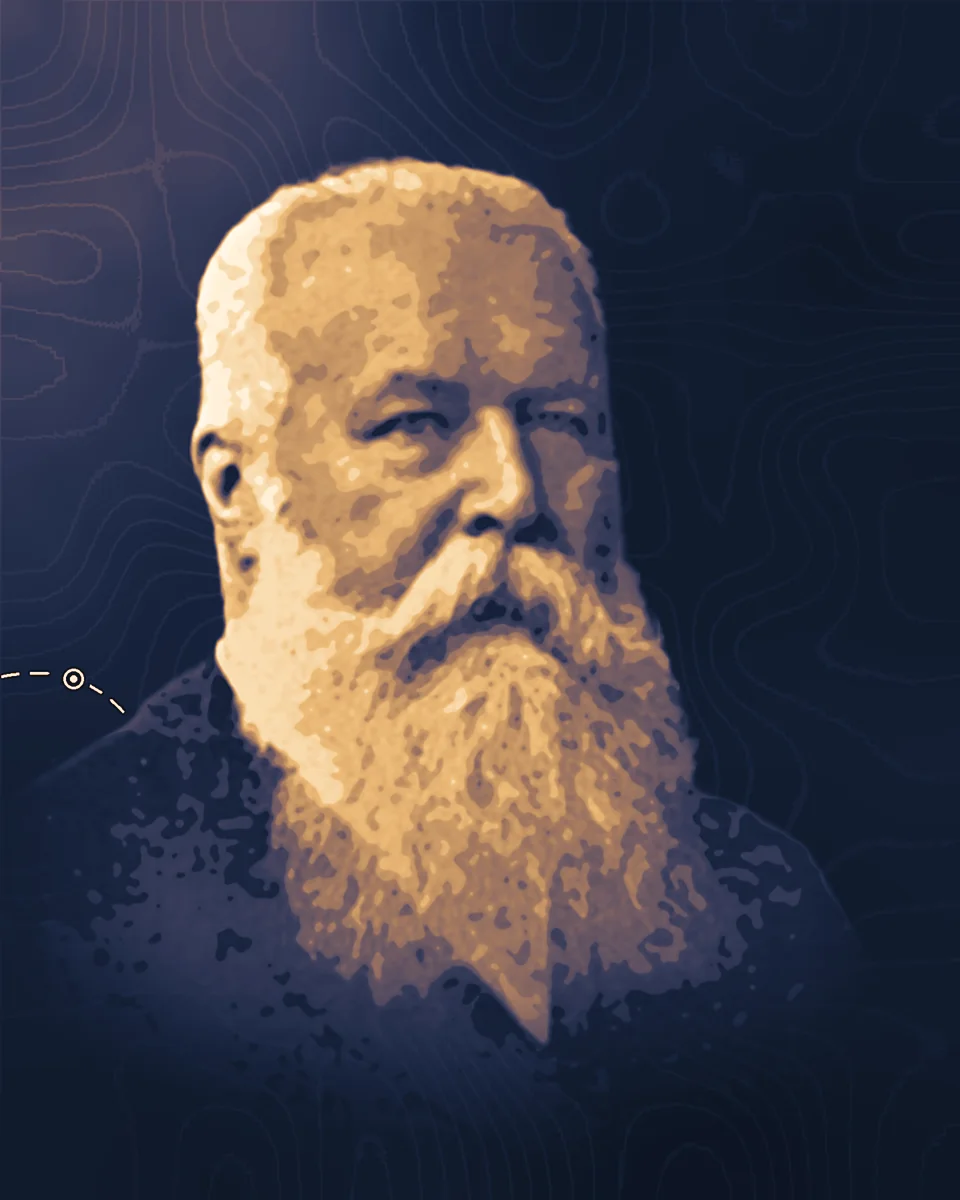
Alexander Mitscherlich
A German chemistry professor who built sulfite cooking of wood into a working factory process and licensed it to the mills that founded Germany's pulp industry.
1836–1918
What they changed
1872
A professor takes up wood
Mitscherlich taught chemistry at the Prussian forestry academy at Hannoversch Münden. In 1872, prompted by his brother Oskar, he began work on freeing cellulose, the fibre of wood, by chemistry, so that it could be made into paper.
1874
Sulfite cooking as a process
With his brother Richard and a local manufacturer named Rißmüller he worked out a factory method. Chipped, barked wood was heated for several days in a pressure vessel at 2.5 to 5 atmospheres in sulfite liquor. The liquor was made by passing the gas from roasted pyrite up towers 30 metres high filled with limestone. The brothers took out German and foreign patents between 1874 and 1878.
1877
A mill and licences
In 1877 he was allowed to build his own pulp mill at Hannoversch Münden, and from 1879 he signed contracts with licensees. Many pulp mills were built on his method within a few years.
1884
The patent falls
A paper maker named Behrend sued, and in 1883 parts of German patent 4179 were declared void. Germany's supreme court confirmed it in 1884, because the American Benjamin Chew Tilghman had patented pulping with calcium bisulfite in 1866 and 1867. The licensees stopped paying, and Mitscherlich fought about 30 lawsuits against them between 1884 and 1900.
Life
Alexander Mitscherlich was born in Berlin on 28 May 1836, the youngest of six children of the chemist Eilhard Mitscherlich. Alexander von Humboldt was his godfather. He began medicine at Göttingen in 1857 at his father's wish, gave it up after one term and studied chemistry in Berlin, partly under his father. He took his doctorate in 1861, worked as assistant to Friedrich Wöhler in Göttingen and in the Paris laboratory of Adolphe Wurtz, and from 1863 to 1868 lectured in Berlin. In 1867 he was one of the founders of the German Chemical Society.
In 1868 he was called to the new forestry academy at Hannoversch Münden as professor of chemistry, physics and geology. He served in the Franco-Prussian War of 1870 to 1871 and then turned to wood. He was not the first to cook wood in sulfite. Tilghman had patented the chemistry in the United States and abandoned it when his equipment corroded. In Sweden the chemist Carl Daniel Ekman devised a sulfite method in 1872, and the mill at Bergvik used it from 1874, before Mitscherlich had a mill of his own. A 2018 review from the US Forest Products Laboratory credits Tilghman with the discovery and says that "other engineers, inspired by his work, went on to develop the sulfite process".
deutsche-biographie.deresearch.fs.usda.govsverigesingenjorer.se
His mill brought him into conflict with his employer. In 1881 the Prussian ministry that ran the academy told him to sell it, fearing that the business would harm his teaching. He asked for his release in 1883, sold the mill and moved to Freiburg im Breisgau as a private man. The loss of the patent followed within a year, and the lawsuits against his licensees took up much of the next two decades. He settled with some of the firms in 1897.
In 1893 he founded a chemical works at Hof that made, among other things, size for paper mills. His attempts to make yarn and cloth from pulp or straight from wood fibre came to nothing commercially. Wide recognition came only on his 80th birthday in 1916, when the trade journal Der Papier-Fabrikant called him "der Begründer der Zellulose-Fabrikation", the founder of pulp making, and the German association of pulp and paper chemists made him an honorary member. He died at Oberstdorf on 13 May 1918. In 1936 the association founded a medal in his name for work on cellulose.
Read more
4 accounts
Mitscherlich, Alexander, Frieder Schmidt, Neue Deutsche Biographie, 1994.
The national biography's entry, by a historian of paper, with the patent case and a list of the older literature. In German.
deutsche-biographie.de
Zu Alex. Mitscherlich's 80. Geburtstag, Georg Reuter, Der Papier-Fabrikant, 1916.
A birthday article from the trade, with the portrait and an account of the first trials in glass tubes. In German.
archive.org
Lebensbeschreibung von Alexander Mitscherlich, Alexander Mitscherlich, 1887.
His own short life, written by hand for an album now at the Deutsches Museum. In German.
commons.wikimedia.org
Pulping, Carl Houtman, US Forest Products Laboratory, 2018.
A review chapter that places the sulfite process between soda and kraft cooking and says what limits it.
research.fs.usda.gov