Industries / Figureheads
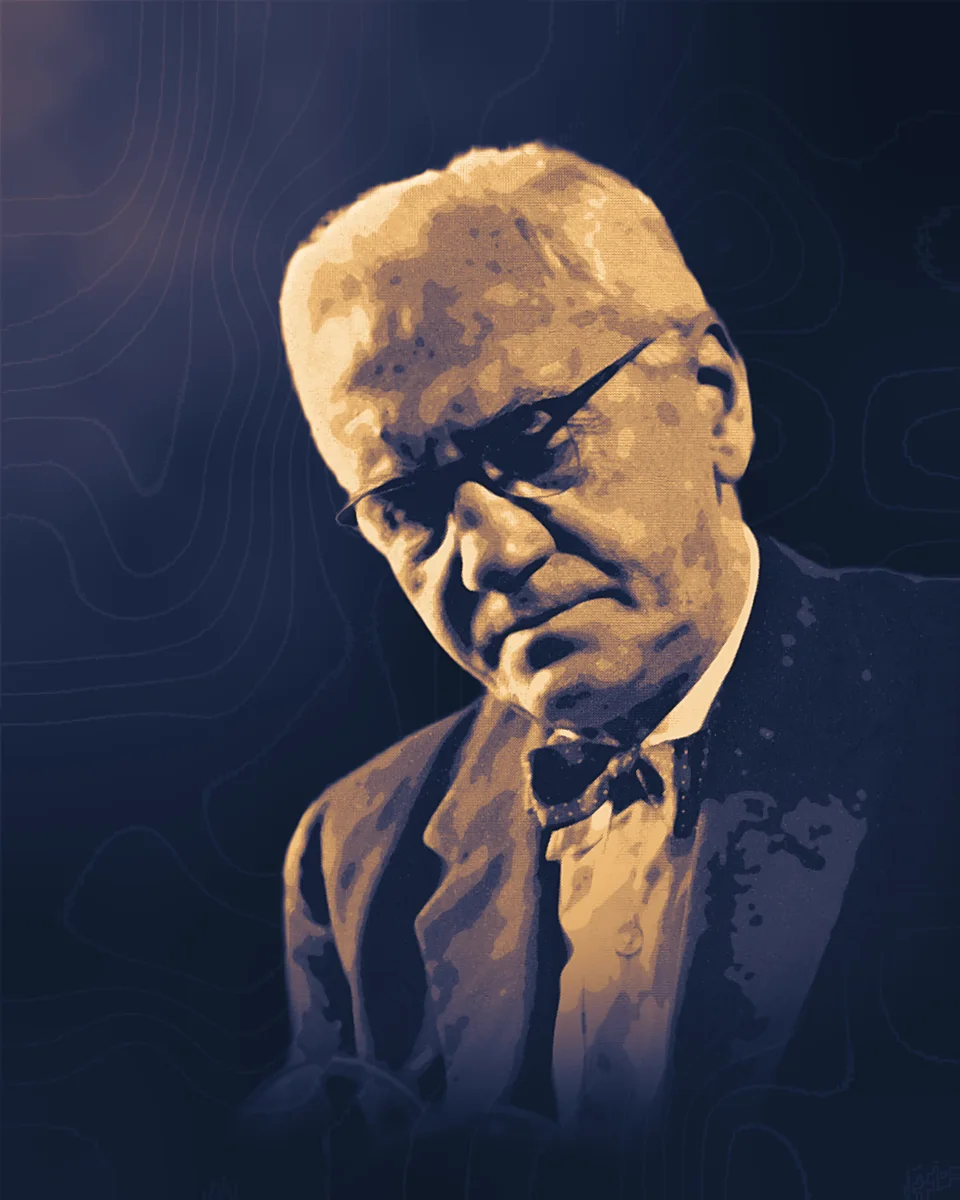
Alexander Fleming
He noticed in 1928 that a mould had killed the bacteria around it on a culture plate, named its product penicillin and published the finding that others turned into a medicine twelve years later.
1881–1955
What they changed
1921
Lysozyme
He found in body tissues and fluids a substance that dissolves some bacteria, and named it lysozyme. Around the same time he worked out ways to measure how strongly a substance stops bacteria growing in blood and other fluids, which he later used on penicillin.
1928
A mould on a plate
Back from a holiday, he saw that a mould had grown by accident on a plate of staphylococcus bacteria and that no bacteria grew in a ring around it. He grew the mould, a Penicillium, and found that its broth stopped staphylococci growing even when diluted 800 times. He named the active substance penicillin.
1929
Published, then stalled
His paper came out in June 1929 and few scientists took notice. He could not purify the unstable substance, and for about a decade he used penicillin as a surface antiseptic and as a laboratory tool for sorting bacteria. He sent the mould to anyone who asked for it, and a culture kept at Oxford from one such request was the one Howard Florey's team later worked from.
1945
A warning about resistance
In his Nobel lecture he said: "It is not difficult to make microbes resistant to penicillin in the laboratory by exposing them to concentrations not sufficient to kill them, and the same thing has occasionally happened in the body." He pictured a man who takes too little for a sore throat and passes on a resistant germ, and ended: "If you use penicillin, use enough."
Life
Alexander Fleming was born on 6 August 1881 at Lochfield, a farm near Darvel in Ayrshire, Scotland. He moved to London as a boy, spent four years as a clerk in a shipping office, and then entered St Mary's Hospital Medical School, where he qualified in 1906. He stayed at St Mary's for the rest of his working life, at first in the department of Sir Almroth Wright, who believed in treating infection with vaccines.
In the First World War he served as a captain in the Army Medical Corps at a wound research laboratory in Boulogne. There he showed that the antiseptics poured into deep, ragged wounds did not sterilize them and harmed the white blood cells that fight infection. After the war he looked for substances that would kill bacteria without harming the body's own tissue.
He did not make penicillin into a drug. In his Nobel lecture he said of the substance, "we failed to concentrate and stabilize it", and handed the rest of the story to Florey. The purifying, the animal tests and the first treatments were done at Oxford from 1939 by Florey, Ernst Chain, Norman Heatley and their colleagues.
The public gave him most of the credit all the same. In August 1942 he treated a dying patient with penicillin supplied by Oxford, and the cure was reported in The Times. His chief, Wright, wrote to the paper to claim the discovery for Fleming. Fleming talked freely to the press, and Florey forbade his team to give interviews. The historian Robert Gaynes writes that this led many people to believe, wrongly, that Fleming alone was responsible for penicillin.
He became a professor at St Mary's in 1928, a Fellow of the Royal Society in 1943 and a knight in 1944. In 1945 he shared the Nobel Prize in Physiology or Medicine with Florey and Chain "for the discovery of penicillin and its curative effect in various infectious diseases". He died in London on 11 March 1955 and is buried in St Paul's Cathedral.
Read more
5 accounts
Penicillin, Alexander Fleming, Nobel lecture, 11 December 1945.
His own account of the chance plate, what he tested and where he failed, with the warning about under-dosing.
nobelprize.org
Alexander Fleming: The Man and the Myth, Gwyn Macfarlane, 1984.
A life by a haematologist who also wrote Florey's, written to separate what Fleming did from what was claimed for him.
archive.org
The Life of Sir Alexander Fleming, André Maurois, 1959.
The biography written with his widow's help, translated from the French.
archive.org
The discovery of penicillin: new insights after more than 75 years of clinical use, Robert Gaynes, Emerging Infectious Diseases, 2017.
A short history that covers the Oxford work, the American production and wartime efforts in occupied Europe.
pmc.ncbi.nlm.nih.gov
Alexander Fleming, Science History Institute, undated. A biography that follows his work from wound research to lysozyme and penicillin.
sciencehistory.org