Industries / Figureheads
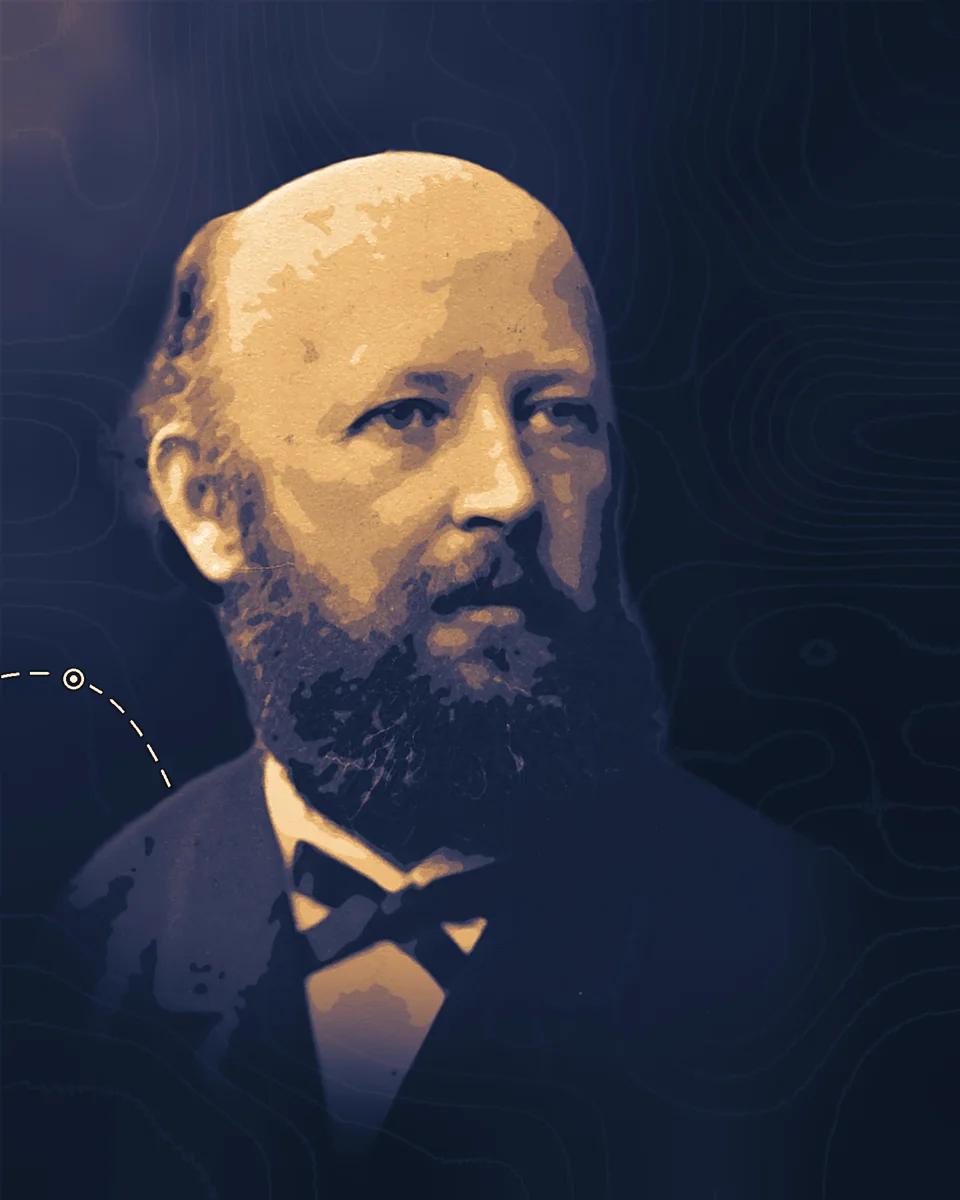
Adolf von Baeyer
He worked out how to build the blue dye indigo from coal-tar chemicals, the laboratory work that factory-made indigo, the dye of blue jeans, rests on.
1835–1917
What they changed
1865
A chemist takes on indigo
Indigo, the blue dye taken from the indigo plant and grown mainly in India, was the most important natural dye of its day. Baeyer began to take it apart chemically in Berlin in 1865. A method he devised along the way, heating a substance with zinc dust, let his students Carl Graebe and Carl Liebermann work out in 1868 how to make the red dye alizarin, which became BASF's first big seller.
1870
Indigo made in a flask
With his student A. Emmerling, Baeyer turned isatin, a substance then obtainable only from indigo itself, back into the dye. By his own account that became a complete synthesis on 6 June 1878, when he made isatin from phenylacetic acid, which does not come from the plant.
1880
A patent the factory dropped
Baeyer found a route to indigo from cinnamic acid and patented it. BASF, the German dye maker, bought the rights. The route cost too much: a regional history says BASF made a little indigo with it from April 1881 and stopped after three years.
1897
Factory indigo goes on sale
BASF put "Indigo Pure BASF" on the market in July 1897. It was not made by Baeyer's route but by one that Karl Heumann, a professor in Zurich, proposed in 1890. BASF counts 17 years of research and 18 million gold marks spent, more than the company's share capital at the time.
1905
A Nobel Prize for dyes
Baeyer received the Nobel Prize in Chemistry "in recognition of his services in the advancement of organic chemistry and the chemical industry, through his work on organic dyes and hydroaromatic compounds." The presentation speech said the price of indigo had already fallen to a third and that Germany exported synthetic indigo worth more than 25 million marks in 1904.
Life
Johann Friedrich Wilhelm Adolf Baeyer was born in Berlin on 31 October 1835. His father, Johann Jakob Baeyer, was a Prussian general who founded the European system of geodetic measurement, the survey of the Earth's shape. He studied physics and mathematics at Berlin, then chemistry under Robert Bunsen and August Kekulé at Heidelberg, and took his doctorate at Berlin in 1858.
From 1860 he taught organic chemistry at the Trade Academy in Berlin, a post with little pay and a large laboratory. He became professor at the new University of Strasbourg in 1871, and was called to Munich to follow Justus von Liebig, who died in 1873; the Science History Institute dates his start there to 1875. In Munich he built a new laboratory and a school of chemists. The Nobel Foundation counts fifty future university teachers among his students.
Indigo was not his only work. He discovered barbituric acid, the parent of the barbiturate drugs, and the phthaleins, a family of dyes that includes eosin. His studies of ring-shaped molecules gave chemists the strain theory that carries his name. The Royal Society of London gave him its Davy Medal in 1881 for the indigo work. He was raised to the hereditary nobility on his fiftieth birthday, which is where the "von" comes from.
The dye that reached the mills was the work of many hands. Baeyer said so himself. In a lecture of 1900 on the history of the synthesis he said it was Heumann's method that had put BASF in a position to compete with the natural product. BASF's own history adds Eugen Sapper, who in 1891 found a cheaper way to make phthalic acid, a starting material for dyes. Baeyer kept his distance from the factories. The Nobel Foundation records that when industry pressed the universities to teach with business in mind, he argued that economic factors should not decide what science studies.
Factory indigo ended a farm trade. The historian Prakash Kumar writes that after BASF's launch the export of natural indigo from India "fell within a decade to less than a fifth of the 1895–6 total". Planters in Bihar pooled money for research stations to improve the plant dye, and Kumar concludes that "even their best efforts failed to save the industry." The Nobel presentation speech of 1905 had welcomed the change, expecting India's indigo fields to grow food instead.
Baeyer died at his country house on Lake Starnberg, near Munich, on 20 August 1917.
Read more
5 accounts
Adolf von Baeyer's Gesammelte Werke, volume 1, Adolf von Baeyer, Vieweg, 1905.
In German: his collected papers, opened by his own memoir of his life and his 1900 lecture on the history of the indigo synthesis.
archive.org
Adolf von Baeyer, Biographical, the Nobel Foundation, 1905.
The biography written at the time of the prize, republished in Nobel Lectures in 1966.
nobelprize.org
Award ceremony speech, A. Lindstedt, Royal Swedish Academy of Sciences, 1905.
What the Academy thought the indigo work had done to industry and to India.
nobelprize.org
Plantation science: improving natural indigo in colonial India, 1860–1913, Prakash Kumar, The British Journal for the History of Science, 2007.
A historian's account of what synthetic indigo did to the planters of Bihar and how they fought back.
cambridge.org
BASF chronicle, BASF Corporate History, 2015.
The company's own year-by-year account, with the indigo entries for 1880, 1890, 1891 and 1897.
basf.com