Industries / Figureheads
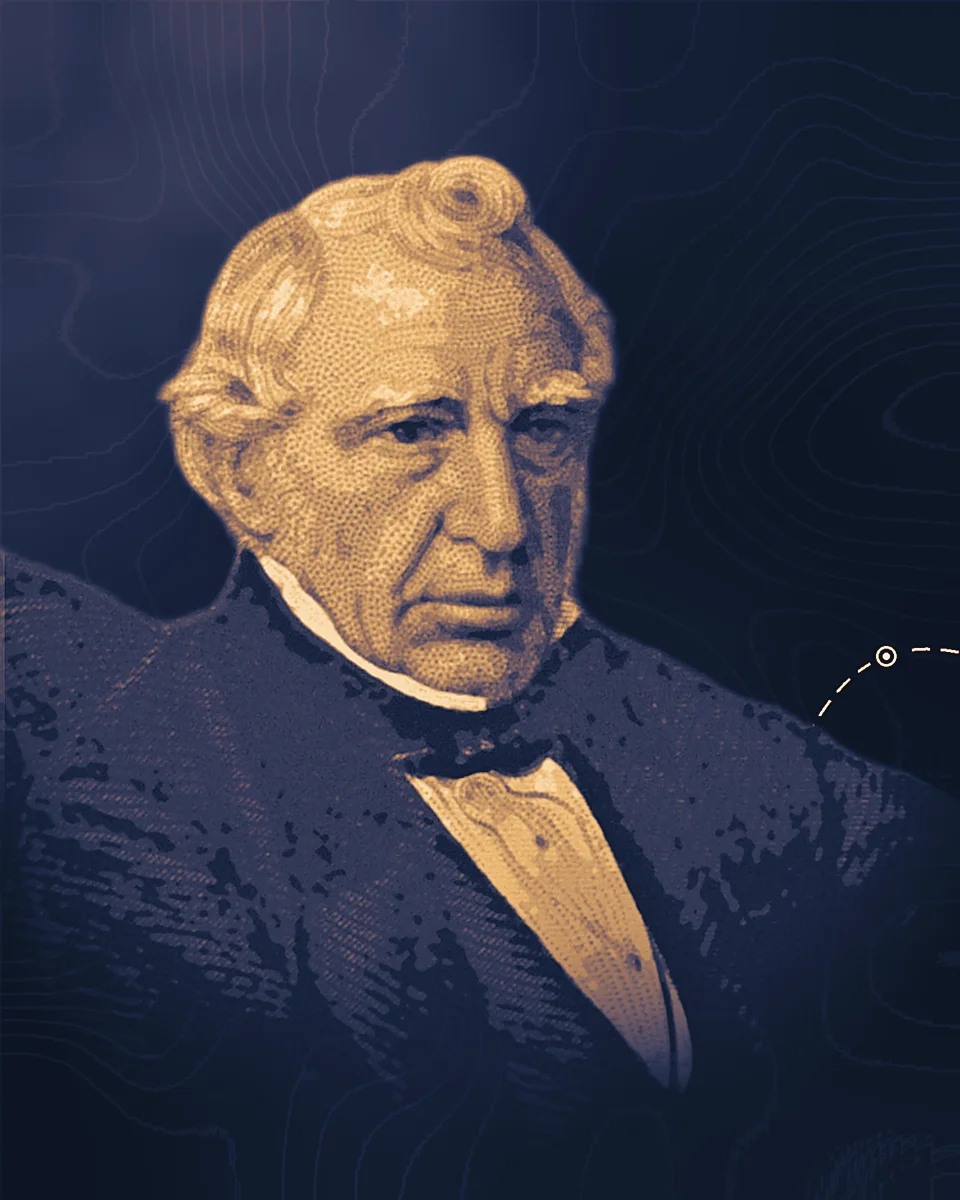
William Fairbairn
He founded the Manchester association that sent its own engineers to inspect members' steam boilers, the start of paid, independent plant inspection.
1789–1874
What they changed
1844
A boiler with two flues
The Cornish boiler of the day had one large fire tube through its water space, which took a heavy crushing strain and had little water above it. Fairbairn and the engineer John Hetherington patented a boiler with two smaller fire tubes on 30 April 1844 (patent no. 10,166). The smaller tubes took less strain, and more water could be kept over them, so a fall in the water level was less likely to leave hot metal bare. By 1877 his biographer called it by far the most usual high-pressure boiler in the manufacturing districts, where it was known as the Lancashire boiler.
1854
Owners hire their own inspectors
After giving evidence at inquests into boiler explosions, Fairbairn proposed that steam users form a society and employ engineers to inspect their boilers at regular intervals. Meetings in Manchester in August and September 1854 set it up, and on 23 January 1855 it was formally established with 271 members. The Science Museum Group says the association employed mechanical engineers to inspect the boilers of members who paid for the service, credits the proposal to Fairbairn, and calls it the first boiler inspection authority in Britain.
1855
A guarantee on every inspection
The association backed each approved boiler with a money guarantee of £300: if it exploded, the damage was made good up to that sum. Its rules said the guarantee was there less to insure members than as a pledge that the inspections were meant to prevent explosions. Its engineers reported the defects they found to each owner in writing, and the owner decided whether to repair them.
1858
Why boiler flues collapse
With money from the Royal Society and the British Association, Fairbairn tested iron tubes of different lengths and thicknesses under outside water pressure until they crushed. He reported to the Royal Society on 20 May 1858 that a tube grew weaker as it grew longer, and that stiff iron rings fixed along a boiler's fire tube shortened its working length and so raised the pressure it could stand. The mathematician Thomas Tate and a young engineer named Unwin, his secretary, worked on the inquiry with him.
Life
William Fairbairn was born in Kelso, in the Scottish Borders, on 19 February 1789. He learned to read and do arithmetic at the parish school and was apprenticed in 1804 to John Robinson, a millwright near Newcastle upon Tyne, finishing in March 1811. He came to Manchester in 1813 and from 1817 ran a firm making mill machinery with James Lillie. The partnership ended in 1832 after a heavy loss on a cotton mill.
archive.orgcollection.sciencemuseumgroup.org.ukgracesguide.co.uk
His own works made steam engines and boilers from the 1830s. He built iron ships at Millwall, on the Thames, with his former pupil Andrew Murray until 1844, and brought a riveting machine into boiler making when his riveters went on strike.
For Robert Stephenson's Britannia Bridge over the Menai Strait he tested riveted iron tubes, including a model 75 feet long at Millwall, and argued that a tube of the right shape needed no chains to hold it up. Eaton Hodgkinson, a leading authority on the strength of materials, doubted it, and Stephenson backed Fairbairn. Before the bridge opened on 5 March 1850 the two men fell out over who should be credited with the design. Fairbairn resigned and published his own account, and Stephenson had Edwin Clark write one from his side.
The boiler association grew out of the inquests. At Stockport in 1851 and Blackburn in 1853 Fairbairn said inspection would be better run by steam users than by the government. A letter of 29 July 1854 from Richard Johnson reminded him of the idea, and the cotton spinner Henry Houldsworth agreed to lead it; Houldsworth was the first president and Fairbairn followed him in 1858. Robert Longridge was its first chief inspector, and Lavington Fletcher later served as its chief engineer for many years. By 1874 it had 768 members and 2,689 boilers under regular inspection.
The association was also a way of keeping the state out. Fairbairn wrote to the French engineer Charles Combes in 1863 that it had been set up "in order to prevent Government interference". When a bill to put every steam boiler under government inspection came back to Parliament in 1870, he worked to defeat it and to have a select committee appointed in its place, which was done on 16 May 1870. After his death the association changed course: it put proposals for a law to the Home Secretary in 1876, and its draft Boiler Explosion Bill was first read in the House of Commons in 1881.
He was president of the Institution of Mechanical Engineers in 1854 and of the British Association for the Advancement of Science in 1861. He turned down a knighthood in 1861 and was made a baronet in 1869. He died at Moor Park, near Farnham in Surrey, on 18 August 1874, and was buried at Prestwich, near Manchester.
collection.sciencemuseumgroup.org.ukwellcomecollection.orggracesguide.co.uk
Read more
4 accounts
The Life of Sir William Fairbairn, Bart., partly written by himself, edited and completed by William Pole, 1877.
The full life, with his own memoir and a chapter on the boiler association drawn from its engineer's report.
archive.org
Useful Information for Engineers, William Fairbairn, 1856.
His lectures to the working engineers of Yorkshire and Lancashire, with appendices on the strength of materials and the causes of boiler explosions.
archive.org
On the Resistance of Tubes to Collapse, William Fairbairn, Philosophical Transactions of the Royal Society, 1858.
His report of the flue experiments.
api.crossref.org
The State and the Steam-Boiler in Nineteenth-Century Britain, Peter W. J. Bartrip, International Review of Social History, 1980.
A historian's account of boiler explosions, inspection and the long argument over regulation.
cambridge.org