Industries / Figureheads
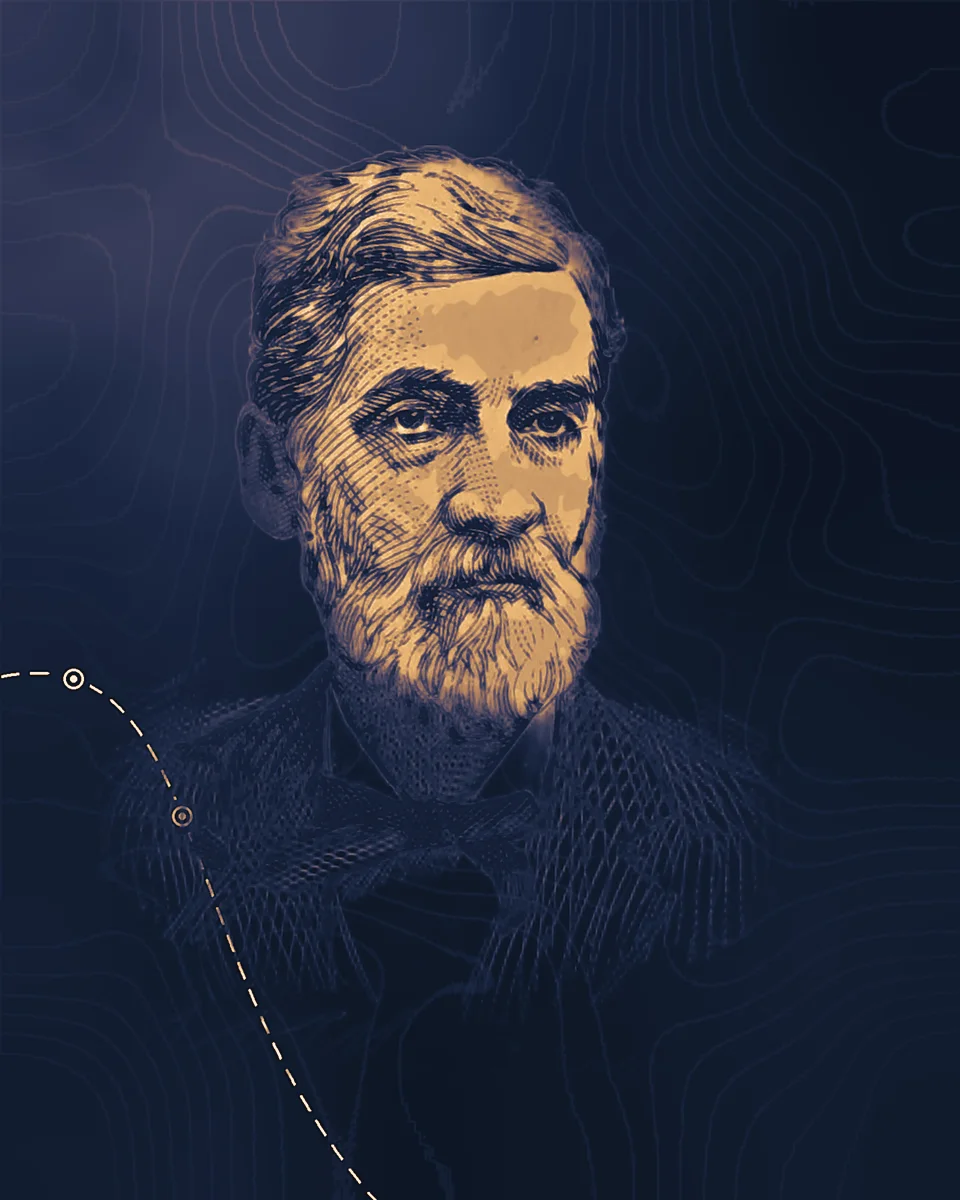
Thomas Volney Munson
He was a Texas nurseryman who classified America's wild grape species and guided France to the Texas vines whose roots could carry European grapes in chalk soils.
1843–1913
What they changed
1885
America's wild grapes sorted
At the New Orleans exposition in 1885 Munson showed pressed specimens of all the known American grape species, classified and framed, beside living plants of each, and read his first attempt at a new botanical classification to the American Horticultural Society. Between 1887 and 1892 he sent full sets of specimens arranged by his scheme to the viticulture school at Montpellier, to Harvard, Cornell and Columbia, and to the US Department of Agriculture.
1887
Texas vines for French chalk
When Pierre Viala came to Texas in 1887 to find vines that could grow in lime-rich soil, Munson guided him. Viala concluded that Vitis berlandieri, cinerea and cordifolia were the stocks for chalky soils, and wrote that the "disinterested counsels" of Munson and the Missouri grower Hermann Jaeger had given him most of his answers, even where the facts went against their own trade.
1888
Honoured by France
In 1888 the French government made him a knight of the order of agricultural merit, the Mérite agricole, for his help to French viticulture, and by the Handbook of Texas's account sent a delegation to Denison to present it.
1909
A handbook of American grapes
His Foundations of American Grape Culture set out his classification of the species, which ones grafted well and on which soils, and the varieties he had bred. The Handbook of Texas credits him with introducing more than 300 grape varieties and calls the book the standard reference for grape culture in the United States.
Life
Thomas Volney Munson was born near Astoria, Illinois, on 26 September 1843, and grew up on a farm. He taught school in Illinois for three years, graduated in science from Kentucky University in Lexington in 1870 and taught science there for a year. In 1870 he married Ellen Scott Bell, a florist's daughter, and worked in her father's nursery business.
He opened a nursery in Lincoln, Nebraska, in 1873, where drought, hard winters and grasshoppers made the work difficult, and moved to Denison, Texas, in April 1876, where his brothers ran insurance and property businesses. From there he travelled through Texas, about forty other states and Mexico collecting wild grapes, by the Handbook of Texas's count more than 50,000 miles by rail. In 1883 the State Agricultural and Mechanical College of Kentucky gave him a master's degree for a thesis on the forests and trees of Texas.
He worked closely with the French. He wrote that he corresponded with Jules-Émile Planchon, Alexis Millardet and Viala and studied their work before making his own classification, and he wrote for the Revue de Viticulture. The daughter who typed the manuscript of his 1909 book was named Viala Laussel. The Handbook of Texas, a state historical association's reference written in 1952 and revised in 1995, credits him and Jaeger with helping save the European wine industry; that overstates two men's part in work shared by many on both sides of the Atlantic, but Viala's report, as translated in 1888, thanks Munson above all the others who helped him.
The French Société nationale d'agriculture elected him a foreign corresponding member in 1898, and the University of Kentucky gave him an honorary doctorate in 1906. He died at Denison on 21 January 1913. Grayson College, near Denison, planted a memorial vineyard of his varieties around 1975 and opened the T. V. Munson Viticulture and Enology Center beside it in 1988.
Read more
3 accounts
Foundations of American Grape Culture, T. V. Munson, 1909.
His own book on the American species, grafting stocks and his varieties, with an account of his work.
archive.org
Munson, Thomas Volney, Robert C. Overfelt, Handbook of Texas Online, Texas State Historical Association, 1952, revised 1995.
The fullest biography found online.
tshaonline.org
The French Viticultural Mission to the United States, Pierre Viala, translated by Justina Robinson Hill, 1888.
Viala's report on the Texas vines, with his thanks to Munson.
archive.org