Industries / Figureheads
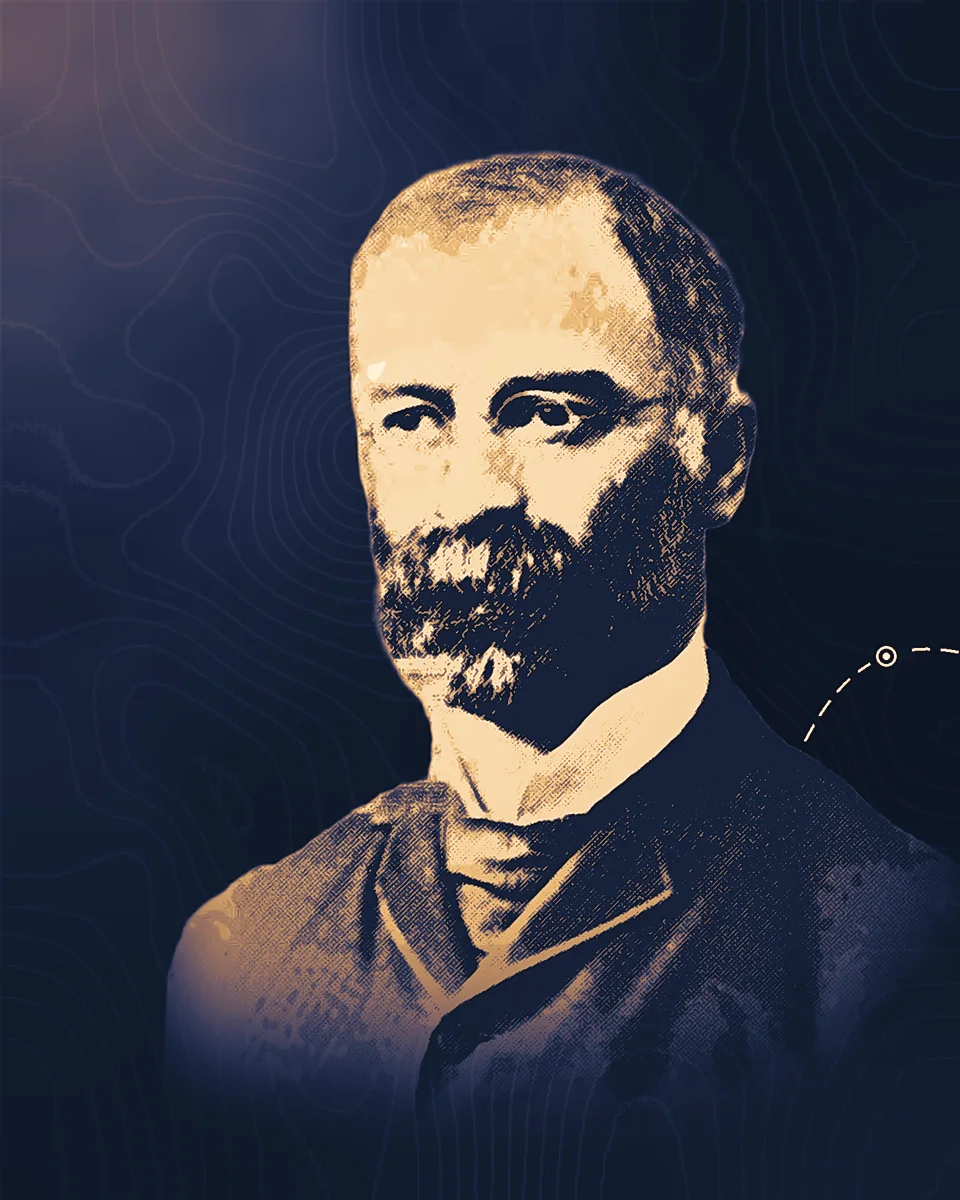
Stephen Moulton Babcock
He gave creameries a cheap, quick test for the butterfat in milk and refused to patent it, so milk could be paid for by what was in it.
1843–1931
What they changed
1890
A fat test for creameries
Creameries bought milk by the pound and paid the same for skimmed or watered milk as for whole milk. On 15 May 1890 Babcock announced a test that dissolves the milk's casein, its main protein, in sulfuric acid and spins the sample in a centrifuge so the fat comes free. Hot water lifts the melted fat into the bottle's graduated neck, where its length gives the percentage of fat.
1890
Given away, not patented
Babcock refused to patent the test and insisted that it be "given to the public", which kept it cheap. The University of Wisconsin, where he taught, says the test set the worldwide standard for measuring butterfat in milk.
1891
Stations take it up
In March 1891 the Connecticut Agricultural Experiment Station told its creameries that the Babcock method was as rapid and accurate as any and the simplest of all, and that with it milk could be paid for "by the only fair method", the quantity of fat in it. At the station a tester new to the method ran 40 samples of milk in one hour and 48 minutes.
1892
The idea crosses to Europe
The Swiss chemist Niklaus Gerber took up Babcock's idea of dissolving milk in sulfuric acid in graduated glass and spinning out the fat, added amyl alcohol, and published his acid butyrometer in 1892. By the account of Germany's national biography, his version soon pushed the older methods aside.
c. 1906
Cows on single plants
H. L. Russell, his colleague and dean at Wisconsin, wrote in 1931 that Babcock refused to believe a balanced ration could be built from chemical analysis alone. Russell credited him with the germ of the experiment in which E. B. Hart and colleagues fed cattle on rations from a single plant, work Russell said led to the later Wisconsin findings on vitamins and minerals in animal feeding.
Life
Stephen Moulton Babcock was born on 23 October 1843 in Bridgewater, New York. He graduated from Tufts in 1866 and took a doctorate at Göttingen in Germany in 1879. From 1887 to 1913 he was professor of agricultural chemistry at the University of Wisconsin.
He arrived at Wisconsin as a chemist trained in Germany who was already working on tests for the fat in milk. American Heritage records the dean telling him that the creamery business was "going to pot" because honest farmers had stopped bringing milk to creameries that paid the same for watered milk. The test he announced in 1890 was not the only one: the Connecticut station wrote in 1891 that some who knew the field preferred the rival Beimling method.
The test made skimming and watering milk easy to catch, so they stopped paying. William D. Hoard, a former governor of Wisconsin, said "the Babcock Test has made more dairymen honest than the Bible has ever made." Paying by measured content outlasted him: in India's village dairy cooperatives each member's milk is tested and paid by its fat and other solids.
He worked alone. Russell wrote that he would not have an assistant, would rather whittle a piece of apparatus with his jack-knife than have one made in the shops, and said he would never write a book. From 1896 he studied casein and cheesemaking. He counted as his most important biological finding his work on "metabolic water", showing that clothes moths living on dry wool make enough water inside their own bodies to live.
He received the Capper Award in 1930. He died on 2 July 1931, still at work, and left the university an unpublished manuscript on the constitution of matter, which he had worked on for about twenty years.
Read more
5 accounts
Stephen Moulton Babcock, H. L. Russell, Science, 24 July 1931.
An obituary by his dean and colleague, with the funeral address that follows it in the same issue.
archive.org
The Babcock Method of Determining Fat in Milk and Cream for the Use of Creameries, Connecticut Agricultural Experiment Station, Bulletin 106, 1891.
How an outside station tested the method in its first year and told creameries to use it.
archive.org
Testing Milk and Its Products, E. H. Farrington and F. W. Woll, 1897.
The manual for creamery testers written by two of his Wisconsin colleagues, with his portrait as frontispiece.
archive.org
Stephen Moulton Babcock, E. B. Hart, The Journal of Nutrition, 1949.
A memoir by the colleague who ran the single-plant feeding experiment.
doi.org
Hunger Fighters, Paul de Kruif, Harcourt, Brace, 1928.
A popular history with a chapter on Babcock, under "The hidden hunger".
archive.org