Industries / Figureheads
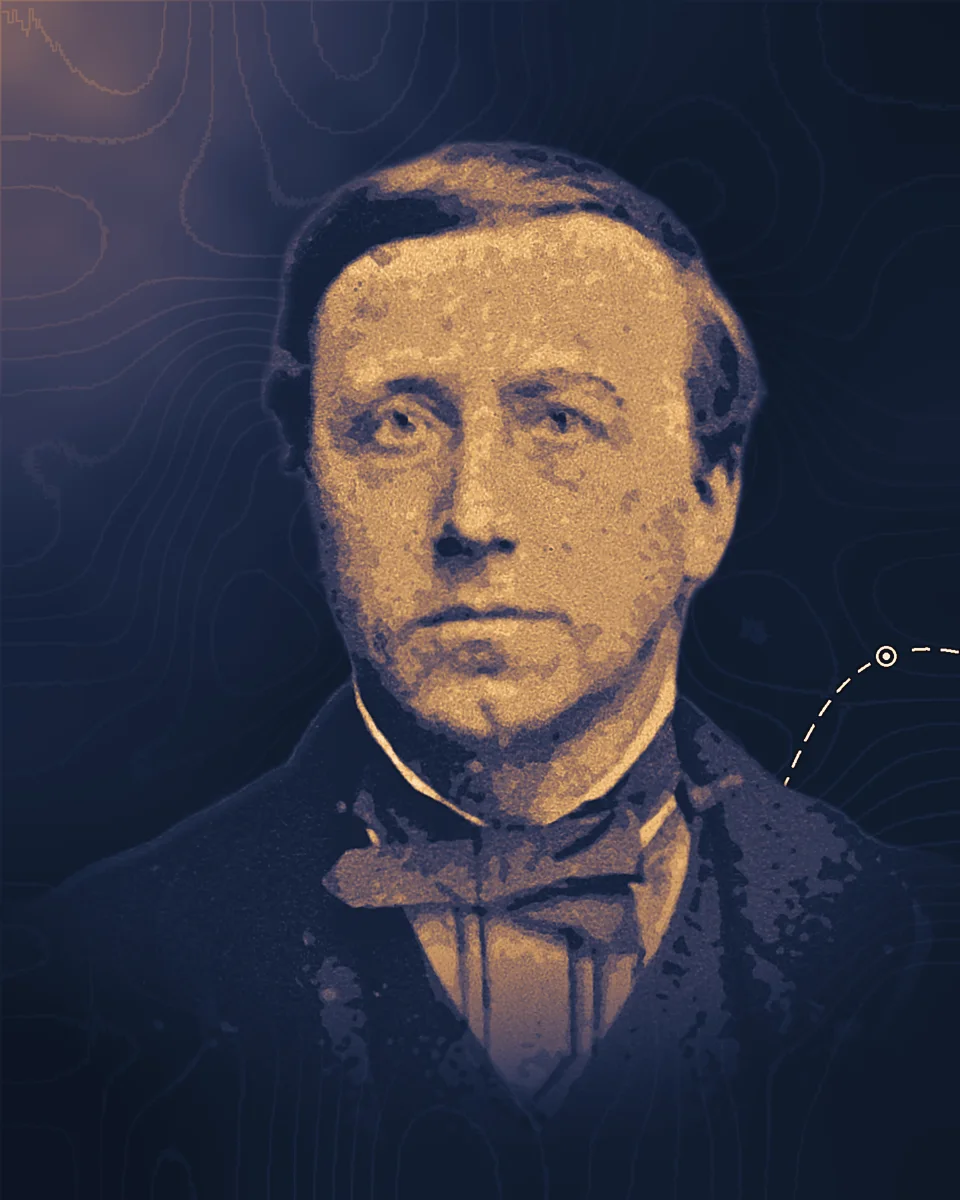
Jules-Émile Planchon
He helped find the root insect that was killing France's vines in 1868 and argued for the resistant American vines on whose roots most of the world's grapes are now grafted.
1823–1888
What they changed
1868
Roots show the cause
Growers in the Rhône valley asked the agricultural society of the Hérault for help, and it sent Planchon, the grower Gaston Bazille and the nurseryman Félix Sahut. On 15 July 1868, at Saint-Martin-de-Crau, they dug up vine roots and found them covered in tiny yellow aphid-like insects. Their report, printed by the Academy of Sciences in August, warned that without a remedy Provence would have no vines within ten years.
1868
The insect gets a name
The Paris entomologist Victor Signoret placed the insect in the genus Phylloxera, and Planchon named it Phylloxera vastatrix, "the devastator". By 1873 Planchon and Jules Lichtenstein wrote that it was the same insect Asa Fitch had described on American vine leaves in New York in 1854. Specialists later returned to Fitch's naming, and it is now Daktulosphaira vitifoliae.
1873
A mission to America
The French agriculture ministry sent Planchon to study American vines. He landed in New York on 29 August 1873, the Missouri entomologist Charles V. Riley joined him the next day, and he reported to the minister on 10 November. He found that the insect lived in America and that some American vines resisted it.
1875
The case for American vines
His book Les vignes américaines set out which American vines resisted the insect and how they might be grown in Europe. In a survey of the Hérault's American vines that year, he added a footnote, against his more cautious co-authors, saying he believed some varieties fully resistant, and listed them.
1880
Vitis berlandieri described
Planchon described the American species he named Vitis berlandieri and argued before the Academy of Sciences that it was distinct from other species. It tolerates lime-rich soils, and crosses of it became the parents of rootstocks for chalk and limestone vineyards, such as Alexis Millardet's 41 B.
Life
Jules-Émile Planchon was born at Ganges, in the Hérault department of southern France, on 21 March 1823. He studied botany under Auguste de Saint-Hilaire and took his doctorate in science in 1844. From 1844 to 1849 he looked after the herbarium of William Hooker at Kew, near London, and corrected the naming of a large part of its specimens. He then taught at the horticultural institute in Ghent from 1849 to 1851 and at the school of medicine and pharmacy in Nancy, where he also qualified in medicine, from 1851 to 1853.
He spent the rest of his career at Montpellier, as professor of botany and pharmacy and director of the botanic garden. Vines along the Rhône had been dying since the mid-1860s when the agricultural society sent him and two others to look in the summer of 1868. Paris was not convinced. On 20 August 1868 the Comte Paul de Gasparin wrote in the Journal de l'Agriculture that the idea that "these poor little creatures" had killed the vines seemed to him unlikely, and much of the scientific establishment held for years that the insects only attacked vines that were already sick.
The cure was the work of many people, and Planchon said so. In 1873 he credited the Bordeaux grower Léo Laliman with observing that some American vines resisted the insect, confirmed and extended by Riley, and credited Gaston Bazille with the idea of using them as rootstocks for French vines. Bazille grafted French vines onto American roots in 1871, out of curiosity. Planchon himself still argued in 1877 for growing American vines for their own grapes, before he and Louis Vialla wrote that year that grafting looked hopeful. Laliman and the Roquemaure grower Borty, whose imported vines were doing well, were later accused of bringing the insect to France.
Riley was his closest ally. Planchon dedicated Les vignes américaines to him, to Lichtenstein and to Vialla, and wrote that Riley alone had made it possible to answer the main questions of the American mission in so short a time. Planchon became a corresponding member of the Academy of Sciences in 1872. He died at Montpellier on 1 April 1888, and in 1894 the city put up a monument to him, his bust above the stone figure of a vineyard worker, in the square that now bears his name.
Read more
5 accounts
Le Phylloxera (de 1854 à 1873): résumé pratique et scientifique, J.-E. Planchon and J. Lichtenstein, 1873.
Their own summary of the insect, the disease and the remedies tried, written just before the American mission.
archive.org
Les vignes américaines, leur culture, leur résistance au phylloxera et leur avenir en Europe, J.-E. Planchon, 1875.
His report on the 1873 mission, written from his travel notes, and his case for American vines.
archive.org
Les Américanistes du Languedoc, 1868–1893, Jean-Paul Legros, Étude et Gestion des Sols, 2005.
A history of the Montpellier group, Planchon, Bazille, Sahut, Foëx, Viala and Ravaz, who rebuilt the vineyards on American roots.
afes.fr
The Botanist and the Vintner: How Wine Was Saved for the World, Christy Campbell, 2005.
A book-length history of the phylloxera crisis built around Planchon and Riley, first published in London as Phylloxera in 2004.
archive.org
Jules-Émile Planchon, William B. Ashworth Jr., Linda Hall Library, 2023.
A short essay by a historian of science, with the Montpellier monument.
lindahall.org